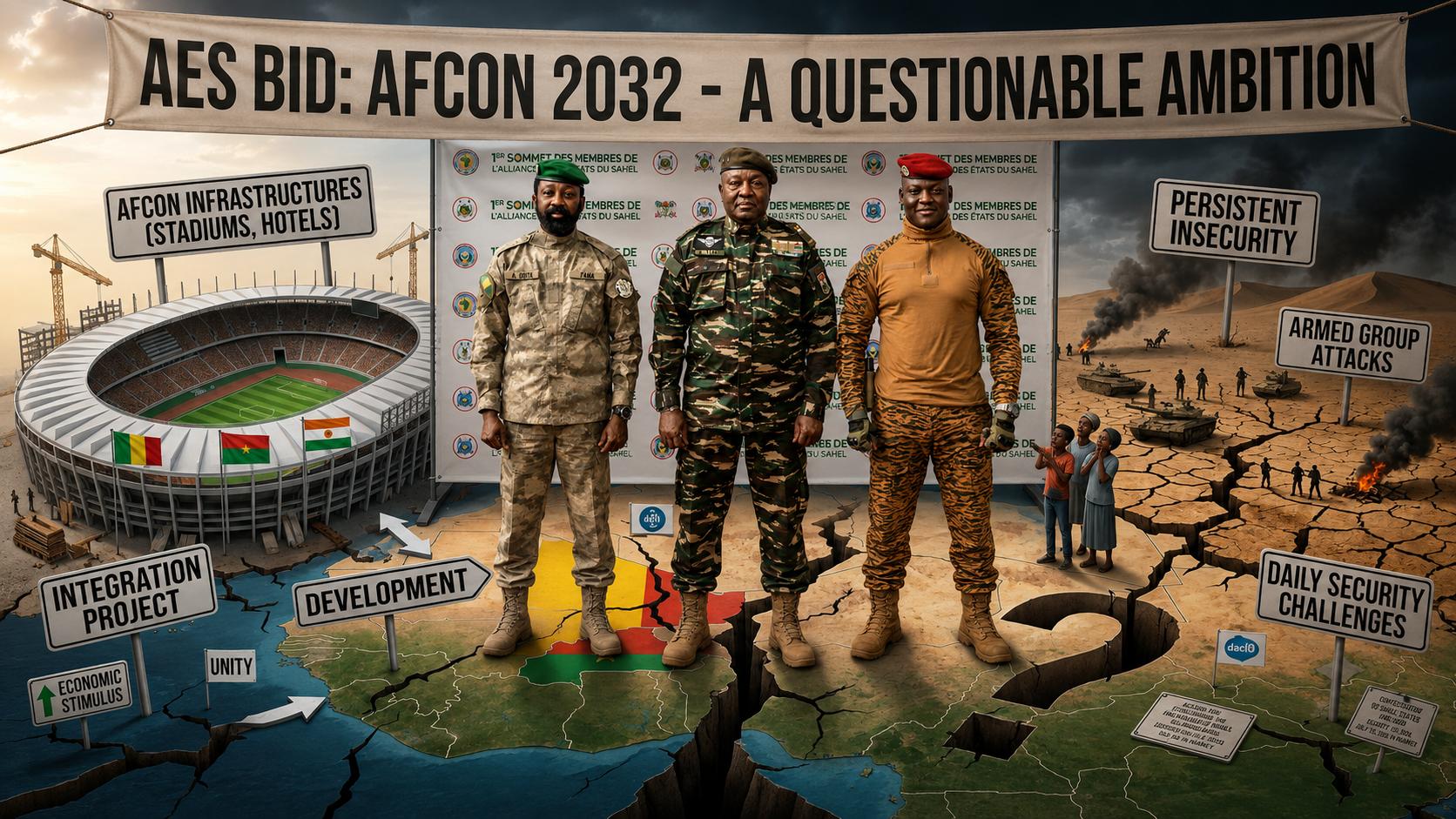

Burkina Faso, Mali and Niger have jointly submitted an official bid to host the 2032 Africa Cup of Nations (CAN), positioning it as a symbol of unity among the three nations of the Alliance of Sahel States (AES). While the move is framed as a bold statement of continental confidence, it raises critical questions: do these countries currently possess the minimum conditions of safety and stability required to stage Africa’s premier football tournament?
Beyond stadiums: the security dilemma
The successful hosting of a CAN goes far beyond stadium construction or renovation. It demands an environment capable of ensuring the safety of athletes, officials, journalists, fans, and the hundreds of thousands of visitors expected to attend over several weeks. This is where the bid by Burkina Faso, Mali and Niger faces its greatest scrutiny.
Since military-led governments assumed power in each of these nations, security restoration has been the central justification for their rise to authority. Yet today, the reality remains stark. Civilian communities, military personnel, and critical infrastructure continue to be targeted in attacks across all three countries. Many regions remain under the grip of pervasive insecurity, casting doubt on whether such an international event can be safely organized.
A mismatch between ambition and priority?
To many observers, the timing of the bid appears misaligned with national priorities. Before welcoming thousands of international tourists and delegations, should these governments not first demonstrate that their own citizens can move and live safely across their territories? The persistent violence undermines the very foundation on which such a tournament could be built.
Logistical hurdles and financial constraints
Hosting a CAN requires robust infrastructure: high-performance road and airport networks, a sufficient hotel capacity, advanced medical facilities, and a credible security apparatus. Meeting these standards demands substantial investment—precisely when each country continues to allocate significant resources to counterinsurgency efforts. The financial strain raises further concerns about feasibility.
International credibility is another major factor. Federations, sponsors, broadcasters, and commercial partners demand stability above all else. Any sign of ongoing violence or instability could jeopardize the bid’s viability, deterring essential stakeholders from supporting the initiative.
National expectations and delayed promises
The military-led transitions in Burkina Faso, Mali and Niger were sold to the public as a path toward more effective security governance. Yet years into these regimes, communities in multiple regions still face daily threats from armed groups. The gap between promise and progress has fueled public skepticism about the true impact of these political changes.
Many citizens argue that the first victory any new government should claim is the restoration of daily safety. Until tangible improvements are seen across security, governance, and stability, calls to host a CAN may ring hollow. An event of this magnitude must guarantee safety not only for foreign participants but for the local population as well.
A bid with potential—but only if grounded in reality
There is no denying that hosting a CAN could serve as a unifying project and a catalyst for development. However, its credibility hinges not on political rhetoric, but on demonstrable, sustained progress in security, institutional strength, and public trust. Without these foundations, the bid risks being perceived as premature or even tone-deaf in the face of ongoing crises. The priority, many agree, must remain securing the safety and dignity of citizens—not chasing continental glory while instability lingers.