
The illusion of progress: why social media images don’t equal university reality
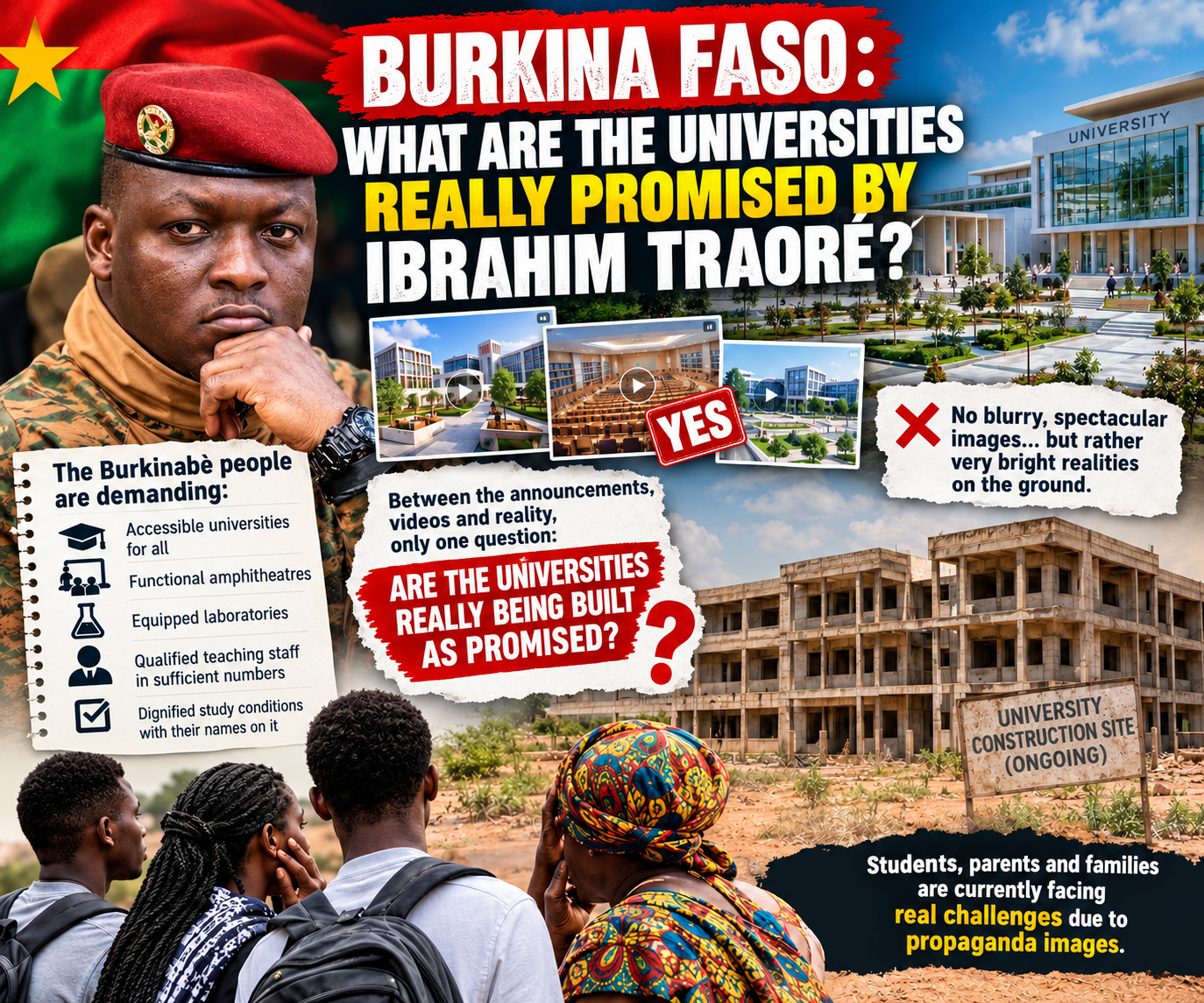
In a country where political narratives often eclipse tangible progress, Burkina Faso’s government has leaned heavily on social media to showcase sweeping educational reforms. Viral videos and staged footage have painted a picture of sprawling, state-of-the-art universities rising across the land. Yet behind the curated images lies a persistent question: how much of this vision has truly materialized, and what can students and families actually expect when they enroll?
The disconnect between digital spectacle and ground reality is not just a matter of perception it’s a structural issue. For parents pouring life savings into their children’s education, promises hold little weight without verifiable results. The demand is simple: concrete infrastructure, functional lecture halls, equipped labs, and a teaching staff capable of delivering quality education. Anything less risks reducing Burkina Faso’s young population to spectators of a political narrative rather than beneficiaries of real progress.
Manipulated media and the erosion of trust in governance
The rise of AI-generated content has given politicians a powerful tool to shape public opinion. In Burkina Faso, viral videos have been used to showcase non-existent buildings, exaggerate progress, and attribute foreign achievements to local initiatives. Investigations have exposed multiple instances where footage from other countries such as an Algerian real estate project was falsely presented as a Burkinabè educational milestone. Such manipulations, while not unique to Burkina Faso, reflect a deeper crisis in accountability when governance relies on curated imagery rather than measurable outcomes.
This doesn’t mean every video or image is fabricated. Some initiatives, like the University Nazi-Boni complex in Bobo-Dioulasso, have indeed been completed. But without transparent verification such as third-party site inspections, independent audits, or direct testimonies from students and faculty it remains impossible to distinguish between actual progress and digital illusion. The burden of proof lies with those in power to demonstrate, not merely assert, the existence and functionality of these institutions.
The dangerous gap between announcements and achievement
Political rhetoric in education often follows a predictable cycle: a grand announcement, a ceremonial groundbreaking, and a carefully staged inauguration all before the first students ever set foot in the building. This gap between promise and delivery is where credibility erodes. A newly constructed amphitheater serves no purpose if students lack access to it due to bureaucratic delays, insufficient staffing, or equipment shortages.
According to official announcements, Burkina Faso’s government has committed to expanding higher education with new complexes under the Presidential Initiative for Quality Education for All. Yet the specifics remain vague. How many universities are fully operational? How many have functioning labs, libraries, and reliable utilities? How many students are currently enrolled in these new facilities? Without clear, independently verified data, families are left to navigate an uncertain landscape one where hope is fueled more by viral posts than by institutional transparency.
The role of AI in shaping political narratives
Artificial intelligence has democratized misinformation, allowing fabricated content to spread with alarming speed. In Burkina Faso, AI-generated videos have amplified the image of progress, blurring the line between reality and political messaging. While some content may be harmlessly exaggerated, other material crosses into outright deception staging nonexistent universities or showcasing uncompleted projects as finished ones. The result is a population bombarded with seemingly credible visuals that bear little resemblance to the ground truth.
Civil society and independent observers have repeatedly called for safeguards against such manipulation. Yet the response from authorities has been inconsistent. While some instances of false content have been debunked, the broader issue remains: without proactive transparency, the credibility of government claims will continue to be overshadowed by the allure of digital perfection.
Measuring progress: what real accountability looks like
To restore trust, Burkina Faso’s government must move beyond staged photo opportunities and embrace rigorous, verifiable reporting. This means allowing journalists, auditors, and civil society to conduct unannounced site visits. It means releasing detailed project timelines, budget allocations, and post-construction evaluations. It means publishing enrollment numbers, student satisfaction surveys, and independent assessments of teaching quality.
A university is not built in a viral video. It is built brick by brick, with funding, oversight, and a commitment to long-term functionality. The true test of Burkina Faso’s education policy will not be the number of views a promotional clip receives, but the number of students who can actually sit in a classroom, access a laboratory, and complete their studies without bureaucratic or infrastructural barriers.
The question is no longer whether progress has been made it is whether Burkina Faso’s leaders are willing to be held accountable for the gap between their announcements and the reality facing its youth.
By Idriss MAMADOU — Journalist