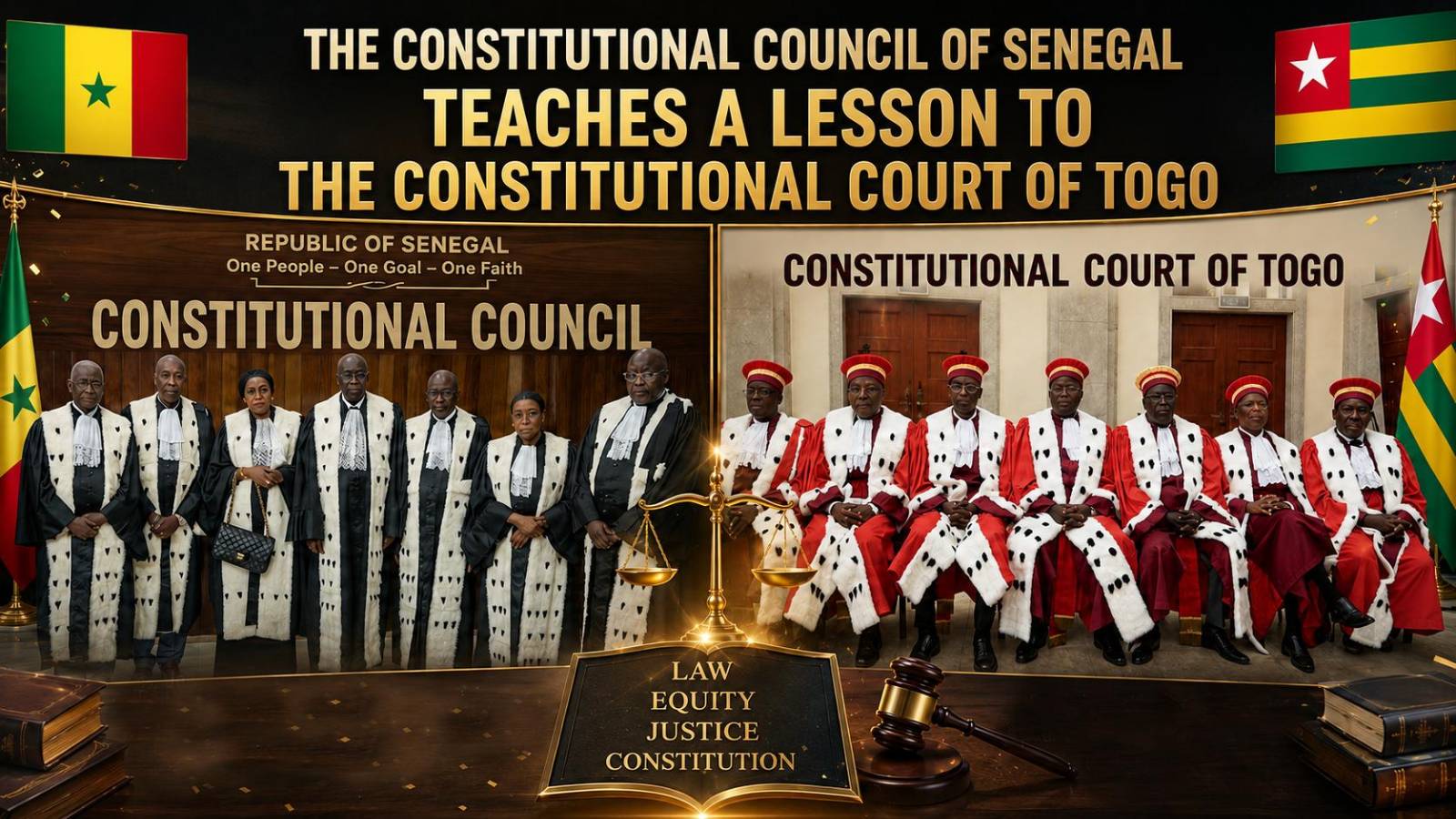

Contrasting visions of institutional authority
Dakar and Lomé now embody two fundamentally distinct interpretations of the rule of law. Recent constitutional decisions in both cities have once again exposed a sharp divide in how institutions should function. On one side, Senegal’s Constitutional Council has reaffirmed that no political majority—no matter how recently elected—stands above the Constitution. On the other, Togo’s Constitutional Court appears, in the eyes of many, to operate as an extension of the executive rather than an independent check on power.
Senegal’s judicial defiance of political pressure
The Senegalese Constitutional Council’s decision to block a constitutional amendment proposed by Ousmane Sonko’s government—and backed by the parliamentary majority—sent a clear message: electoral legitimacy does not equate to unchecked authority. In a functioning state governed by law, political power must yield when it conflicts with constitutional principles. The Council’s ruling underscored that institutional safeguards exist to protect democracy, not to serve transient political interests.
Togo’s constitutional reform under scrutiny
In Lomé, the Constitutional Court’s validation of sweeping constitutional changes—amid widespread political and legal opposition—has raised serious concerns. Critics, including opposition figures, civil society groups, and legal scholars, argue that the reform lacked broad national debate and fundamentally altered the country’s institutional framework. A constitution is meant to anchor the social contract; when perceived as a tool of political expediency rather than consensus, its legitimacy erodes over time.
Why judicial independence matters more than ever
The divergence between Senegal and Togo highlights a critical truth: the strength of a democracy lies not in the text of its laws, but in the willingness of its institutions to enforce them impartially. Strong constitutions become meaningless when their guardians fail to act with conviction. The Senegalese case demonstrates how an independent judiciary can prevent political crises by enforcing constitutional limits. When a court can strike down government decisions without fear of reprisal, it reinforces public trust in institutions and ensures predictable governance—a key factor for economic stability and international credibility.
Togo’s experience, however, reveals the opposite effect. When a constitutional court is seen as rubber-stamping executive decisions, citizens lose faith in domestic legal remedies. This often drives them to seek recourse in regional courts, such as the ECOWAS Court of Justice, which has increasingly stepped in on human rights and governance disputes. Such interventions are not just legal corrections; they signal a systemic failure of national institutions to uphold their constitutional duties.
The dangers of constitution-making by political convenience
Beyond legal technicalities, the process of constitutional reform shapes a country’s democratic future. In mature democracies, such changes are preceded by inclusive consultations, rigorous debate, and a search for consensus. This caution stems from the understanding that constitutions do more than govern the present—they set the rules for future power transitions. When reforms are driven by short-term political gains, they create dangerous precedents, encouraging successive governments to reshape institutions to their advantage and fuel chronic instability.
The political risks are equally severe. A constitution that no longer commands broad support becomes a perpetual source of contention. Institutions meant to serve as neutral arbiters instead become battlegrounds, further eroding public trust and destabilizing governance.
Lessons from comparative governance
In its push toward a parliamentary system, Togo has sent delegations abroad, including to India, to study institutional models. While comparative research can offer valuable insights, it cannot replace the lessons learned from African democracies facing similar political and social realities. The continent has no shortage of examples showing that democratic consolidation depends less on borrowed models than on the strict application of constitutional principles.
Senegal’s experience serves as a case in point. Its Constitutional Council has earned credibility not through rhetoric, but through decisive action—even when it clashes with the ruling power. This distinction is far from trivial. It influences governance quality, citizen trust, international standing, and economic attractiveness. Countries with stable, respected institutions attract more investment and cooperation than those where legal frameworks appear pliable to political whims.
The contrast between Dakar and Lomé ultimately boils down to one question: is the constitution a shield against power, or a tool for it? A resilient democracy is measured not by the number of constitutional amendments it passes, but by its institutions’ ability to protect citizens from all forms of overreach—regardless of who holds power.