How absolute power turns against its own supporters in Burkina Faso
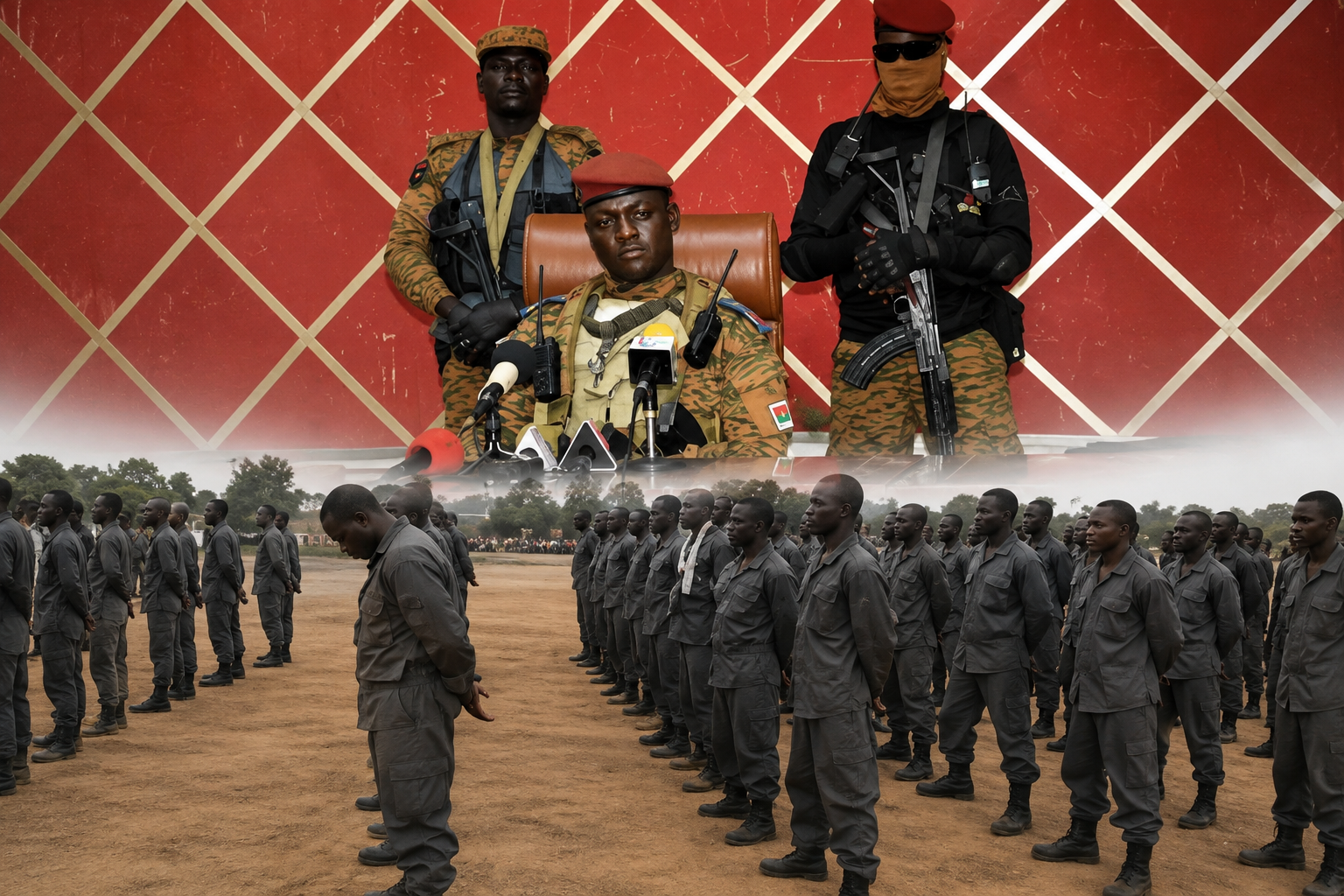
When repression circles back to its creators
The chronicle of authoritarian regimes is marked by a paradox as old as power itself: the tools of repression, designed to silence opponents, eventually turn against those who once wielded them. Burkina Faso now exemplifies this pattern under the leadership of Captain Ibrahim Traoré. Over recent months, a pattern has emerged—arbitrary arrests, forced disappearances documented by multiple observers, smear campaigns, intimidating summons, media restrictions, and mass citizen conscriptions under the guise of national security—has expanded beyond traditional critics. Former allies, including Muslim leaders, civil society activists, commentators, influencers, and opinion makers who once championed the transition, now find themselves ensnared in a system where loyalty no longer guarantees safety.
This isn’t a series of isolated incidents. It reflects a deeper transformation in how power operates. As a regime centralizes authority, eliminates spaces for dissent, and equates criticism with threats to the state, suspicion becomes the defining principle of governance. In such an environment, the line between ally and adversary blurs, as the only acceptable standard is perpetual obedience rather than past allegiance.
The illusion of safety through loyalty
Since assuming power, Ibrahim Traoré has framed his legitimacy around sovereignty, patriotism, and security. This narrative, amplified by a network of online supporters, has reframed dissent as a foreign-backed plot, political opposition, or treason against the nation. Within this framework, critics of the regime’s actions were dismissed as destabilizers, security imperatives justified the absence of due process, and closures of media outlets—whether domestic or international—were celebrated as acts of national sovereignty.
Gradually, this normalization of exception reshaped public discourse. Nuance vanished, replaced by a binary logic: unconditional support for Ibrahim Traoré or immediate labeling as an enemy of the state. Dissent wasn’t just discouraged—it was criminalized. The cost of criticism rose sharply, while the expectation of absolute loyalty became the price of survival.
Yet this strategy carries a fatal flaw. When power demands total allegiance, even the slightest hesitation is treated as betrayal. Yesterday’s allies become today’s suspects. The very voices that once amplified the regime’s narrative now face the consequences of a system that has outgrown its creators.
The danger of personalized power
A defining feature of Burkina Faso’s transition is the intense personalization of authority around Captain Ibrahim Traoré. Public debate increasingly centers on defending the leader’s image rather than scrutinizing policies. Questioning a government decision is often interpreted as an attack on his personal authority.
This personalization fuels a culture of suspicion. Persistent security failures, frequent terrorist attacks, economic strains, social unrest, and international criticism feed a narrative in which internal betrayal—not policy missteps—is blamed for the nation’s struggles. As the regime struggles to deliver on its promises, the search for scapegoats intensifies, expanding the circle of suspects from political opponents to journalists, human rights defenders, judges, academics, religious leaders, and even former allies whose influence is deemed insufficiently aligned with official doctrine.
In such a system, no one can be certain of remaining on the right side of power indefinitely. Loyalty is not a fixed state but a constant negotiation—one that ultimately benefits no one.
Fear as a governing tool
The regime’s use of public arrests, high-profile summons, coordinated online smear campaigns, threats of forced conscription, and administrative sanctions does more than silence individuals. It sends a message to society at large.
Each arrest serves as a warning. Every unexplained disappearance breeds fear. Every summons reinforces the message that no one is safe. Each dramatic conscription demonstrates the regime’s capacity to target anyone perceived as inconvenient.
This climate fosters self-censorship. Intellectuals hesitate before publishing. Journalists limit their investigations. Religious leaders soften their sermons. Citizens avoid public debate. A society governed by fear loses its ability to innovate, correct mistakes, and build collective solutions. The cost of dissent becomes too high—not because of principle, but because of survival.
The erosion of institutional checks
This transformation is especially troubling in a context where key oversight mechanisms are weakening. Judicial independence is frequently questioned when legal procedures appear to serve political agendas rather than justice. Independent media face closures or suspensions, shrinking the space for diverse perspectives. Civil society organizations operate under increasing constraints. Political parties function within tightly controlled parameters.
When no institution can effectively hold the executive accountable, the protections afforded to citizens become fragile. Power is no longer limited by law, but by the whims of those in charge. The result is a system where rights are privileges granted—or revoked—at will, not guarantees embedded in democratic governance.
A historical pattern
Burkina Faso is not alone in experiencing this phenomenon. History offers countless examples of regimes that began with revolutionary ideals or national liberation narratives only to devour their own supporters.
Revolutionaries turn on their former comrades. Military leaders purge their own ranks. Political movements sideline their founders. Ideologues are accused of treason. The logic is consistent: when loyalty to a person—not to institutions or principles—becomes the primary measure of political value, no level of devotion is ever enough. The pursuit of purity leads to purges, expulsions, and accusations that spiral out of control.
Fundamental rights are not negotiable
The current trajectory underscores a fundamental truth: public freedoms are not rewards granted to the faithful. They are universal protections designed to shield every citizen from state abuse. Fair trials, freedom of expression, a free press, the presumption of innocence, and protection from arbitrary detention or disappearance are not privileges bestowed upon loyal subjects. They are rights that belong to all, regardless of political alignment.
Supporting the arbitrary arrest of an opponent is not a tactical victory—it is an endorsement of arbitrariness itself. Once that principle is accepted, it cannot be selectively applied. Injustice does not change its nature based on the identity of its victim. The same mechanisms that target one group today can be turned against any other tomorrow.
Many who once believed their proximity to Ibrahim Traoré would protect them have learned the hard way: in authoritarian systems, loyalty is not a contract. It is a precarious relationship, constantly reassessed based on shifting interests. Yesterday’s champion can become today’s traitor with little notice.
Security cannot justify endless exceptions
Burkina Faso faces a real terrorist threat that demands a robust state response. There can be no dispute about that reality. Yet the effectiveness of counterterrorism efforts cannot be measured solely by the number of coercive measures imposed. It also depends on the trust between citizens and their institutions.
When people fear the state more than the threats it claims to combat, that trust erodes. History shows that no insurgency can be defeated if the institutions charged with protecting the population lose their credibility. Security and the rule of law are not opposing goals—they are complementary. A state that fights terrorism while upholding legal norms strengthens its legitimacy. Conversely, when exceptional measures become permanent, the fight against terror risks becoming a justification for total societal control.
The system consumes its own
The predicament now faced by former regime supporters illustrates a broader political reality: in a system where institutions are weakened and power relies on fear, no one is permanently safe.
Today’s allies may be tomorrow’s suspects. Fervent defenders can be accused of insufficient loyalty. Media allies can be sidelined. Religious figures can be reprimanded for straying from official narratives. The arsonist eventually becomes the arsee.
But the damage extends beyond individual fates. When a regime turns its suspicion inward, targeting even its former champions, it reveals that the problem is not with individuals—but with the system itself. The true safeguard of a nation lies not in proximity to the head of state or ideological alignment, but in strong institutions, an independent judiciary, a free press, and laws applied equally to all. Only within such a framework can a state confront security challenges without sacrificing the liberties of its people.