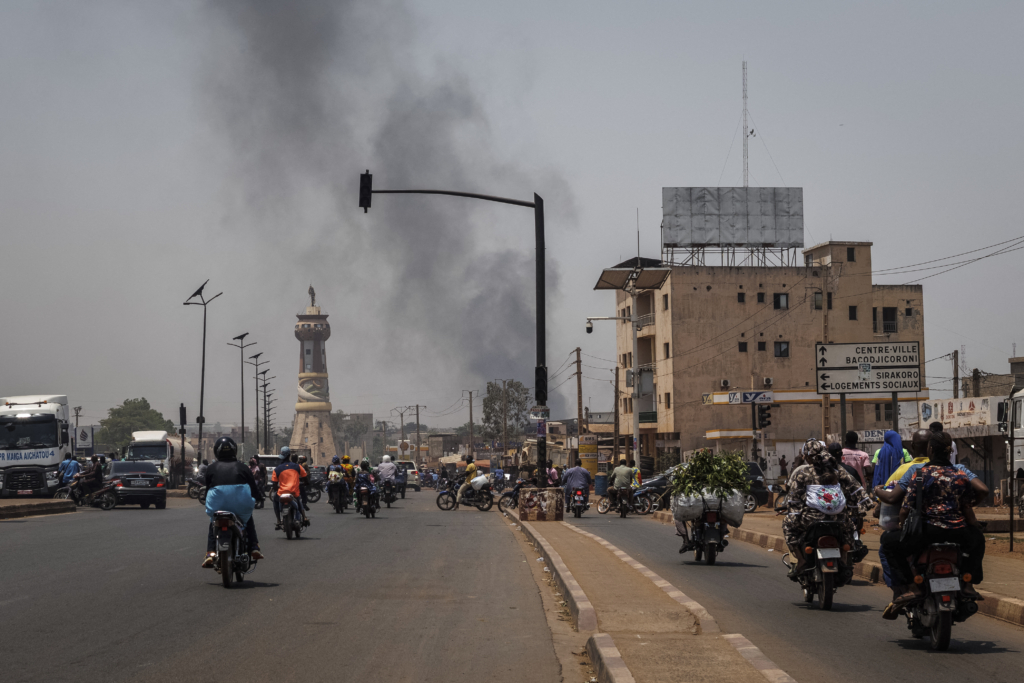

The ongoing blockade imposed on Bamako has created unacceptable impediments to civilian movement and poses a grave threat to fundamental rights, including access to food, healthcare, and ultimately, life itself. We call upon the armed group, the Group for the Support of Islam and Muslims (GSIM), to uphold international humanitarian law and ensure the safety and security of all civilians.
Since April 28, three primary routes leading into Bamako have been rendered impassable, following the GSIM’s declaration of a complete blockade on the Malian capital. This non-state armed group, known for its affiliation with Al-Qaeda, intensified its actions on May 6 by targeting a convoy of trucks. These vehicles were transporting civilian goods, including essential produce like fruits, between Bamako and Bougouni. Crucially, these trucks were not under military escort and carried no military personnel or equipment.
Attacks deliberately targeting civilian vehicles engaged in non-military activities constitute a clear violation of international law. Under the principles of international humanitarian law, all participants in an armed conflict are obligated to differentiate between civilians and combatants. Any direct assaults on civilians or civilian infrastructure, including transportation essential for the population’s survival, are strictly prohibited, as emphasized by Marceau Sivieude, Regional Director for West and Central Africa.
Blockades must not infringe upon the economic and social rights of the civilian population.
Marceau Sivieude, Regional Director for West and Central Africa
A blockade violating the laws of armed conflict
The GSIM’s spokesperson disseminated an online video on April 28, declaring a comprehensive blockade of Bamako effective immediately. This current action marks a significant escalation from a previous blockade announced in September 2025, which primarily targeted fuel tankers supplying the capital. The present restrictions appear to encompass all types of trucks attempting to enter Bamako.
By May 15, at least three of the six main arteries connecting Bamako to regional ports had experienced severe disruptions due to attacks on incoming traffic. This effectively severed vital supply lines for goods and essential provisions to the city’s residents. Reports from local media and inhabitants confirm a noticeable surge in the prices of several basic necessities.
Marceau Sivieude reiterated that “blockades must not violate the economic and social rights of the civilian population. The GSIM is obligated to adhere to the tenets of international humanitarian law and must ensure that Bamako’s civilian inhabitants maintain adequate access to clean water, food, and other fundamental necessities.”
On May 5, the UN Human Rights Office (OHCHR) issued an urgent appeal for an immediate cessation of hostilities. It strongly urged all parties involved to uphold both international humanitarian law and international human rights law, with a particular emphasis on safeguarding civilians and their infrastructure.
Subsequently, on May 6, the GSIM declared a partial easing of the blockade, stating that individuals requiring medical attention would be permitted entry into Bamako. However, confirmation regarding the actual implementation of this concession remains unverified.
Survivor recounts deadly, unlawful GSIM convoy assault
We previously spoke with the driver of a fuel tanker, a target during an earlier GSIM blockade of Bamako. In September 2025, the GSIM had publicly stated its intent to obstruct all fuel shipments to Bamako from regional ports, subsequently launching attacks on numerous trucks traveling from Dakar along the Kayes-Bamako route. By November of that year, the GSIM had explicitly declared that fuel tanker drivers would be considered legitimate targets and treated as combatants.
We urge the GSIM to immediately cease all attacks targeting civilians, including indiscriminate assaults.
Marceau Sivieude, Regional Director for West and Central Africa
On January 29, 2026, this very driver was part of a military-escorted fuel tanker convoy that came under attack between Diboli and Kayes. According to his harrowing account, several drivers and their apprentices, apprehended while attempting to escape, were summarily executed. “About twenty kilometers from Diboli, we were attacked by over two hundred jihadists on motorcycles who opened fire on the convoy. They were more than two hundred,” the driver, speaking anonymously, recounted.
He continued: “Following the initial assault, three military trucks arrived as reinforcements, but the soldiers inside were killed by the jihadists, who then set the trucks ablaze. At least 12 drivers and apprentices were captured and held until the next day. They were forced to dig graves for the few jihadists killed in the ambush, and then their throats were slit.”
Marceau Sivieude emphasized, “International humanitarian law must be honored by all factions engaged in the conflict. We urge the GSIM to immediately halt all attacks targeting civilians, including indiscriminate actions. Furthermore, we call upon the Malian authorities to thoroughly investigate these abuses, which may constitute war crimes. Victims and survivors of international law crimes are entitled to truth, justice, and reparations.”
Contextual developments
On April 25, the GSIM (Group for the Support of Islam and Muslims), also identified as Jama’at Nusrat al-Islam wal-Muslimin (JNIM), alongside the Azawad Liberation Front (FLA), executed coordinated attacks across multiple locations. These assaults targeted military installations and the residences of political and military figures in Bamako, Kati, Mopti, Sévaré, Gao, and Kidal. Notably, in Kati, Defense Minister Sadio Camara, along with several family members, perished when his home was struck by an improvised explosive device delivered via a vehicle.
Further violence erupted on May 6, when GSIM assailants launched attacks on the villages of Kori Kori and Gomassagou in central Mali. Regional authorities reported “numerous human and material losses,” while local accounts indicate at least 40 fatalities and several individuals still missing.



