
Niger: the intersection of symbolic diplomacy and the enduring security crisis
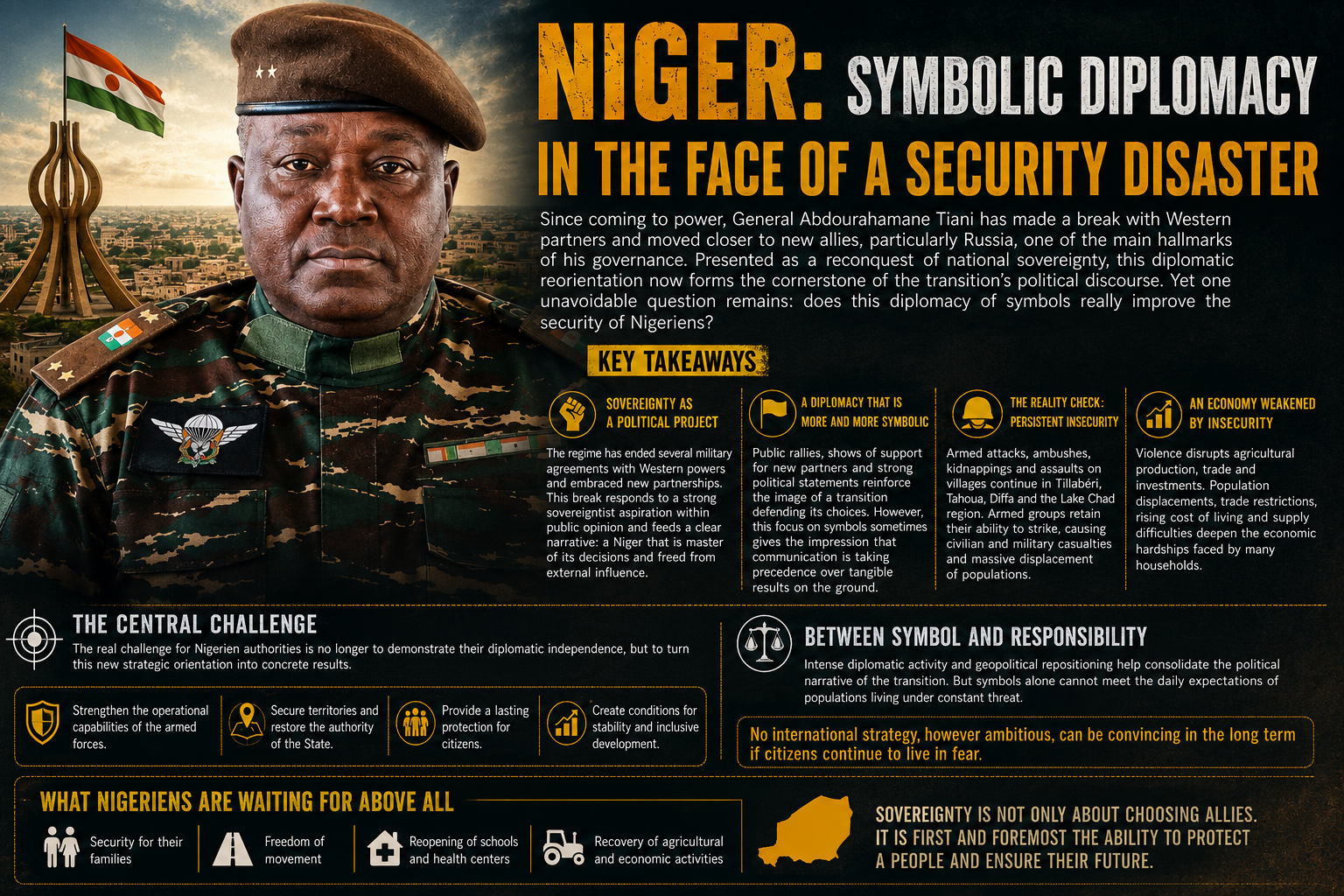
Upon assuming leadership, General Abdourahamane Tiani established a definitive pivot away from traditional Western allies and towards new partnerships, notably with Russia, as a cornerstone of his administration. This diplomatic reorientation, framed as a reassertion of national sovereignty, now forms the bedrock of the transitional government’s political discourse. However, beneath this display of international resolve, a critical question arises: does this diplomacy of symbols genuinely enhance the safety and well-being of Nigerien citizens?
Sovereignty articulated as a core political agenda
It would be an oversimplification to underestimate the profound political implications of the choices made by the National Council for the Safeguard of the Homeland (CNSP). By terminating several military cooperation agreements with Western powers and prioritizing novel alliances, the regime has responded to a prevalent aspiration for sovereignty among a segment of the public. This strategy is underpinned by a clear political narrative: that of a Niger fully in command of its destiny, liberated from external influences, and solely capable of defining its national priorities. Accession to the Alliance of Sahel States (AES), the strengthening of ties with Moscow, and numerous initiatives designed to project this new geopolitical direction all contribute to the ambition of forging a distinct diplomatic identity. For proponents of the transition, this strategic rupture signifies a historic milestone in reclaiming national dignity. Official pronouncements consistently emphasize the necessity of breaking free from decades of security and political dependence to construct a model more intrinsically aligned with national interests.
A diplomacy increasingly focused on symbolism
Nevertheless, this strategic approach occasionally appears to prioritize symbolic gestures over tangible outcomes. Extensive public mobilization campaigns endorsing Niger’s new partners, demonstrations of support for cooperation with Moscow, and a multitude of political declarations occupy a significant portion of governmental communication. While these expressions of diplomatic affinity undeniably reinforce the image of a transitional authority resolute in its chosen path, they also prompt scrutiny regarding immediate priorities. As the authorities dedicate substantial communication efforts to their international repositioning, the populace primarily awaits prompt solutions to their daily concerns: living securely, moving freely, and restoring conditions conducive to normal development.
The reality check: persistent insecurity
It is precisely within the domain of security that the situation remains most disquieting. Despite a proliferation of announcements and new military collaborations, armed group attacks continue to plague several regions across the nation. The areas of Tillabéri, Tahoua, Diffa, and certain parts of the Lake Chad region are regularly subjected to assaults targeting civilian populations, defense forces, and public infrastructure. Ambushes, abductions, village raids, and widespread displacement of communities persistently fuel a climate of entrenched insecurity. Military operations are ongoing, yet armed groups retain considerable capacity for disruption. The human toll among both civilians and military personnel serves as a stark reminder that the security challenge is far from being contained. For residents of the most vulnerable zones, geopolitical discussions often seem detached from their immediate realities. Their paramount concerns remain the protection of their families, the restoration of security on major roadways, the reopening of schools and health centers, and the ability to resume their agricultural and commercial activities.
An economy weakened by instability
Beyond the human cost, the unrelenting violence significantly burdens the national economy. Population displacements disrupt agricultural production, commercial exchanges remain arduous in many regions, and investment is hampered by a climate of uncertainty. Furthermore, trade restrictions imposed following the political upheavals have exacerbated the economic hardships faced by numerous households. In several localities, the escalating cost of living, supply chain difficulties, and diminished economic opportunities intensify a pervasive sense of precarity. Consequently, without a discernible improvement in security, the anticipated benefits from new international partnerships risk remaining insubstantial for a large segment of the population.
The imperative to translate alliances into tangible results
The true challenge confronting Nigerien authorities is no longer merely to demonstrate their diplomatic independence, but to transform this novel strategic orientation into concrete achievements. New partnerships will be assessed less by official ceremonies or political declarations than by their efficacy in bolstering the operational capabilities of the armed forces, durably securing national territories, and re-establishing state authority. Sovereignty is not solely measured by the selection of allies; it is also manifested by a state’s capacity to effectively protect its citizens, safeguard its territorial integrity, and provide prospects for stability to its populace.
Between symbolism and accountability
The disparity between Niamey’s intense diplomatic engagement and the lived reality in insecure zones is becoming increasingly pronounced. While communication surrounding the geopolitical repositioning helps to solidify the political narrative of the transition, it cannot, in isolation, address the expectations of populations daily confronted with violence. History will undoubtedly judge the military transition not solely on the vigor of its sovereignist discourse or the scope of its diplomatic choices, but primarily on its capacity to deliver measurable results in terms of security, stability, and development. For no international strategy, however ambitious, can sustain credibility if citizens continue to live under the constant menace of armed groups. The genuine legitimacy of any power is first built upon its ability to guarantee peace and the protection of its people.