Niger’s security crisis deepens as death toll mounts in latest attacks
Military losses highlight widening insecurity
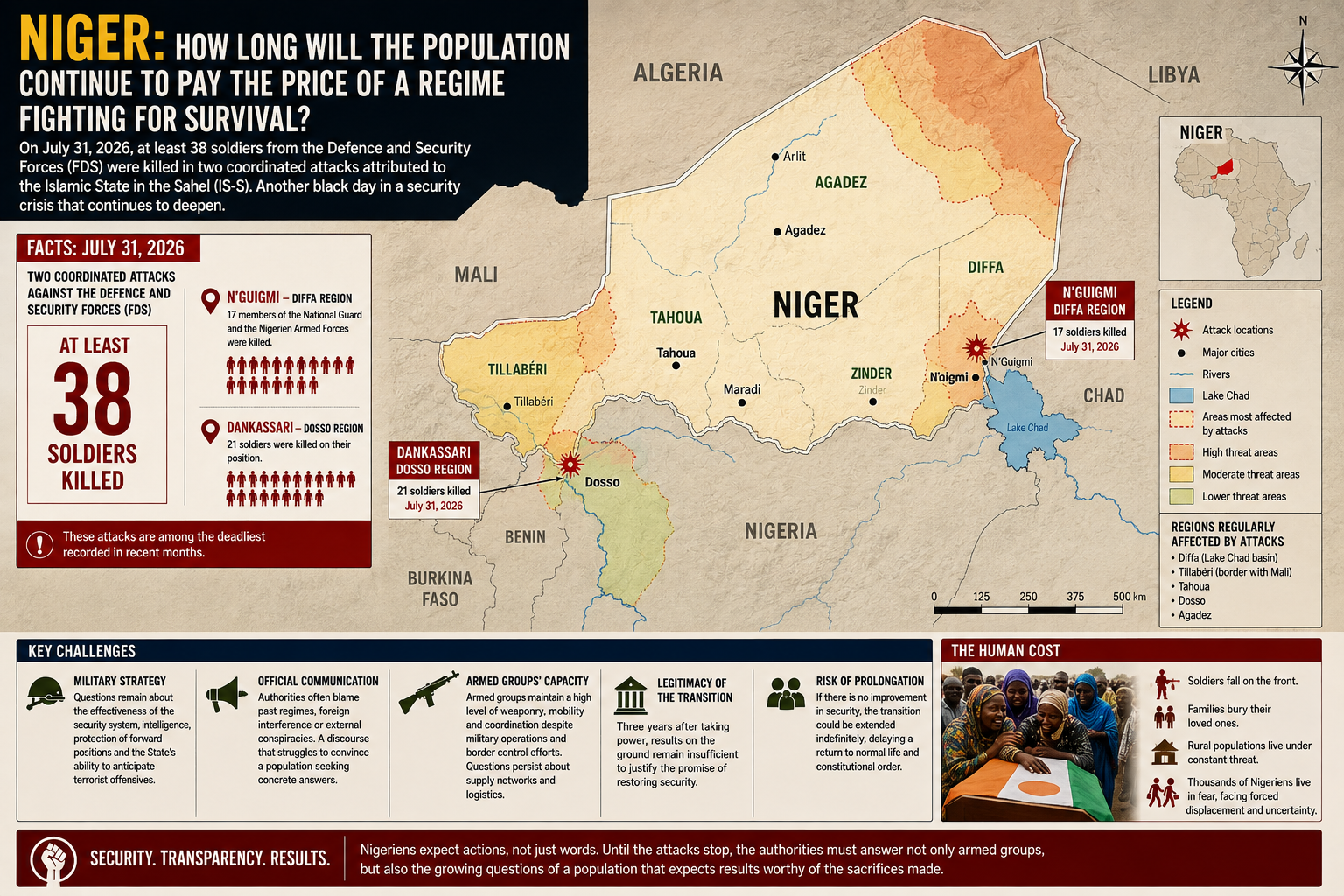
July 31, 2026, has etched another tragic milestone into Niger’s troubled recent history. At least 38 members of the country’s defense and security forces were killed in two synchronized assaults attributed to the Islamic State in the Sahel (ISIS-S). The attacks targeted positions in N’Guigmi, within the Diffa region, where 17 National Guard and Nigerien Armed Forces personnel perished, followed hours later by another strike in Dankassari, Dosso region, claiming 21 more lives.
These coordinated strikes rank among the deadliest in recent months, underscoring a grim reality: terrorism continues its relentless advance while human losses accumulate unchecked. The toll extends far beyond military casualties, raising urgent questions about the nation’s escalating security crisis and how long civilians must bear its consequences.
Broken security promises fuel public discontent
When General Abdourahamane Tiani assumed leadership in 2023, the military junta framed its intervention as an urgent necessity to halt the country’s spiraling insecurity. The stated goal was clear: restore territorial control, dismantle armed groups, and safeguard civilian populations. Yet three years on, the results tell a starkly different story.
Attacks persist across critical regions, including the Lake Chad basin and areas like Tillabéri, Tahoua, and Dosso. Militant factions demonstrate persistent operational capacity, executing coordinated strikes on military outposts despite repeated claims of force reorganization. This pattern fuels growing skepticism about the junta’s strategy and its ability to deliver on its core pledge.
Military failures demand urgent scrutiny
Each deadly assault now transcends mere casualty counts, exposing systemic vulnerabilities in Niger’s security apparatus. The incidents prompt critical inquiries into intelligence gathering, the protection of forward positions, and the state’s capacity to preempt terrorist offensives. As attacks multiply, public scrutiny intensifies, challenging the junta to justify its priorities amid accusations that political consolidation takes precedence over battlefield urgency.
A leadership that derives legitimacy from security guarantees cannot indefinitely evade scrutiny over its performance in this domain. Without tangible improvements, the narrative of reform risks eroding further, undermining the fragile trust between authorities and the populace.
Official narratives struggle to silence growing doubts
Following each attack, officials frequently cite inherited institutional weaknesses, foreign interference, or geopolitical complexities to contextualize failures. While external factors undoubtedly contribute to regional instability, such explanations offer little solace to bereaved families or communities living under perpetual threat.
What citizens demand are concrete answers about operational breakdowns, corrective measures, and tangible steps to prevent future tragedies. As incidents recur, the gap between official rhetoric and ground realities widens, threatening to render government communications increasingly ineffective.
Armed groups adapt while state responses falter
A particularly troubling trend is the sustained operational capacity of militant groups, despite ongoing military operations and border control efforts. Their ability to conduct large-scale attacks suggests persistent access to advanced weaponry, robust logistics, and effective coordination networks. This raises serious concerns about the state’s effectiveness in disrupting arms supply chains and dismantling terrorist support structures.
The lack of transparent public information further fuels speculation, eroding public confidence in both military and civilian institutions. Rumors thrive in the absence of credible updates, exacerbating divisions and mistrust within affected communities.
Transition hinges on tangible security gains
The military’s legitimacy rests squarely on its promise to restore security. Yet as attacks intensify, this promise increasingly collides with harsh realities. Each new assault not only deepens human suffering but also pushes the prospect of a return to normalcy further out of reach, while prolonging the country’s uncertain political transition.
Analysts warn that prolonged insecurity could further delay the transition to civilian rule, unless authorities demonstrate measurable progress. This scenario underscores the urgent need for transparency, verifiable results, and a credible roadmap out of the crisis—elements conspicuously absent in the current narrative.
The human cost of endless conflict
Beyond political debates, an undeniable human tragedy unfolds daily. Soldiers continue to fall in combat, families bury their loved ones, and rural communities endure perpetual fear. Thousands of Nigeriens navigate lives dictated by displacement, uncertainty, and the looming threat of violence.
Security was the cornerstone of the military transition’s legitimacy. Today, it remains its most critical test. Until the cycle of attacks ceases, authorities will face mounting pressure—not only from armed groups, but from a population that increasingly questions their ability to deliver on the promises that once justified their rise to power.