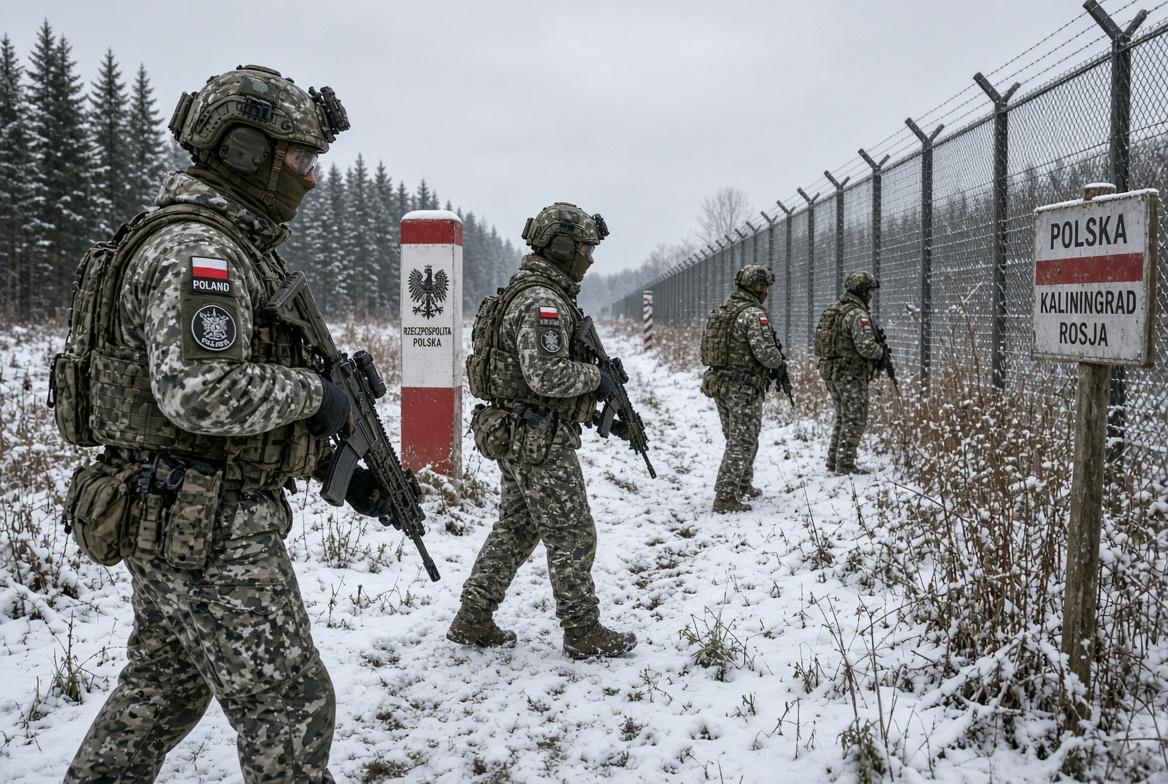

Unseen threats spark Poland’s Baltic wall of defense
Beneath the surface of Europe’s seemingly calm Baltic coastline, a shadow conflict has quietly intensified. While global attention remains fixed on Ukraine, Poland has moved to transform its northeastern frontier into one of the continent’s most fortified borders. The trigger? A convergence of suspicious drone incursions, unmarked aircraft overflights, and intelligence pointing to Russian-backed sabotage cells preparing to exploit Poland’s exposed position near the heavily militarized Kaliningrad exclave. What began as precautionary measures has evolved into Poland’s most ambitious security operation since the Cold War—a direct response to the Kremlin’s evolving playbook of hybrid warfare.
Beyond borders: The making of Poland’s anti-sabotage fortress
The operation now unfolding along Poland’s Baltic frontier is nothing short of a military metamorphosis. Gone are the days of routine border policing. In their place stands a multi-layered defense architecture, meticulously engineered to snuff out infiltration before it starts. At the core of this shield are Poland’s Border Guard, elite counterterrorism units, and rapid-response army battalions operating in seamless synergy. Their mission is clear: to detect, deter, and neutralize any adversary seeking to breach Polish sovereignty through sabotage, espionage, or asymmetric attacks.
But the stakes are higher than just border security. The northern regions of Poland house critical arteries of national infrastructure—energy grids, highways, and fiber-optic networks—that Russian operatives have repeatedly targeted in neighboring conflicts. Failure to protect these assets could trigger blackouts, paralyze transport, or even compromise national communications. Warsaw’s response is a calculated gamble: by hardening its defenses now, Poland aims to deny Moscow any foothold in what has become a geopolitical pressure point.
Kaliningrad’s proximity: The unspoken trigger behind Poland’s militarization
Only 200 kilometers separate Poland’s Suwałki Gap from Kaliningrad, the Russian military stronghold sandwiched between Lithuania and Poland. This proximity makes the region uniquely vulnerable to cross-border provocations—ranging from covert drone deployments to cyber intrusions against civilian infrastructure. Polish intelligence has intercepted multiple reconnaissance flights in recent months, some traced back to Russian aerospace forces operating out of the exclave. These patterns suggest a deliberate campaign to map Poland’s defenses and test their resilience.
Poland’s strategy is not merely defensive—it is preemptive. By positioning heavy armor, air defenses, and electronic warfare units along the border, Warsaw signals that any attempt to destabilize Poland through hybrid tactics will be met with overwhelming force. This stance is backed by NATO’s eastern flank doctrine, which treats the Suwałki Gap as a potential flashpoint where conventional and unconventional warfare could merge into a single, unpredictable crisis.
The Baltic’s silent escalation: Why Poland chose deterrence over diplomacy
Poland’s decision to militarize its Baltic border reflects a sobering realization: in the arena of hybrid warfare, deterrence is the only credible language Moscow understands. Diplomacy has repeatedly failed to curb Russian incursions—from cyberattacks on Polish institutions to the weaponization of migration flows along the EU’s eastern frontier. With Kaliningrad serving as a staging ground for such operations, Warsaw has concluded that passive defenses are insufficient. The new security architecture is designed not just to repel attacks, but to expose them before they materialize.
The shift also underscores a broader truth about Europe’s evolving security landscape: the front lines of the continent’s defense no longer run solely through trenches or missile silos. They exist in the form of encrypted communications intercepted mid-air, in the shadows of unmanned aerial corridors, and in the quiet sabotage of energy pipelines. By fortifying its Baltic frontier, Poland is not just guarding a border—it is asserting sovereignty in a conflict where ambiguity is the enemy.
In doing so, Warsaw sends a message to both allies and adversaries: the era of half-measures is over. In a region where hybrid warfare blurs the line between peace and conflict, Poland has chosen to act first—and that choice may well determine the next chapter of NATO’s eastern defense.