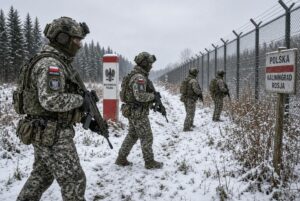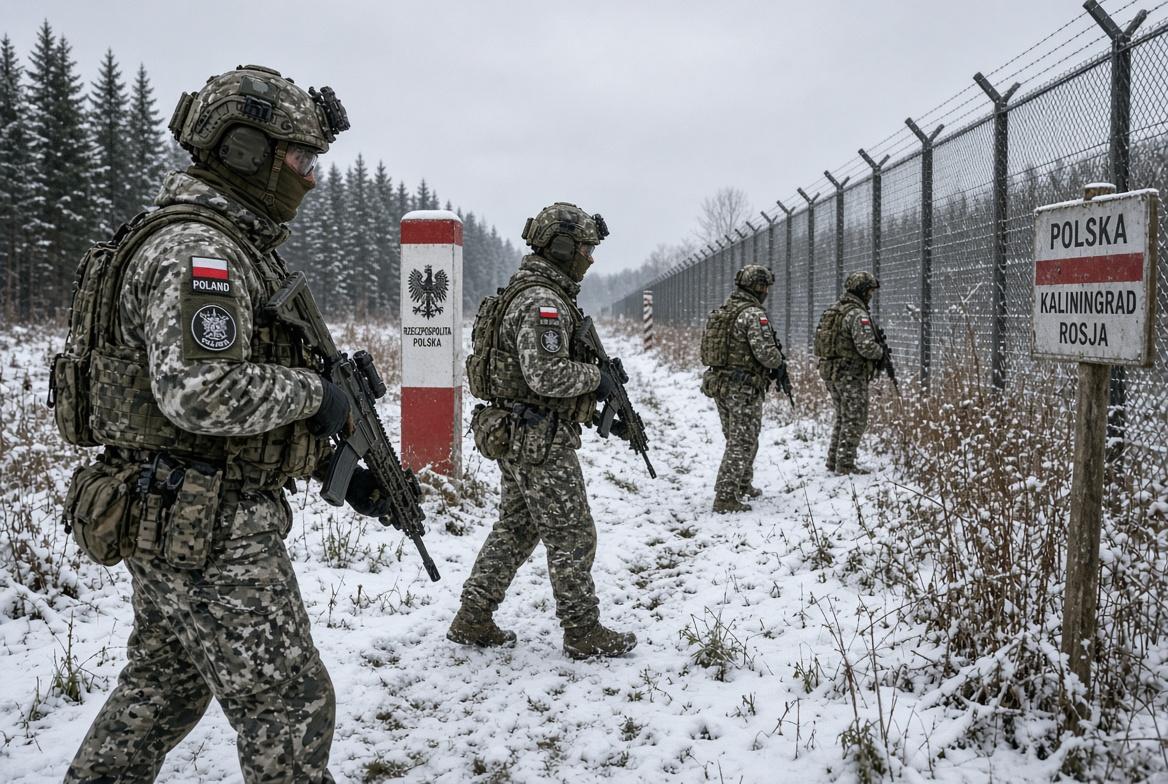

An unprecedented security shift is unfolding along Europe’s northeastern frontier, where Poland’s response to Russia’s creeping hybrid warfare has reached its most decisive phase. The Baltic Sea, once a zone of relative calm, has become the stage for a shadow conflict where drones, sabotage, and psychological operations blur the line between war and deterrence. Warsaw’s latest move isn’t just a reaction—it’s a calculated counterplay to Moscow’s evolving playbook.
The Baltic rift: why Poland’s northern frontier became the new geopolitical battleground
Behind the headlines of Russia’s full-scale invasion of Ukraine, a quieter but no less dangerous game has been playing out along the 200-kilometer stretch of Poland’s border with the Russian exclave of Kaliningrad. This narrow landbridge, sandwiched between Lithuania and the Baltic Sea, has emerged as a critical pressure point where NATO’s eastern flank meets one of Moscow’s most militarized footholds. The region’s strategic value—home to key energy corridors, transit hubs, and NATO’s forward defenses—has made it a prime target for Moscow’s asymmetric tactics.
What triggered Poland’s drastic escalation wasn’t a single event, but a pattern of low-intensity provocations that have intensified since the onset of the Ukraine war. Unidentified drones violating airspace, suspicious vessel movements in coastal waters, and reports of attempted cyber intrusions into energy grids all pointed to a deliberate campaign of destabilization. Rather than wait for an open assault, Polish authorities chose to preemptively seal the border with a security grid so robust it redefines modern frontier defense.
A fortress on the periphery: the anatomy of Poland’s multilayered security shield
The operation—codenamed Iron Veil—isn’t just a wall; it’s a 21st-century security ecosystem. Deployed along the frontier are:
- Elite border hunter-killer teams: Specially trained units combine reconnaissance, rapid response, and counter-sabotage to intercept infiltrators before they cross into Poland.
- Integrated surveillance towers: Equipped with thermal imaging, radar, and AI-driven motion sensors, these structures provide 360-degree coverage in real time—even through dense forests and low-light conditions.
- Drone detection and jamming networks: A layered defense system that disrupts unauthorized UAVs before they reach critical infrastructure or gather intelligence.
- Critical infrastructure protection battalions: Mobile units assigned to safeguard power plants, rail networks, and digital backbone facilities against sabotage or cyber-physical attacks.
- Joint command center (Baltic Shield): A central hub where military, police, and intelligence agencies coordinate responses using shared threat intelligence and predictive analytics.
The scale and coordination of Iron Veil reflect a fundamental shift: Poland is treating its border not as a line to monitor, but as a frontline in a continuous conflict zone. Every patrol, sensor ping, and alert is part of a broader deterrence strategy aimed at making any Russian-backed infiltration too costly to attempt.
Beyond the wall: Poland’s unspoken message to the Kremlin
More than a physical barrier, the new border regime sends a clear message: Poland will not let hybrid warfare remain a one-sided advantage. Moscow has long relied on deniability—migrant flows, disinformation, cyberattacks—that skirt conventional definitions of war. But by militarizing the frontier with elite forces, real-time surveillance, and rapid interdiction, Warsaw is forcing Russia to confront the reality of escalation: every drone incursion, every covert operation, now risks direct engagement with NATO’s second-largest army.
This strategy also signals a deeper transformation in Europe’s defense posture. Warsaw’s bold stance is rooted in the belief that deterrence is not just about strength—it’s about unpredictability. By refusing to leave any channel open to Russian manipulation, Poland has made its northern border a new kind of Maginot Line: one that doesn’t rely on static walls, but on agility, intelligence, and the will to respond preemptively.
The human cost of vigilance: how border communities are adapting
For residents of towns like Elbląg or Braniewo, life near the fortified frontier has changed dramatically. While most support the enhanced security measures, concerns persist about militarization encroaching on daily life. Farmers report restricted access to fields; fishermen are monitored under new maritime surveillance protocols. The psychological toll is real—anxiety lingers not from fear of invasion, but from the knowledge that the next provocation could come from anywhere, at any time.
Yet, in a twist of irony, the border’s militarization has also fostered a sense of solidarity among locals. Volunteer groups now assist in early-warning systems, reporting suspicious activity to authorities. A local teacher quoted in a regional paper said, “We used to worry about the weather. Now we watch the sky.”
What’s next: a new era of European frontier defense?
Poland’s Iron Veil isn’t just a national experiment—it’s a blueprint. As EU leaders debate the future of continental security, Warsaw’s approach is being quietly studied from Helsinki to Bucharest. Could similar doctrines be applied along the Suwałki Gap, the Nordic borders, or even the Mediterranean? More importantly, will Moscow interpret this escalation as a challenge—or a provocation?
One thing is certain: the Baltic Sea is no longer a quiet maritime divide. It has become a laboratory for modern warfare, where technology, strategy, and ideology collide. And Poland, with its ironclad frontier, has taken the lead in redefining what it means to defend a nation in the 21st century.