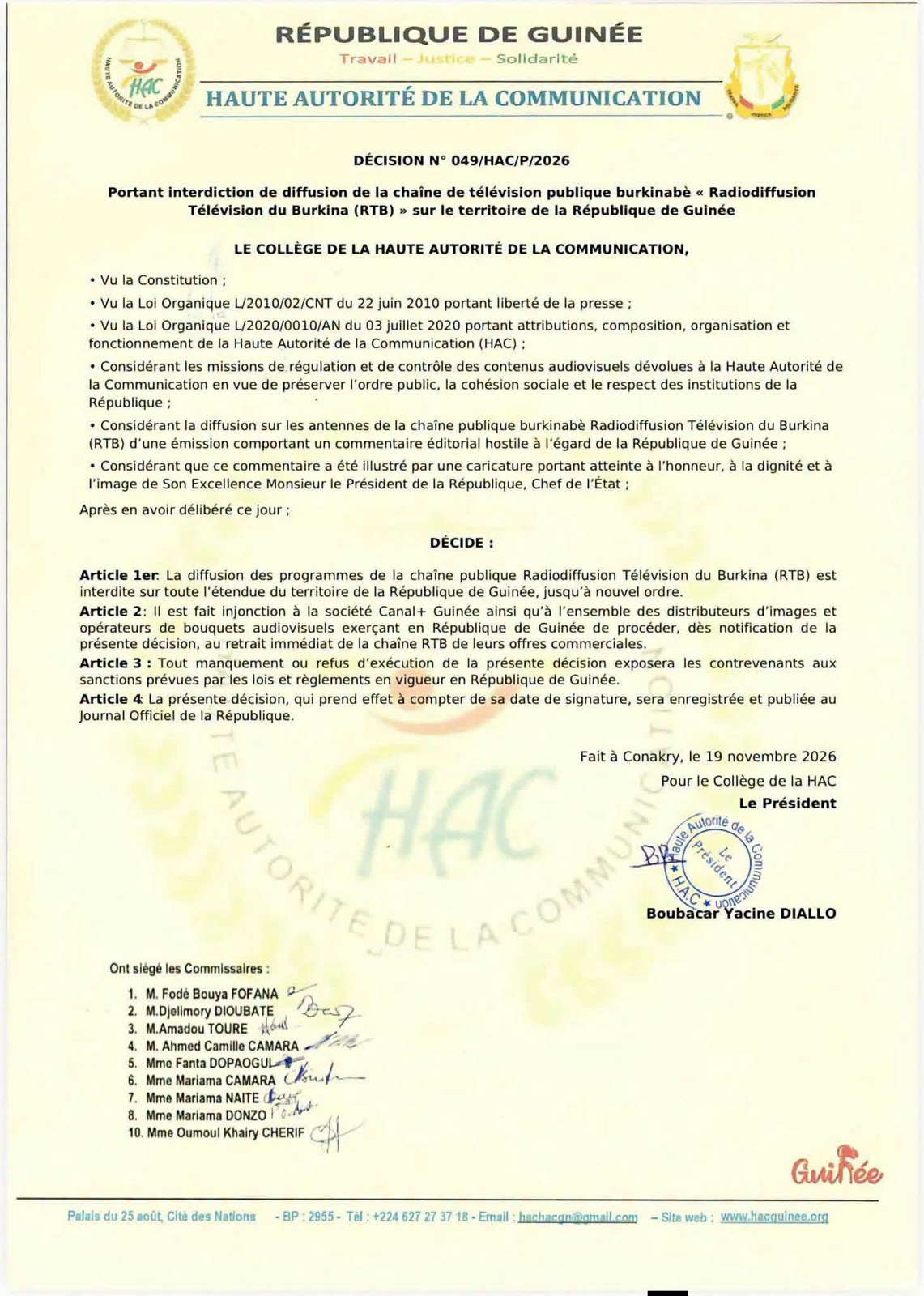

The suspension of Burkina Faso’s public broadcaster, RTB, by Guinean authorities underscores a critical debate: what happens when a state-funded media outlet prioritizes political loyalty over journalistic duty? This unprecedented decision forces an examination of the fundamental role of public broadcasters in West Africa and their relationship with governing powers.
The crisis of public broadcasters in West Africa
Public broadcasters are intended to serve as pillars of democratic societies, providing impartial, accurate, and balanced information to citizens. However, when these institutions become extensions of political narratives rather than neutral sources of news, their credibility erodes rapidly. The Guinean government’s move to ban RTB across the nation is not merely an administrative measure it reflects a growing skepticism toward state-aligned media in the region.
The blurred line between journalism and propaganda
Under the leadership of Burkina Faso’s transitional authorities, RTB had increasingly aligned its editorial stance with the ruling regime’s political objectives. Rather than fostering diverse perspectives, its coverage reflected a pattern of systematic disparagement of dissenting voices, selective reporting, and commentary that blurred the boundaries between news and political advocacy. Such practices not only undermine journalistic integrity but also erode public trust in media institutions that should remain independent.
Media professionals and observers argue that the suspension in Guinea is a response to a broader crisis: the transformation of public broadcasting into a tool for political messaging rather than an instrument for public enlightenment.
Why governance matters for public media
The issue extends beyond Guinea’s borders. Across West Africa, public broadcasters face mounting pressure to conform to the agendas of ruling parties. When these institutions fail to uphold objective journalism, they risk becoming propaganda arms rather than platforms for genuine civic discourse. The ban on RTB serves as a cautionary tale about the dangers of conflating state media with state messaging.
The role of regulatory bodies in media oversight
The decision by Guinea’s High Authority of Communication (HAC) to enforce the ban highlights the delicate balance regulatory bodies must strike between protecting media freedom and ensuring that public broadcasters adhere to professional standards. While the move may be seen as a corrective action, it also raises questions about the long-term sustainability of independent journalism in a landscape where political interference remains a persistent threat.
Lessons for the future of public broadcasting
The suspension of RTB in Guinea is more than a bilateral dispute it is a wake-up call for the entire region. Public broadcasters must reclaim their mandate as guardians of truth, not vehicles for political agendas. For democracy to thrive, media institutions must prioritize transparency, accountability, and the public interest over partisan loyalty.
The integrity of public broadcasting is not negotiable. When media outlets surrender their editorial independence, they betray the very citizens they are meant to serve.
By Moussa Samuel Coulibaly — Journalist