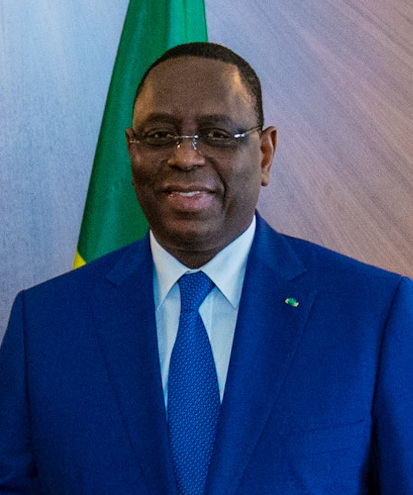

Three days after hosting Macky Sall at the Presidential Palace in Dakar, Bassirou Diomaye Faye made a decisive announcement: Senegal will fully support his predecessor’s candidacy for United Nations Secretary-General. While this endorsement is significant, its impact may not be absolute.
The president’s decision reflects a clear shift in Senegal’s political landscape. It signals a willingness to move beyond personal grievances in favor of national and continental interests. For observers, this move was long overdue—after all, Senegal’s refusal to back a former head of state for such a prestigious role had seemed increasingly difficult to justify on the global stage.
From confrontation to cooperation: a strategic pivot
The relationship between Bassirou Diomaye Faye and Macky Sall has been anything but smooth. Faye’s rise to power in March 2024 was marked by tumultuous circumstances. Imprisoned in April 2023 during a crackdown on opposition figures, including Ousmane Sonko, he was released just days before the election—a presidential pardon secured in the heat of a pre-vote crisis. Sonko’s resilience, despite his own legal troubles, paved the way for Faye’s victory in the first round. No Senegalese president had ever ascended to power through such a turbulent path, transitioning from prison to the presidency in a matter of weeks.
This backdrop shaped the early narrative of Faye’s administration, built on promises of systemic change and criticism of Sall’s perceived authoritarian tendencies. Yet, in a surprising turn, the new leader has chosen to prioritize Senegal’s diplomatic standing over personal or partisan disputes. Official statements emphasize a commitment to national cohesion, framing the decision as part of a broader effort to advance African interests within the UN framework.
A political rupture paved the way for this diplomatic shift.
Until recently, Faye’s alliance with Ousmane Sonko—his former mentor and prime minister—had constrained his options. Sonko’s deep-seated opposition to Sall, rooted in his own imprisonment and exclusion from the 2024 election, made any rapprochement with the former president politically toxic. However, their split in May 2024 removed this obstacle. Freed from the weight of Sonko’s hardline stance, Faye gained the latitude to pursue a more pragmatic foreign policy, one aligned with Senegal’s long-term strategic goals.
Diplomatic leverage and personal ambition
This move also serves Faye’s broader political strategy. With plans to launch his own party in the coming months, he is seeking to consolidate support beyond his traditional base. By engaging with figures from Sall’s and former president Abdoulaye Wade’s networks, he aims to build an alternative electoral coalition—one that could secure his re-election in 2029. Sall’s recent visit to Dakar, marked by an overwhelmingly warm reception, underscored his enduring influence in Senegalese politics.
For Macky Sall, this support is a game-changer.
His candidacy, officially submitted in March by Burundi on behalf of the African Union’s rotating presidency, had faced a critical vulnerability: the absence of endorsement from Senegal. In the high-stakes world of UN leadership races, a candidate’s home country’s silence is often interpreted as a lack of confidence. This perception weakens their position long before the Security Council’s veto-wielding members even cast their votes.
By securing Senegal’s backing—and mobilizing its diplomatic corps—Faye has removed a major obstacle. Sall can now present himself as a candidate fully endorsed by the nation he once led, silencing critics who questioned his legitimacy. Yet, this endorsement does not guarantee victory. The UN Secretary-General role has historically followed an unwritten continental rotation system, and this cycle favors a Latin American candidate. With four of the five declared contenders hailing from the region, the odds are stacked against Sall, who remains the sole non-Latin American and former head of state in the race.
The last African to hold the position was Boutros Boutros-Ghali in the 1990s, and while the continent’s underrepresentation is undeniable, regional customs often outweigh symbolic representation in UN elections.
What lies ahead for Sall’s campaign?
Sall’s fate will ultimately hinge on the Security Council’s deliberations, where the five permanent members hold veto power. His diplomatic track record suggests a balanced approach: while he cultivated close ties with France during his presidency, he also maintained constructive relations with Russia. Senegal’s abstention on the March 2022 UN resolution condemning Russia’s invasion of Ukraine reflected this pragmatic stance. Days after securing Senegal’s support, Sall met with Russian Foreign Minister Sergei Lavrov in Moscow, signaling his intent to broaden his international outreach.
The verdict on his candidacy is expected this autumn, but even with Dakar’s backing, the road to the UN’s top job remains fraught with challenges.