
Southern Libya serves as strategic rear base for Tuareg rebels’ assault on Kidal
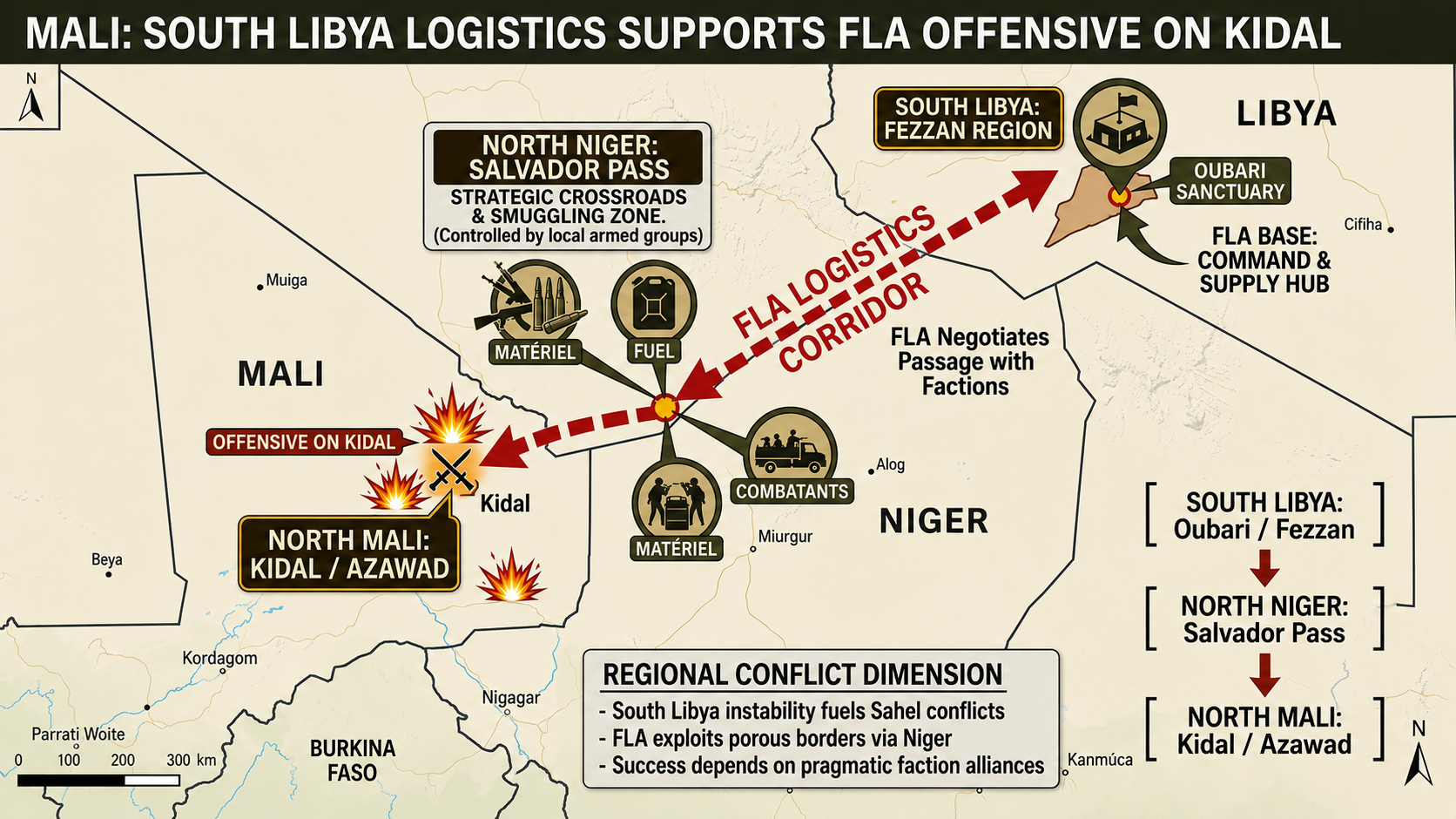
Consistent intelligence reports indicate that the Azawad Liberation Front (FLA) has established a strategic corridor connecting Libya to northern Mali via Niger in order to orchestrate their recent military campaign.
In the constantly shifting security landscape of the Sahel, southern Libya once again emerges as the epicentre of rebel dynamics. Tuareg insurgents from the Azawad Liberation Front are believed to have utilised Libyan territory as a critical logistics hub to prepare and execute the large-scale offensive launched on 25 April aimed at recapturing Kidal.
Fezzan and Oubari: logistic sanctuaries
At the heart of this setup lies the Fezzan region, a historically porous area of southern Libya. Rebel infrastructure is reported to have been organised near the town of Oubari. Far from being a mere passive refuge, this zone is said to have served as a launch point, logistical command centre, and supply hub for FLA fighters.
From this sanctuary, the movement planned the military operations that are currently shaking northern Mali.
The Salvador Pass: artery of all trafficking
To project their forces and equipment toward the Malian theatre of operations, the rebels rely on a highly strategic cross-border axis. This corridor forms a continuous line linking southern Libya to northern Mali, cutting straight through Nigerien territory.
The central element of this route is the well-known Salvador Pass. Located in the far north of Niger, this desert crossroads is notorious as a transit zone favoured by terrorist groups as well as arms and drug trafficking networks.
In the context of this offensive, the pass facilitates the flow of three vital elements:
- Military materiel (weapons, ammunition, and logistical supplies);
- Fuel, a precious commodity for the mobility of pick-up convoys across the desert;
- Fighter movements, using this vector to head to the front before withdrawing into Libyan territory after combat.
[South Libya: Oubari / Fezzan]
│
▼
[North Niger: Salvador Pass] *(Zone under control of local armed groups)*
│
▼
[North Mali: Kidal / Azawad]
Niger, a conditional passage
The use of this corridor highlights the complexity of cross-border alliances. Since the Nigerien portion of this axis is controlled by various local armed groups, the FLA could not act unilaterally.
To move its troops and supply convoys, the Tuareg rebellion had to negotiate transit rights and obtain authorisation from these actors who control northern Niger. This logistical compromise demonstrates that the success of Sahel offensives now depends on pragmatic agreements among interconnected armed factions across the region.
As the battle for control of northern Mali intensifies, these elements confirm the profoundly regional dimension of the conflict, where Libyan instability continues to radiate its effects onto Sahelian hot spots.