
Niger–Bénin border closure: a political bargaining chip
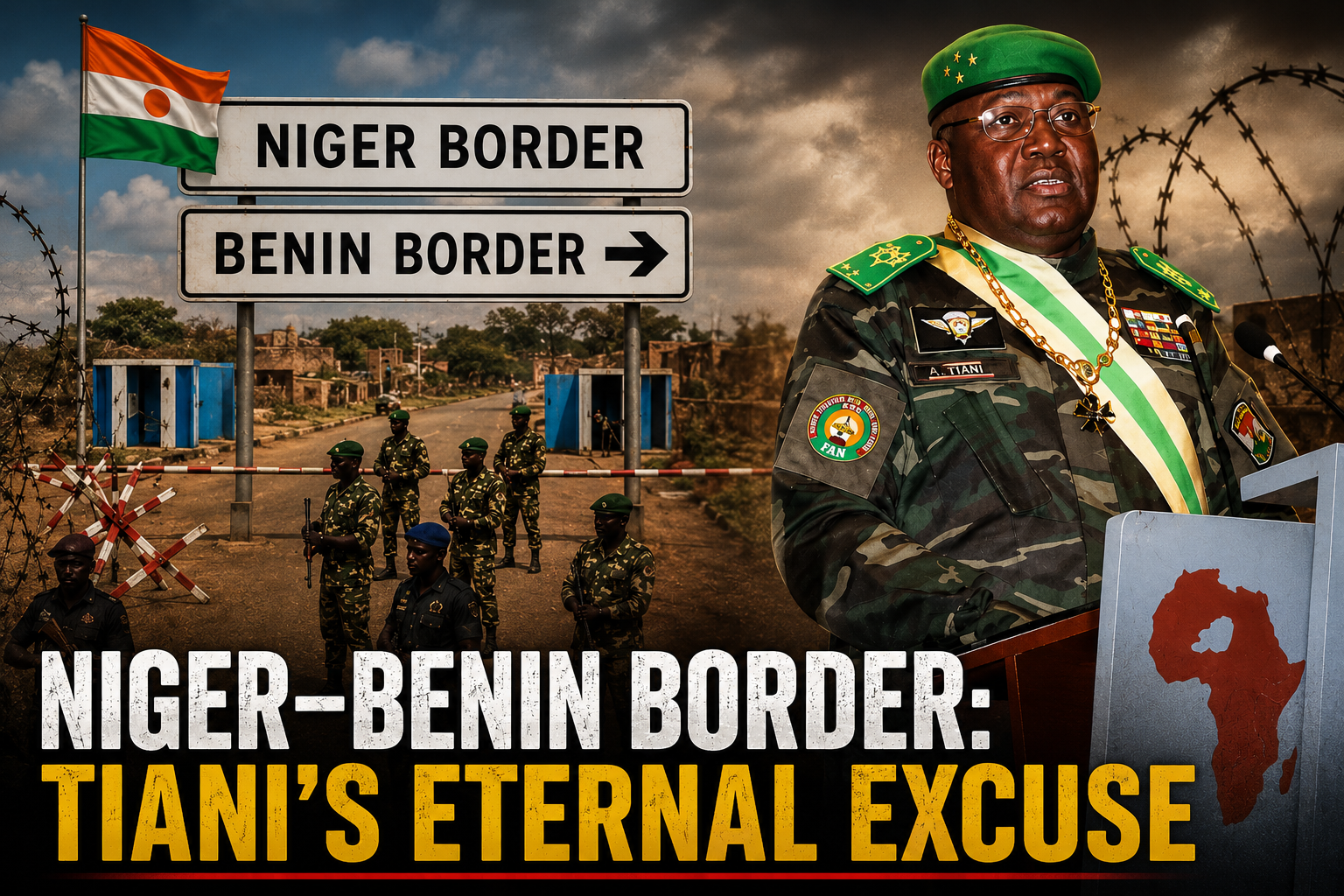
Nearly two months after Benin’s President Romuald Wadagni visited Niamey, and five weeks following technical discussions between experts from both nations, expectations for a swift resolution to the Niger–Benin border crisis had risen. Initial signs suggested a gradual easing of tensions, with renewed dialogue offering hope for the resumption of cross-border exchanges.
Yet on July 26, during a national address marking the first anniversary of his rise to power, General Abdourahamane Tiani dismissed any prospect of imminent change. Speaking on national television ORTN, he stated: ‘Certain prerequisites must first be addressed before any irreversible decision is made regarding the reopening of the border.’
This declaration underscores a pattern that has persisted for nearly three years: the border has evolved from a mere transit point into a political tool, wielded to sustain a sovereigntist narrative and sustain tensions with Cotonou.
Unclear demands, indefinite postponement
The crux of the issue lies in the complete lack of specificity. What exactly constitutes these ‘prerequisites’? What measurable criteria would signal their fulfillment? When might these conditions be met? None of these questions have received clear answers.
The absence of concrete details grants the military leadership significant political leverage. It enables them to delay the border’s reopening indefinitely without ever having to justify their stance through tangible evidence. In practice, each new demand can be replaced by another, ensuring the matter remains perpetually unresolved. This deliberate ambiguity sustains uncertainty and obstructs any lasting normalization.
A security rhetoric that has lost its credibility
Since the July 2023 coup, the regime has consistently cited security as its primary justification for maintaining the closure. Niamey alleges that Benin’s territory serves as a rear base for armed groups or foreign actors posing a threat to Niger. However, these claims have never been substantiated with verifiable public evidence.
Meanwhile, terrorist attacks continue to devastate several Nigerien regions, including Tillabéri, Tahoua, and Diffa. The persistence of such violence raises a critical question: if border closure were an effective security measure, why have attacks not significantly diminished?
Technical expertise sidelined in favor of political calculations
Weeks earlier, Beninese and Nigerien experts had reconvened to explore practical steps toward a phased reopening, focusing on balancing security concerns with the restoration of trade flows. These discussions aimed to bridge gaps while addressing legitimate concerns.
By implicitly dismissing these efforts, General Tiani sends a clear message: the final decision rests solely on political grounds. Technical exchanges now appear to serve as a delaying tactic rather than a pathway to resolution.
Economic fallout: Niger bears the heaviest burden
The prolonged closure has severe economic repercussions for both nations. Benin has seen a decline in transit traffic to the Port of Cotonou, reduced customs revenue, and sluggish activity among transporters. Yet the impact on Niger is far more severe.
As a landlocked country, Niger relies heavily on regional corridors for essential supplies. Diversions through longer routes in neighboring states inflate logistics costs, which are then passed on to consumers:
- Rising food prices;
- Increased costs for construction materials;
- Higher prices for imported medicines and goods;
- Supply shortages for local businesses;
- Reduced competitiveness for Nigerien enterprises.
Small traders along the border are among the hardest hit. Many have seen their incomes plummet, while once-thriving border towns now face economic stagnation.
Regional cooperation weakened by prolonged closure
Beyond economic losses, the border dispute undermines broader regional cooperation. Academic exchanges, cross-border local governance initiatives, joint development projects, and anti-trafficking efforts have all become far more challenging to implement.
Ironically, an officially closed border does not prevent illicit networks from flourishing. In fact, the absence of legal trade often fuels informal economies, complicating authorities’ efforts to monitor and control them.
Sovereignty as a political communication tool
By framing the closure as an ‘irreversible’ decision, General Tiani seeks to position it within a symbolic narrative. The move is framed as a demonstration of sovereignty against external pressures. Yet this raises a fundamental question: should sovereignty be measured by a nation’s ability to isolate its economy, or by its capacity to safeguard the welfare of its people?
For many observers, the prolonged closure increasingly appears driven by political messaging rather than measurable security objectives. It reinforces a discourse of perpetual resistance, bolstering the junta’s domestic legitimacy among certain segments of the population.
The human toll of a political standoff
Behind official declarations lie the untold struggles of thousands of families. Transport operators left without livelihoods, merchants facing ruin, students barred from travel, separated families, and business owners grappling with uncertainty—these are the silent victims of the impasse. Each passing week deepens their hardship and pushes the dream of normalcy further out of reach.
A stalemate sustained by ambiguity
Three years into the crisis, the Niger–Benin border is no longer a security issue but a political lever. By invoking undefined ‘prerequisites,’ the Nigerien leadership retains absolute latitude to prolong the status quo indefinitely. Meanwhile, citizens on both sides continue to endure the economic, social, and human consequences of a decision whose tangible benefits remain elusive.
Ultimately, a return to normalcy may only materialize when political considerations yield to the urgent needs of citizens and the imperative of restoring regional cooperation built on dialogue, mutual trust, and pragmatic solutions.