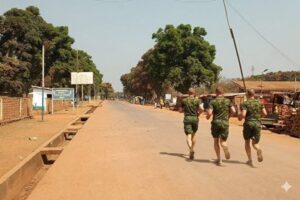

The Central African Republic (CAR) stands at a crossroads as the future of its security partnerships hangs in the balance. With the looming question of whether to embrace the Wagner Group or the newly formed Africa Corps, residents face a grim reality: both options promise the same cycle of violence, only the payment method differs.
President Touadéra has long favored Wagner, a Russian private military company known for its brutal tactics and resource extraction. However, Moscow now pushes for the Africa Corps, a Kremlin-aligned force with a reported monthly cost of 10 billion West African CFA francs. For ordinary citizens, the choice is stark: more bloodshed, more massacres—just a different accounting system for the atrocities.
the Mali experience: a warning sign for the CAR
Since replacing Wagner in Mali after the 2025 death of its leader Evguéni Prigojine, the Africa Corps has become a symbol of unrelenting violence. Reports from refugees who fled to Mauritania reveal a pattern of indiscriminate killings, abductions, and sexual violence that mirrors Wagner’s methods. A Malian village leader who escaped put it bluntly: “They are the same men, paid by the government, committing the same atrocities.”
The Africa Corps operates under the Russian Ministry of Defense, making Moscow directly accountable for war crimes—a key difference from Wagner’s semi-autonomous structure. Analysts estimate its forces in Mali at around 2,000 fighters, though their origins are murky. Refugees report encountering black men speaking foreign languages, suggesting recruits from Russia, Belarus, and multiple African nations.
humanitarian catastrophe unfolds in Mali
Testimonies from 34 Malian refugees near the Mauritanian border paint a harrowing picture. Their accounts describe a “scorched earth” policy where no one is spared—men, women, and children targeted without warning. Fatma, a survivor from Kurmare, watched as Russian fighters looted her home, executed her son, and left her daughter to die from a neglected medical crisis. “I am alive in body only,” she confessed.
Mougaloa, a Fulani herder, remains haunted by the disappearance of her daughter. Her son was beaten and slaughtered before her eyes—a common fate for the Fulani, who are often accused of ties to jihadists. When Africa Corps troops arrive with Malian soldiers, there are no distinctions made. As one displaced villager explained: “Speak up, and the militants kill you. Stay silent, and the soldiers will.”
Evidence of the Africa Corps’ brutality includes burned villages, mutilated corpses, and organ harvesting—tactics already documented in Wagner’s operations. While official civilian death tolls have dropped slightly (447 this year vs. 911 last year), experts warn the numbers are unreliable due to fear of retaliation. “The violence persists, even if the reports don’t capture it all,” noted Sukru Cansizoglu, a UNHCR representative in Mauritania.
As the Central African Republic weighs its options, the lessons from Mali are clear: neither Wagner nor Africa Corps offers a path to peace—only a continuation of suffering under a different banner.