After the flames at Sévaré, Mali’s security model faces a reckoning
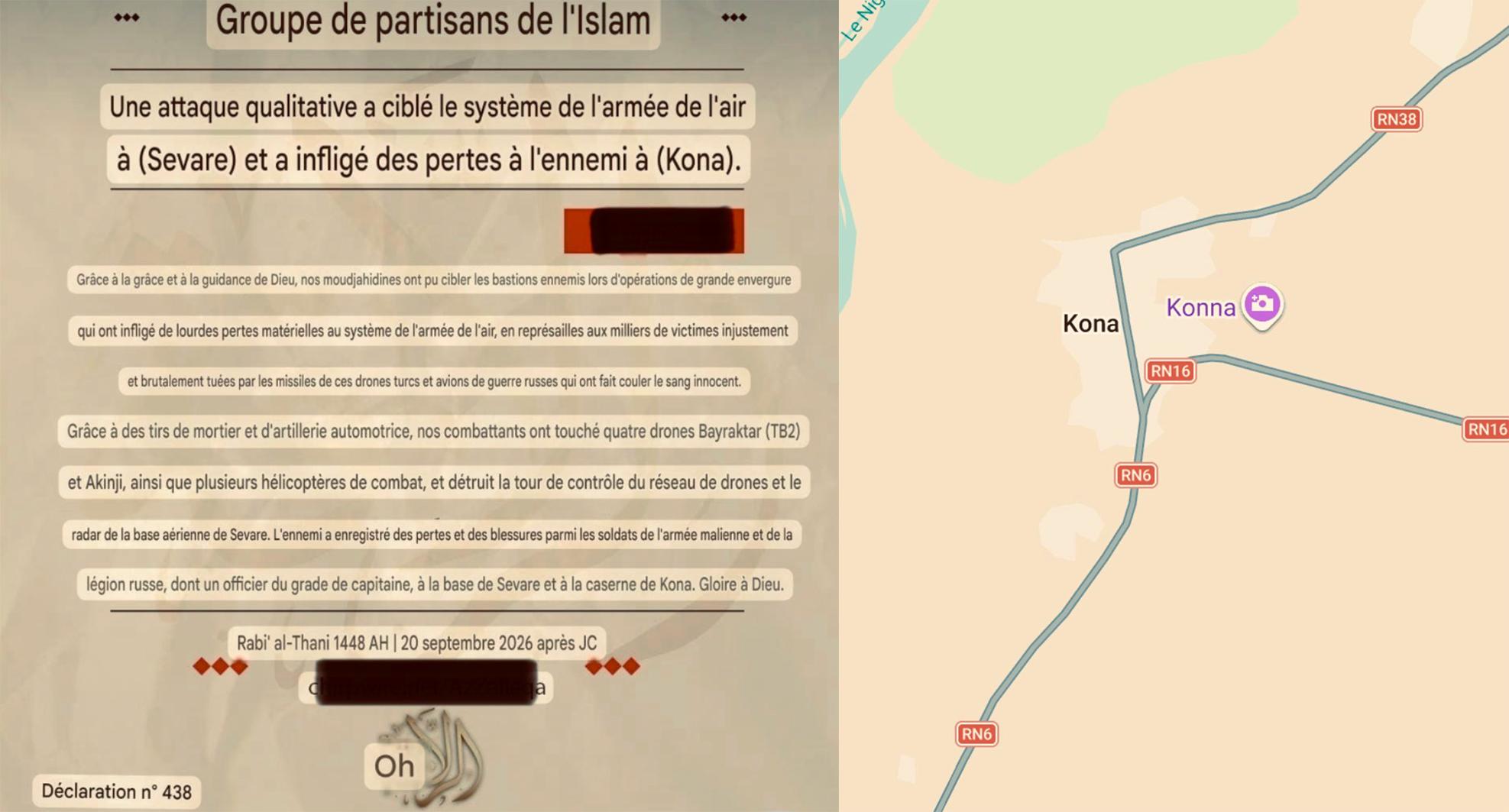
The assault that hit Sévaré air base and the Konna military camp has reignited a national conversation about the true state of Mali’s defense strategy. The attack, claimed by the al-Qaeda-affiliated Group for the Support of Islam and Muslims (JNIM), has exposed the fragile foundations of a security architecture that was supposed to be transformed after 2020. Despite heavy investments in advanced weaponry and the arrival of Russian Africa Corps personnel, the system remains dangerously exposed.
What the JNIM says it destroyed at Sévaré
In its official statement, the JNIM asserted that its fighters struck multiple military installations at Sévaré, damaging or destroying four Bayraktar TB2 and Akıncı drones, several helicopters, a radar station, and an air traffic control tower. The group also claimed to have inflicted casualties among Malian troops and Russian fighters. These assertions, if verified, would mark one of the most significant blows to Bamako’s military infrastructure in recent months.
The paradox at the heart of Mali’s new security model
Since the coups of 2020 and 2021, Mali’s military leadership has radically reoriented its defense policy. The break with Western partners, France in particular, opened the door to a strategic partnership with Moscow. Bamako frames this shift as a sovereign choice — the right to pick its own allies and equip its army without external interference. Politically, the narrative resonates. On the ground, the picture is far more complicated.
The arrival of Turkish-made drones and Russian personnel has not erased the jihadist threat. Recent attacks demonstrate that armed groups still possess formidable capacity to strike at the heart of the state’s military apparatus. The real challenge is not the quantity of weapons but the ability to translate military power into lasting territorial control.
The Africa Corps and the limits of conventional force
The Russian presence is a central pillar of Mali’s revamped security apparatus. After the French withdrawal and the end of Operation Barkhane, Bamako made an exclusive choice: Moscow. The Africa Corps, which has taken over from the Wagner Group in several African nations, is now fully integrated into Mali’s defense system.
But this partnership runs straight into the reality of a deeply rooted insurgency. JNIM fighters operate in familiar terrain, know the land intimately, and use asymmetric tactics that blunt the edge of technological superiority. Modern drones can surveil and strike precise targets; helicopters can support ground troops; foreign fighters can bolster certain units. Yet none of these tools alone guarantees durable control over territory.
Why Sévaré matters beyond the base
The Sévaré episode fits into a broader pattern of insecurity. Malian forces are suffering deadly attacks on military positions, strategic axes, and critical infrastructure. This points to a structural weakness: the army concentrates considerable resources around main bases but struggles to control rural areas and surrounding communication routes.
Sévaré is the most emblematic case. As a major military hub in central Mali, it hosts aerial surveillance and combat infrastructure. The fact that JNIM could strike such a high-value target proves the group retains the ability to reach deeply strategic installations. Repeated attacks only worsen the situation. A security strategy cannot be judged by the number of drones acquired or strikes announced — it is measured by its concrete capacity to prevent attacks, protect civilians, and sustain state authority over time.
The technology trap
The emphasis on Bayraktar drones illustrates an operational contradiction. Mali has acquired capable platforms for intelligence and long-range strikes, a clear leap forward. But advanced technology remains vulnerable when concentrated on fixed, identifiable infrastructure. If JNIM’s claims about the Sévaré equipment are confirmed, it would represent a major symbolic setback for Bamako — proof that a portion of its technological investment can be neutralized directly on the tarmac.
The Malian conflict shows that fighting a jihadist organization demands more than sophisticated hardware. It requires human intelligence, force mobility, population protection, logistics route security, and a continuous state presence in remote areas.
The political cost for the junta
For Mali’s military leadership, the stakes go beyond the battlefield. Since taking power, the junta has built its political narrative on national sovereignty and the fight against terrorism. The French withdrawal and the Russian partnership are presented as symbols of a new security policy free from old dependencies. Every attack on a strategic position exposes the limits of that orientation and forces the authorities to confront the real-world results of their military partner shift.
At Sévaré, as elsewhere, the effectiveness of this policy is verified only by facts on the ground.
What the public debate is really about
For ordinary Malians, strategic debates about France, Russia, Wagner, the Africa Corps, or Turkish drones are secondary to daily survival. The only priority is the effective security of villages, roads, markets, and cities. A security policy succeeds not through weapons displays at military ceremonies but by neutralizing threats against civilians and permanently restoring state authority.
The Sévaré attack confirms the depth of Mali’s security crisis. The junta has renewed its alliances, strengthened its arsenal, and asserted its will to seize the initiative. Yet military power alone cannot defeat the JNIM. Bamako’s challenge now is to convert its military means into lasting security. As long as strategic bases come under attack, communication routes remain vulnerable, and jihadist groups set the pace of operations, the junta’s security model faces a critical test.
At Sévaré, power is now judged exclusively on results in the field.