Burkina Faso’s armored vehicle claim: the moment the Faso Armored myth began to crack
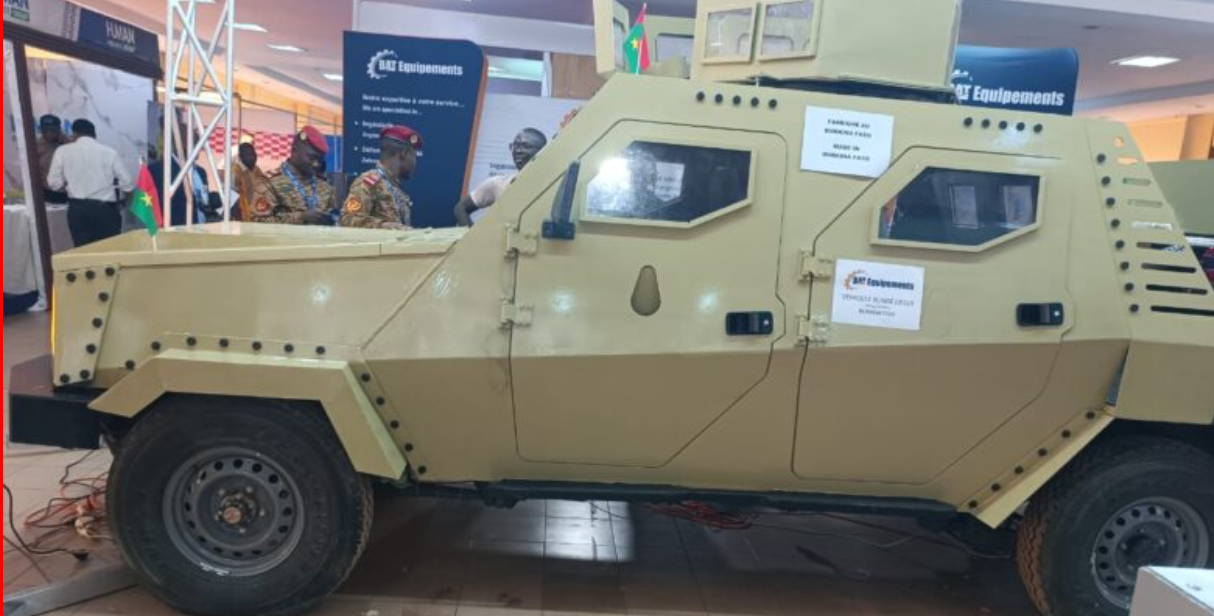
Something shifted in Burkina Faso when the junta announced that nearly 300 armored vehicles had rolled off domestic production lines since November 2025. That claim, delivered with maximum fanfare, marked a turning point — not toward industrial sovereignty, but toward a more aggressive phase of state-engineered illusion. The reality behind the “Made in Burkina” label tells a far different story, one that exposes the gap between the regime’s narrative and the country’s deepening security crisis.
The making of a phantom defense industry
On September 21, 2026, during an exchange with winners of the Hakili Mousso women’s science competition, Captain Ibrahim Traoré stated that close to 300 armored vehicles had been produced locally for the Defense and Security Forces (FDS) and the Volunteers for the Defense of the Homeland (VDP).
The junta leader credited these vehicles to a supposed national design program run by a company called Faso Armored. The regime invoked defense secrecy to conceal the complete absence of industrial facilities, factories, or assembly lines in Burkina Faso. The truth is that no local engineering capacity exists to manufacture chassis, engines, transmissions, or armored steel. Faso Armored is an empty shell used to dress up a vast disinformation campaign.
What the ground actually shows: improvised work on old Casspirs
Far from the birth of a sovereign military industry, the material reality on the ground amounts to artisanal scavenging.
According to revelations published on September 27, 2026, by LSI Africa, citing a high-level military source, the regime simply cannibalized old heavy armored vehicles of the Casspir type that were no longer in service. Armor elements and metal stripped from these old vehicles were hastily welded onto standard civilian pickup trucks.
This is in no way “production” or “design” — it is rough makeshift work on Toyota or Land Cruiser-type vehicles. Presenting simple salvaged sheet metal fixed onto pickups as “high-tech armored vehicles” constitutes a deliberate deception of the population.
“Made in Burkina”: the Traoré system of relabeling
This falsehood fits a well-practiced method of falsifying reality under Captain Ibrahim Traoré. To feed the myth of national self-sufficiency, the regime has made a specialty of rebranding imported or existing equipment.
This tactic was already used for the so-called “Made in Burkina” ITAOUA vehicles, which were in reality simply models imported from Chinese manufacturer Dongfeng and stamped with a local logo. In the same way, military equipment purchased from China or other foreign partners is regularly presented by propaganda as the fruit of Burkinabè engineering. Faso Armored applies exactly this same strategy of symbolic counterfeiting.
The technology illusion amid a security abyss
This escalation of communication aims to mask the military government’s inability to curb the security crisis. As the state loses ground daily to armed terrorist groups and civilian massacres multiply, Ibrahim Traoré substitutes media staging for military victories.
On the front line, these roughly reinforced pickups offer no effective protection for soldiers and VDP fighters against improvised explosive devices (IEDs) and heavy weaponry. The regime’s obsession with its image strategy takes priority over operational reality and troop safety.
The rigged sovereignty of a cornered power
The figure of 300 armored vehicles is a purely rhetorical construction. By turning “Made in Burkina” into an untouchable political dogma, the government instrumentalizes patriotic sentiment to paralyze all criticism.
Industrial sovereignty cannot be decreed in political speeches, nor does it rest on cutting up old Casspir carcasses. By elevating the distortion of facts into a mode of governance, Ibrahim Traoré locks Burkina Faso into a dangerous illusion that protects no village and does nothing to resolve the country’s urgent security emergency.