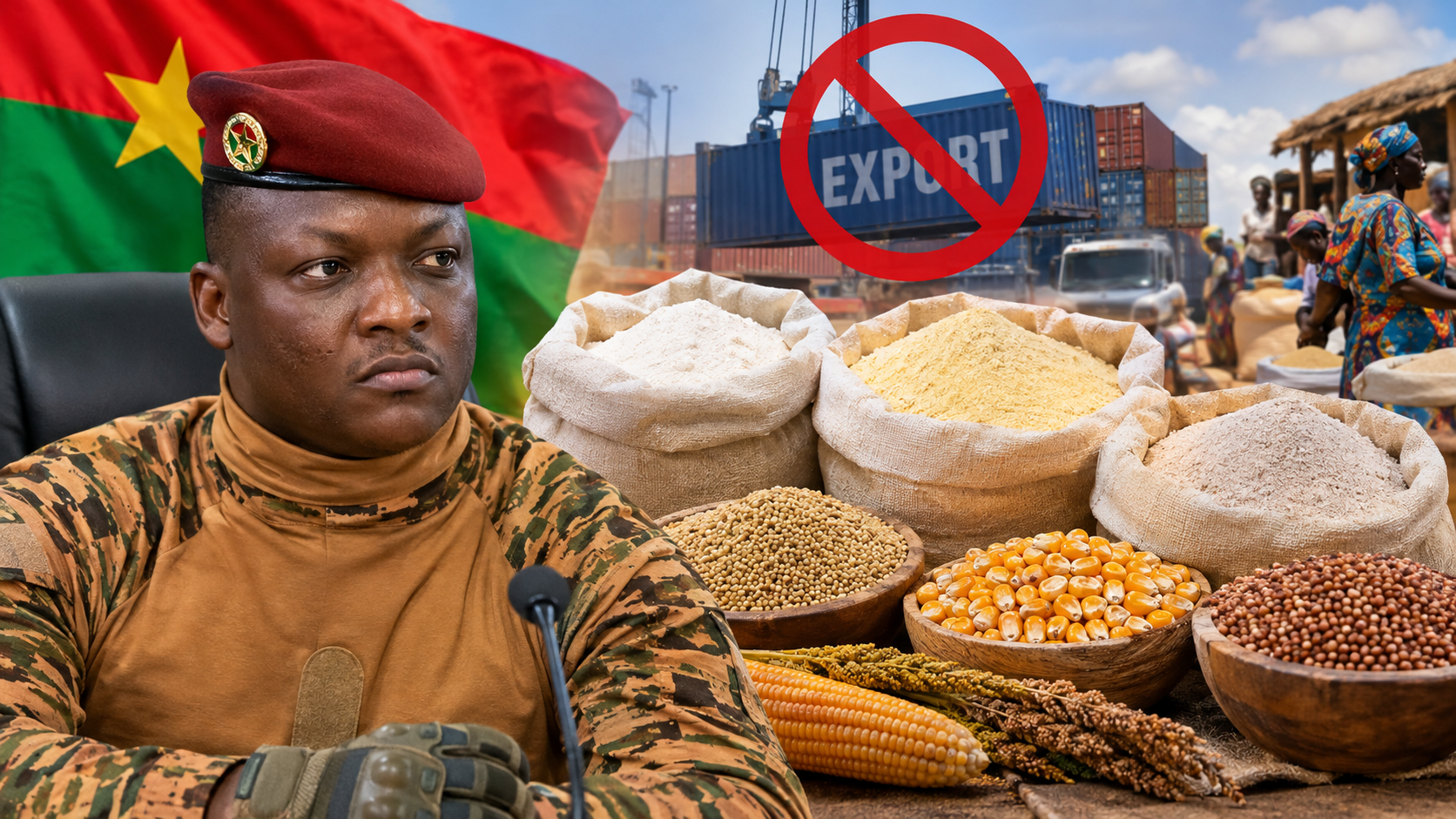

Government halts flour exports in bold policy shift
The Burkinabè government has implemented a sweeping suspension of flour exports, a move that marks a significant turning point in national economic policy. The ban, enforced through a ministerial directive, targets millet, maize, and sorghum flours alongside their derivatives, effectively freezing all previously issued export permits for these staple products.
Balancing food security with economic freedoms
While authorities justify the decision as a safeguard for domestic food security, the policy introduces complex questions about the limits of state intervention in private enterprise. In a nation where food security remains a pressing concern, the measure seeks to ensure adequate supply within local markets. Yet the absence of a transparent public consultation raises critical concerns about the balance between state authority and economic liberty.
Critics argue that blanket export restrictions may not necessarily translate into lower prices or improved access for consumers. The effectiveness of such measures hinges on real-time stock availability, production capacity, and the government’s ability to monitor distribution channels without stifling legitimate trade.
Who bears the cost of protectionism?
The policy’s ripple effects extend beyond urban consumers to the very producers and traders who rely on export markets to sustain their livelihoods. By curtailing these outlets, the government risks undermining the economic resilience of rural communities whose income depends on cross-border commerce.
Moreover, the measure raises broader questions about dietary diversity. While millet, maize, and sorghum flours form dietary staples for many, not all Burkinabè rely exclusively on these grains. Restricting exports could inadvertently limit access to alternative food sources and disrupt long-standing trade relationships.
From food policy to civic freedoms: a growing concern
This latest intervention reflects a broader trend in which state decisions increasingly shape daily life in Burkina Faso. While comparisons to extreme cases of state control may be hyperbolic, the pattern of sweeping, unchallenged policies fuels concerns about the erosion of civic space. Citizens and economic actors alike face a landscape where policy shifts occur with little opportunity for public deliberation or feedback.
The policy’s open-ended nature currently set “until further notice” leaves room for further restrictions, prompting speculation about future targets. Could the next measures extend to digital freedoms, agricultural exports, or other sectors? The uncertainty itself underscores the need for clear, time-bound policies that are subject to regular review and public accountability.
Measuring success beyond rhetoric
For the Burkinabè people, the true test of this policy lies not in its implementation but in its outcomes. Will consumers see tangible benefits through stable prices and consistent supply? Will producers receive fair compensation for their goods? Will traders navigate a predictable regulatory environment?
Protecting consumers demands more than restricting exports. It requires a holistic approach: bolstering purchasing power, supporting local production, and ensuring transparent governance that prioritizes public welfare over short-term fixes. The government’s challenge now is to prove that this bold move delivers on its promises—not just in principle, but in practice.
By Moussa Samuel Coulibaly — Journaliste / Rédacteur