
The Mopti region in central Mali endured a fresh wave of coordinated assaults on the morning of July 19, as the Group for the Support of Islam and Muslims (JNIM) launched simultaneous strikes against government forces and their allies. The al-Qaeda-affiliated faction claimed responsibility for four distinct attacks, exposing the persistent vulnerabilities of the Malian military and its partners amid a worsening security crisis.
An orchestrated campaign of violence in central Mali
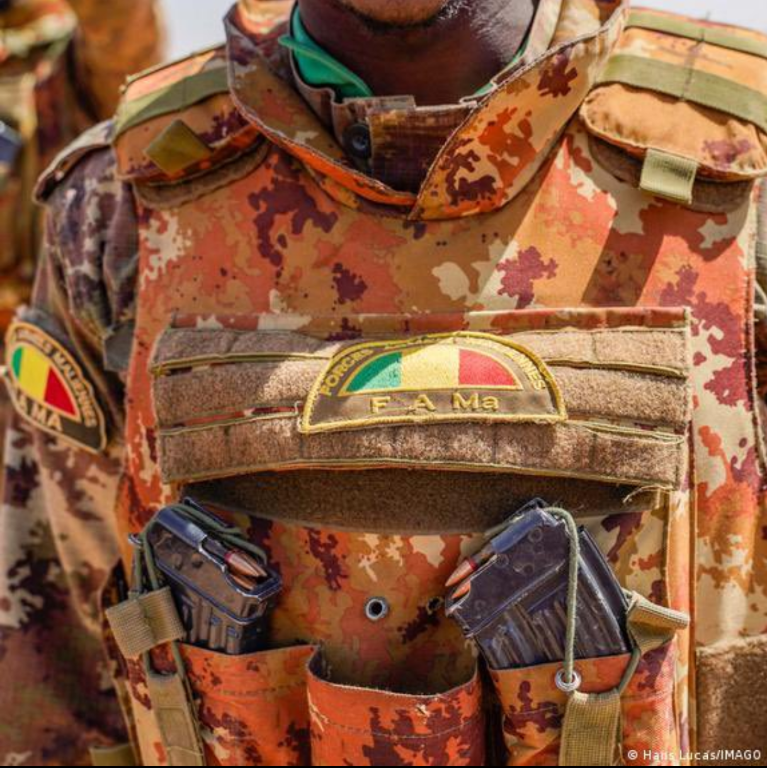
The assaults unfolded in two key locations. In the Douentza district, the JNIM deployed three improvised explosive devices (IEDs) targeting a logistics convoy, a military truck, and a motorcycle detachment carrying government troops and Russian mercenaries from Africa Corps. The group asserted that all strikes were carried out with precision, inflicting casualties on both FAMa soldiers and their foreign allies. Meanwhile, near the village of Kansila, militants launched a direct assault on a local self-defense militia known as the Dozo hunters—a group often deployed by Bamako to bolster security operations. According to the JNIM’s claims, three Dozo fighters were killed in the ambush.
The junta’s unmet promises: five years of unraveling security
When Colonel Assimi Goïta seized power in 2019, his transitional government pledged to restore state authority across the entire national territory. Yet half a decade later, the situation has deteriorated dramatically. Data from conflict tracking initiatives reveals a stark contrast to the junta’s narrative of progress. Fatalities from political violence and terrorist attacks have surged, with some regions experiencing a two- to threefold increase in casualties compared to pre-coup levels. The proliferation of armed actors—including the deployment of Africa Corps and the targeting of specific ethnic communities—has deepened interethnic tensions and inadvertently fueled recruitment for jihadist factions. The frequency of attacks has also intensified, with IEDs and ambushes becoming near-daily occurrences that paralyze critical roadways.
The widening void of state control
Official statements from Bamako frequently highlight tactical victories, such as the recapture of Kidal in late 2023. However, these isolated successes fail to mask a broader reality: vast swathes of the country remain beyond government control. The Mopti region, along with other central and northern zones, has become a lawless expanse where public services have collapsed. The human toll is staggering—United Nations agencies report that over 400,000 Malians have been internally displaced, fleeing both jihadist brutality and the collateral damage of military operations.
Blockades imposed by the JNIM and the Islamic State in the Greater Sahara (EIGS) have triggered acute food shortages in several localities. The inability of state forces to secure vital supply routes has crippled humanitarian aid delivery, turning a security crisis into a hidden humanitarian catastrophe.
Africa Corps: a failed gamble against insurgency
To fill the void left by departing French troops and the UN’s MINUSMA mission, the Malian junta turned to Moscow for support. Initially relying on the Wagner Group, Bamako later transitioned to Africa Corps, a Kremlin-backed paramilitary force directly under the Russian Ministry of Defense. Despite the deployment of hundreds of mercenaries, the results have been underwhelming. Tactically, Africa Corps has struggled to curb the insurgency, suffering frequent losses and lacking the manpower for effective counterinsurgency operations. Strategically, their heavy-handed tactics have drawn widespread condemnation from human rights organizations, particularly following incidents like the Moura massacre. Such actions have alienated local populations, pushing many toward the jihadist factions they are meant to combat.
The aerial strategy’s critical flaws
With ground forces stretched thin, the Malian regime has prioritized air power, acquiring drones and attack helicopters—primarily from Russia and Turkey. While these assets initially enabled large-scale strikes, their limitations are now glaringly apparent. Maintenance issues plague the fleet, with several aircraft lost to technical failures or rebel fire. The scarcity of spare parts, compounded by logistical challenges, has grounded much of the air force. Meanwhile, insurgents have adapted their tactics, dispersing into smaller units, blending into civilian areas, and exploiting terrain to evade airstrikes—rendering aerial campaigns increasingly ineffective and prone to civilian casualties.
The dead end of military-first governance
The July 19 attacks in the Mopti region are not isolated events but symptoms of a systemic failure. The junta’s reliance on a purely military approach has proven unsustainable. By severing dialogue channels, isolating itself from regional and international partners, and entrusting security to Russian mercenaries whose primary focus appears to be resource extraction rather than stabilization, Bamako has cornered itself. Without a holistic strategy that prioritizes governance, the restoration of essential services, and civilian protection, Mali risks further territorial fragmentation under the relentless pressure of an emboldened Sahelian jihadism.