Mali’s air war: 199 drone strikes, 731 civilians dead
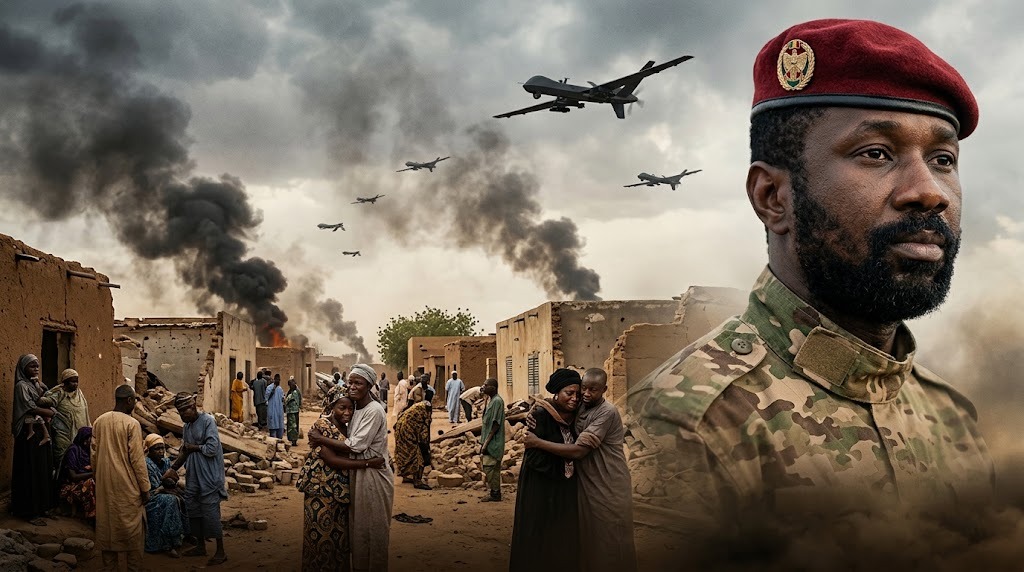
Mali’s aerial campaign has killed 731 civilians in 199 strikes over three years. That is the core finding of a review of strike records covering September 2023 to September 2026, a period in which armed drones and combat aircraft became the backbone of the country’s war against armed groups.
The totals do not establish individual responsibility for every raid, and not all of the dead have been named. They do measure the weight of civilian losses tied to an air war that keeps widening, from the north of the country to its centre.
The numbers behind three years of airstrikes
Between September 2023 and September 2026, records list 199 airstrikes that struck mainly civilians, with 731 civilian deaths. The strikes were carried out with drones and combat aircraft, and the pattern marks a sharp rise compared with earlier years of the conflict.
Those figures should be read for what they are: a measure of scale, not a legal ruling on each operation. Establishing what happened in any single strike still requires evidence on the ground, and that evidence is often hard to collect in areas where villages are isolated and armed groups move among the population.
Twelve strikes rebuilt from debris, images and testimony
Roughly 60 strikes were examined in detail, and 12 of them were reconstructed independently by cross-checking satellite imagery, video, photographs, munition debris, witness accounts and geolocation data. In those twelve cases alone, 146 civilians were killed.
Reconstructing a strike this way takes months. It also exposes how little is publicly known about most operations: the weapons used, the target selected, the intelligence that justified the shot.
Children in the frame when the trigger was pulled
Among the most sensitive elements of the record are witness accounts and material gathered in certain strikes, which raise doubts about what operators knew before firing. One phrase, reported by people close to the events, captures the accusation with brutal clarity: “They saw the children, they still fired.”
What international law requires
If such conduct were confirmed, it would collide with the founding rules of international humanitarian law — above all the distinction between fighters and civilians, and the obligation to take every possible precaution to spare non-combatants.
The question, however, reaches far beyond the person sitting behind a screen. It runs through the entire sequence that ends in a strike: intelligence gathering, target identification, authorisation of the operation, choice of munition and the final order to fire.
A chain of command that resists tracing
Mali’s air war involves several sets of actors: the national armed forces, Russian partners from the Africa Corps and, in the case of Turkish drones, players linked to their acquisition and deployment.
That overlap makes accountability unusually difficult to pin down. Who identifies the target? Who confirms it is military? Who authorises the strike? Who watches the feed at the moment of firing? And when a raid hits civilians, who answers for the victims?
These questions carry extra weight in a conflict where aerial operations are routinely presented as actions against armed groups.
Turkish drones, Russian partners, one crowded air war
In northern and central Mali, the low hum of a drone overhead has become a sound of dread. Over the past several years, the authorities have substantially expanded their air capability, deploying Turkish Bayraktar TB2 and Akinci drones alongside combat aircraft in operations conducted by the Malian Armed Forces (FAMa) and their Russian Africa Corps partners.
On paper, this hardware is meant to strike identified targets from a distance with greater accuracy. In practice, the picture on the ground is far more troubling.
Precision weapons do not fix bad intelligence
The arrival of drones has long been sold as the promise of cleaner warfare. An operator can watch an area remotely, follow a target and pick the moment to strike without putting soldiers directly in the line of fire.
Technology, though, does not erase human error, and it does not guarantee that intelligence is correct. In a region where armed groups move in and out of villages, where settlements sit far from any road and where information is fragmentary, confirming that someone is a fighter can be extremely difficult.
The result is a stark contrast between the sophistication of the weapons and the vulnerability of the people living under them. From the ground, a drone in the sky does not separate a fighter from a herder, a trader or a child.
Distance does not dissolve responsibility
Strike data shows a significant shift in how the war is being fought from the air, with a marked increase in raids that produce civilian casualties. That shift comes as violence against civilians remains a major problem across the Sahel, where armed groups themselves carry out numerous attacks and are building their own drone and explosive capabilities.
For Malian families, the distinctions between technologies and chains of command change nothing about the outcome. When a strike hits a village, lives end.
The real question, then, is not only whether drones are militarily effective. It is what limits must frame their use. As Sahelian armies acquire ever more advanced air power, accountability becomes impossible to defer: a weapon that can hit from kilometres away does not free the person firing it from verifying the target.
In Mali, the hundreds of deaths recorded in the data carry the same reminder. The distance between the hand on the button and the person who dies may be enormous. Responsibility does not shrink to match it.