Mali’s new presidential jet sparks controversy amid ongoing security crisis
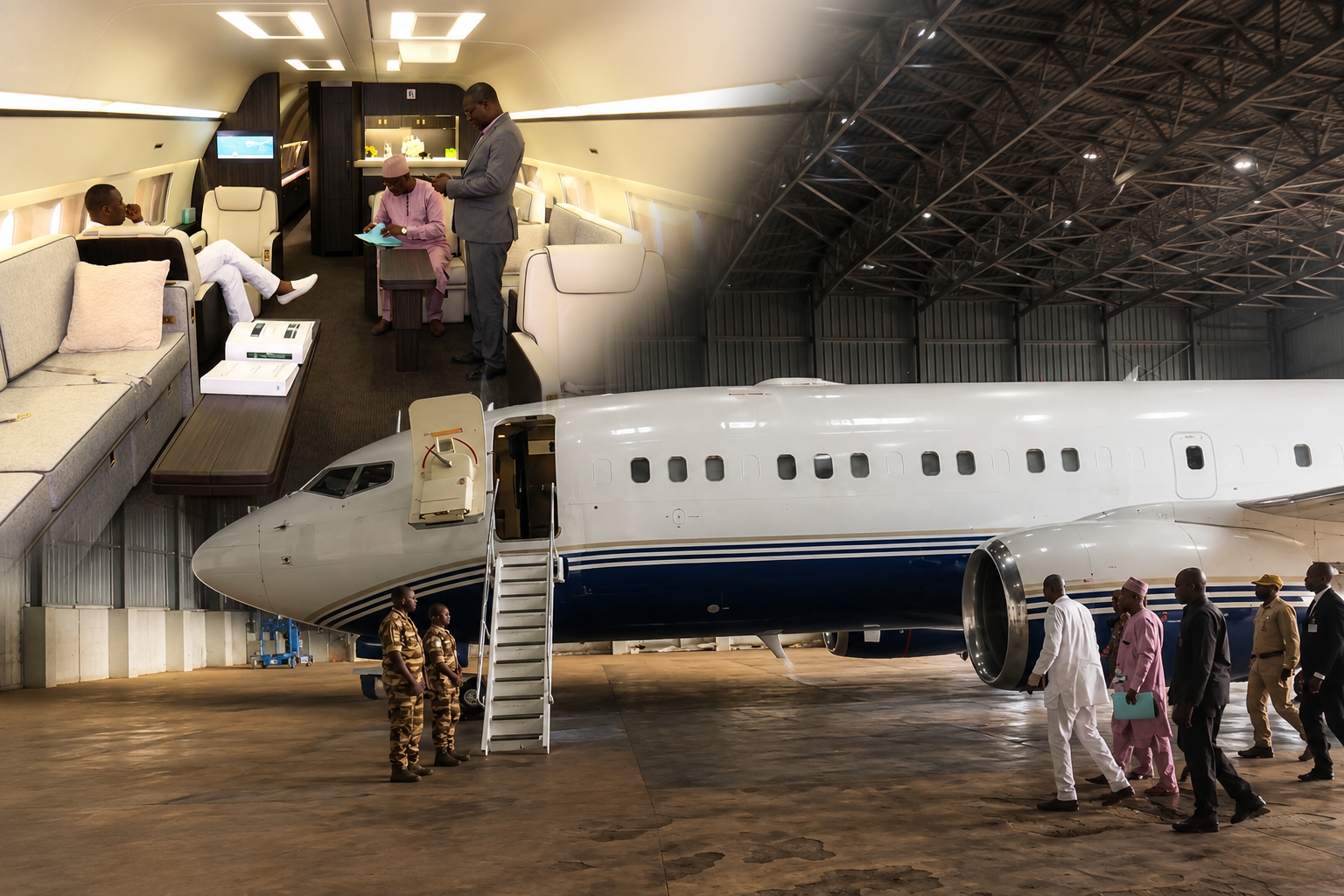
The unveiling of Mali’s new presidential aircraft amid heightened insecurity
On Wednesday evening, viewers of the national broadcaster ORTM were presented with the unveiling of a new Boeing 737 assigned for the official travels of Colonel Assimi Goïta and other high-ranking officials. The government justified the acquisition by highlighting its financial prudence, asserting that the gross expenditure of 15.6 billion CFA francs would be reduced to approximately 6 billion through insurance compensation and the resale of components from the previous aircraft.
A stark contrast with ground realities
The timing of this announcement has drawn significant scrutiny. While authorities repeatedly urge citizens to embrace sacrifice, resilience, and national unity, the introduction of a state-of-the-art presidential jet has fueled perceptions of a leadership more concerned with projecting prestige than addressing the pressing needs of the populace.
Across multiple regions, insecurity remains a daily reality. Military outposts continue to face attacks, roadside ambushes persist, and civilians endure targeted violence. Numerous localities remain inaccessible, and the state struggles to re-establish its authority in vast areas of the country.
Unaddressed security challenges persist
Three years after territorial restoration was declared a national priority, the Transition government still grapples with formidable security challenges.
In northern Mali, the Permanent Strategic Framework and its affiliated groups, including the Front de Libération de l’Azawad (FLA), maintain significant operational capacity and contest control over key zones. Meanwhile, in central and southern regions, the Jama’at Nusrat al-Islam wal Muslimin (JNIM) continues its incremental expansion, launching repeated attacks against military forces, state infrastructure, and administrative personnel. Several major roadways remain hazardous, disrupting trade, transportation, and economic activities.
This stark reality starkly contrasts with the image of strength the regime seeks to project.
Questioning budgetary allocations
Despite official claims of cost efficiency, critics argue that the funds allocated for this acquisition could have been redirected toward more pressing priorities, including:
- Enhancing the operational capabilities of the Malian Armed Forces;
- Procuring armored vehicles, communication systems, and protective equipment;
- Bolstering intelligence gathering and aerial surveillance capabilities;
- Providing medical and financial support to wounded soldiers and the families of fallen servicemen;
- Supporting internally displaced persons and funding the reconstruction of damaged infrastructure.
Beyond financial figures, the debate centers on the fundamental question of governance priorities.
Undermining a narrative of austerity
Since assuming power, the Transition authorities have cultivated their legitimacy on a platform of discontinuity with past regimes, vowing a governance model characterized by sobriety, patriotism, and national focus. However, the acquisition of a high-capacity presidential aircraft has cast doubt on this message. To many citizens, it signifies a return to the politics of prestige and centralized power—values that stand in stark opposition to the sacrifices demanded of the population.
The contrast is further underscored by persistent economic hardships: rising living costs, strained public finances, unmet social needs, and sluggish economic performance.
Diplomatic utility versus domestic credibility
The government contends that a modern presidential jet facilitates diplomatic engagements, official missions, and international representation. Yet this rationale struggles to resonate with those who argue that a nation’s credibility on the global stage is rooted not in the quality of its presidential fleet but in its ability to secure its territory, protect its citizens, and restore functional governance.
For many, sovereignty is not measured by the modernity of an aircraft but by the state’s capacity to exercise effective control over its land.
A symbol fueling political dissent
In opposition circles and critical public discourse, the acquisition has taken on deeper political significance. Some interpret it as evidence of a leadership prioritizing its own mobility over that of the state. Others speculate that a long-range, readily available aircraft serves as a safeguard for senior officials in the event of further deterioration in the security situation—though such claims remain unverified.
Regardless of the validity of these interpretations, they reflect a growing climate of distrust toward the government’s strategic decisions.
Reassessing governance in times of crisis
The introduction of the new Boeing 737 transcends a mere procurement decision—it has reignited a broader debate on the Transition’s governance priorities. As security threats persist, attacks continue unabated, and economic hardships deepen, every expenditure perceived as symbolic is subjected to heightened scrutiny.
For a significant segment of the Malian population, true sovereignty lies not in the modernization of the presidential fleet but in the state’s capacity to safeguard its citizens, reclaim its territorial integrity, and improve living conditions. Until these core objectives are met, investments in prestige risk being seen as a widening gap between the priorities of power and the aspirations of the people.