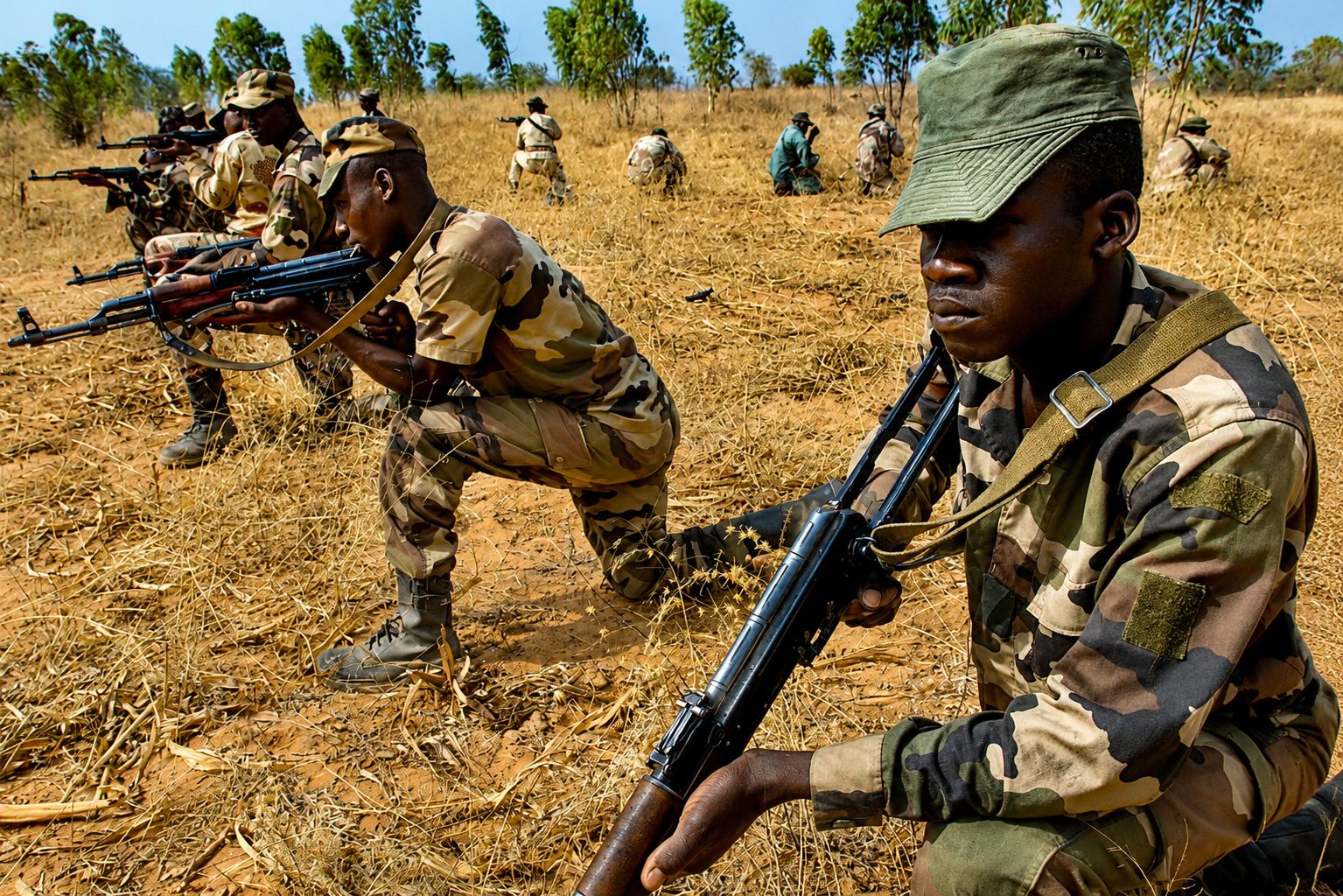

A recent ambush tragically targeted a detachment of Niger’s Defense and Security Forces (FDS) on Friday, July 17, 2026, in the Tillabéri region. The Ministry of National Defense confirmed the significant toll, reporting that sixteen soldiers lost their lives and twenty-three others sustained injuries. Among the wounded, nine required urgent medical evacuation to the Army’s Hospital Center.
This major incident unfolded in the Téra department, part of the broader Tillabéri region, an area notoriously known as the “three borders” zone. The FDS detachment, engaged in an administrative liaison mission, encountered what military authorities described as a “complex attack.” This assault involved the detonation of improvised explosive devices (IEDs) followed by sustained heavy gunfire from armed groups. The confrontation occurred on the road connecting Bankilaré to Téra, in the vicinity of Doungouro village.
In a determined response, the Nigerien army engaged the assailants, neutralizing fifteen of them. Forces also managed to destroy or recover approximately ten motorcycles, along with various pieces of light military equipment. Following the engagement, immediate aerial and ground sweep operations were initiated across the zone, aiming to track down and apprehend any remaining fleeing attackers.
The porous borders: a persistent security vulnerability in the three borders zone
The devastating ambush near Téra starkly underscores the persistent challenge posed by the extreme porosity of the “three borders” zone, which fuels the recurrence of terrorist attacks in Niger. In this vast territory where the geographical lines separating Niger, Mali, and Burkina Faso often exist merely in theory, armed factions like the Islamic State in the Greater Sahara (EIGS) or Jama’at Nusrat al-Islam wal Muslimeen (JNIM) exploit these fluid boundaries. They operate with a “communicating vessels” strategy, leveraging territorial discontinuities to evade military pressure from one state by seamlessly retreating into a neighboring country. This unhindered cross-border movement, combined with immense, difficult-to-monitor bush areas, provides a continuous logistical sanctuary for these terrorist groups.
Until the security response transcends political compartmentalization and embraces comprehensive transnational technical cooperation, the effective control of this crucial strategic nexus will remain elusive for the armies of the Alliance of Sahel States (AES).