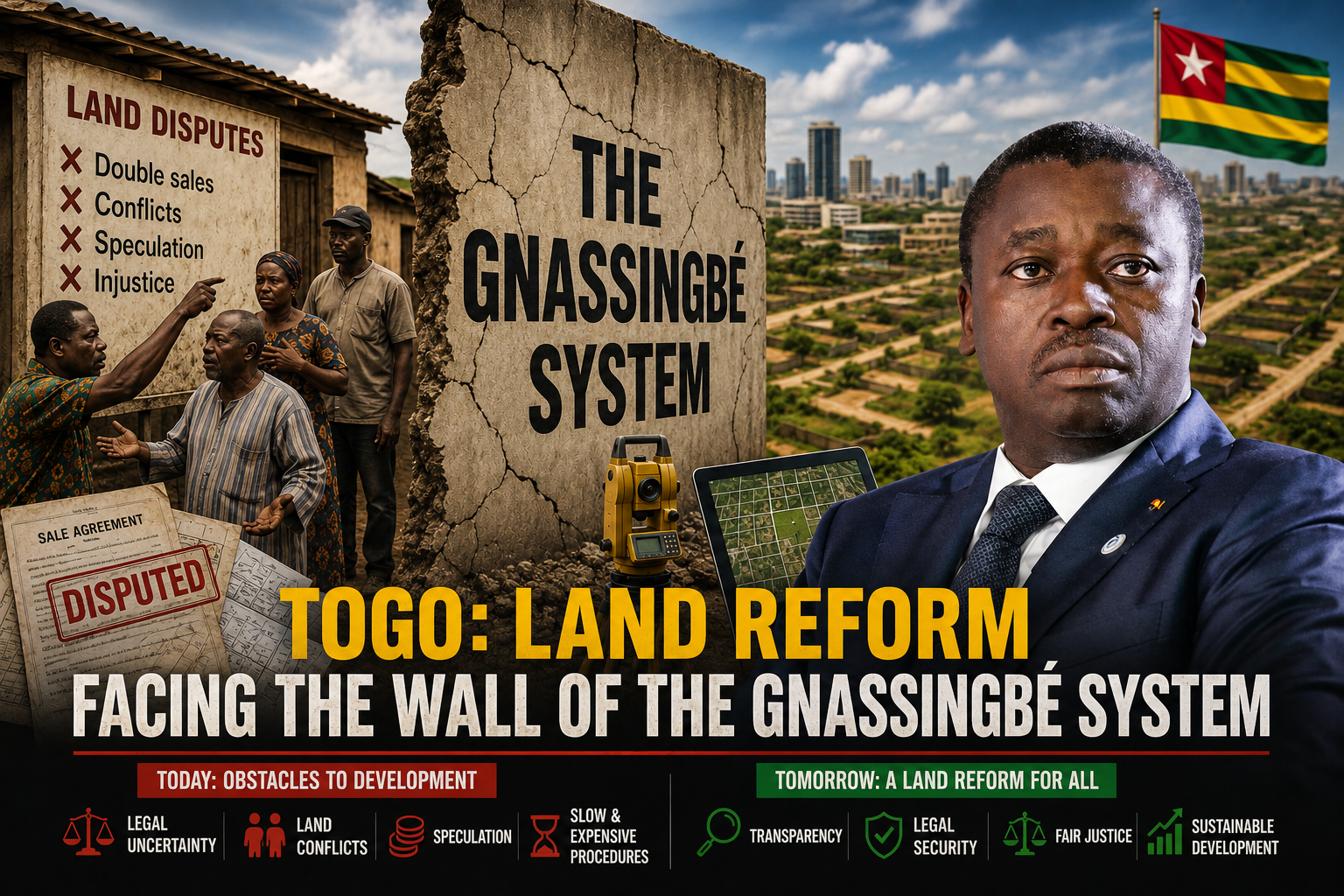

After more than sixty years characterized by often inconsistent land administration, the Togolese government now expresses a renewed aspiration: to transform the land sector into a vital engine for economic advancement. While this commitment appears compelling in theory, it immediately confronts a starker reality on the ground. Many observers caution that this initiative risks joining a long list of reforms announced but never fully realized, primarily because fundamental structural deficiencies remain unaddressed.
The core issue: pervasive disputes
At the heart of the problem lies a pervasive challenge familiar to Togolese citizens: the proliferation of land disputes. These conflicts are frequently fueled by practices such as double sales, contested ownership claims, inadequate record-keeping, and the inherent opacity of certain transactions. How can a sustainable development strategy be forged when private property rights are perpetually undermined by legal uncertainty? A mere title deed or sales agreement often proves insufficient to guarantee peace of mind for an acquirer when the same parcel of land is subject to competing claims. This persistent ambiguity deters investment, erodes household savings, and can tragically transform land acquisition into a financial quagmire.
Administrative hurdles and lack of transparency
Adding to these complexities is the protracted nature of administrative procedures. Both individuals and corporations frequently encounter land-related processes that are excessively lengthy, costly, and difficult to comprehend. When access to land information remains restricted and procedural transparency is lacking, those with influential connections, substantial financial resources, or a superior understanding of the system inevitably gain an unfair advantage. Consequently, any reform should not merely aim to generate a greater volume of land titles; it must, more critically, ensure that every citizen can ascertain a parcel’s complete history before committing to a purchase.
The imperative for judicial integrity
The judicial system also grapples with significant challenges. A land dispute that drags on for years transcends a mere administrative inconvenience; it can devastate families, impede inheritances, render land unproductive, and obstruct the realization of crucial economic projects. Judicial rulings must be executed swiftly and impartially, ensuring that the social, political, or financial stature of the parties involved cannot sway the outcome. Without an accessible, independent, and adequately resourced land justice system, administrative reforms alone will fail to yield lasting results.
Political entanglements and conflicts of interest
Beyond the technical assessments, it is the political dimension that further complicates the entire equation. On the ground, the land system involves a diverse array of stakeholders: customary owners, families, intermediaries, surveyors, administrative bodies, local authorities, and community leaders. When certain actors within this intricate web maintain close ties with dominant political or economic networks, the potential for conflicts of interest and favoritism becomes particularly alarming. A credible reform must precisely aim to dismantle these grey areas rather than inadvertently perpetuate them in new guises.
Addressing land speculation
The issue of speculation also warrants serious consideration. In urban and peri-urban areas where land values are appreciating rapidly, real estate pressures can exacerbate land grabbing, multiple sales, and manipulative practices surrounding parcels. Vulnerable populations frequently become the primary victims of a market they struggle to navigate. Land, in such contexts, ceases to be a transmissible heritage and progressively transforms into a speculative commodity reserved for those possessing significant capital.
The social fabric of land disputes
There is also a frequently underestimated social dimension: land conflicts sometimes pit members of the same family against each other, or neighboring communities, or even multiple generations over a shared inheritance. As long as the safeguarding of customary rights and their integration with modern law remain imperfect, these tensions will continue to resurface. A meaningful reform must therefore more comprehensively integrate mediation, conflict prevention, and public awareness campaigns regarding legal procedures.
Digitization: a tool, not a panacea
While digitization offers a potential component of the solution, it must not devolve into a mere administrative catchphrase. A reliable, accessible, and regularly updated land database could significantly mitigate the risks of double sales and streamline verification processes before any transaction. However, a digital system alone cannot rectify fraudulent practices if the underlying data is incomplete, susceptible to manipulation, or unequally accessible.
Transparency in land governance
Transparency must equally extend to the actors entrusted with land management. Who allocates parcels? Based on what criteria? Who oversees transactions? How are irregularities penalized? What guarantees exist for citizens challenging an administrative decision? As long as these critical questions remain inadequately addressed, public distrust will persist, and each new reform will be met with skepticism.
The broader economic imperative
Finally, the economic stakes must be fully appreciated. A secure land tenure system empowers individuals to invest, enables businesses to construct, allows banks to more accurately assess collateral, and permits the state to effectively plan territorial development. Conversely, land insecurity immobilizes capital, stifles projects, and fosters an economy built on mistrust. The problem thus extends far beyond individual property owners; it directly impacts the nation’s capacity to attract and secure investments.
Therefore, the fundamental question is not whether Togo can enact another land reform, but whether it is prepared to embrace the political, administrative, and judicial ramifications of a truly stringent transformation. A serious reform would necessitate greater transparency, effective sanctions against fraudulent activities, a more expeditious justice system, enhanced oversight of the administration, and strengthened protection for the most vulnerable citizens.
Without a genuine political resolve to dismantle complicit networks, reinforce the rule of law, and sustainably purify land justice, any new legislation or reform commission risks being nothing more than a superficial cosmetic change. As long as the protection of private or partisan interests takes precedence over transparency and equality before the law, land will remain a source of conflict instead of becoming the promised economic engine.