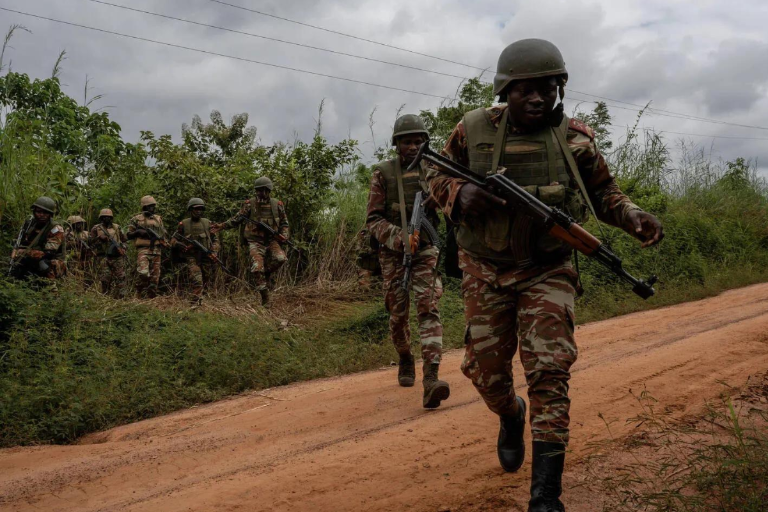

The growing military collaboration between Benin and Germany is not just about rifles and helmets—it’s a calculated move to reshape security dynamics in West Africa’s most vulnerable flank. As terrorist incursions edge closer to Benin’s northern borders, Berlin is recalibrating its approach from tactical aid to long-term strategic partnership with Cotonou. This evolution underscores a broader German ambition: to anchor itself in the Gulf of Guinea as a stabilizing force, while aligning its efforts with European security frameworks.
From equipment drops to embedded partnerships
Germany’s recent military assistance to Benin transcends traditional aid. In 2026 alone, Berlin delivered over 550 helmets and 1,266 mobile breathing units, but the scope extends far beyond hardware. Earlier in the year, high-value military gear including night vision and personal protective equipment valued at approximately three million euros was also transferred. Yet these deliveries represent just one facet of a deeper engagement.
Military engineering support stands out as a cornerstone of this shift. A September 2026 proposal unveiled plans to equip and train Benin’s military engineering corps with advanced logistics and specialized technical training—an initiative aimed at fortifying national defense capabilities from within.
High-level dialogue signals shift in political posture
The most telling development came from Germany’s ambassador to Benin, Stefan Buchwald, during a late-2026 briefing. He disclosed plans for high-level joint staff consultations between Berlin and Cotonou, signaling a transition from transactional military cooperation to structured strategic alignment. Even more revealing was his mention of a forthcoming bilateral agreement—details yet undisclosed—hinting at formalized defense collaboration.
This diplomatic pivot is built on decades of foundational work. Over the past 40 years, more than 350 Beninese military personnel have received training in Germany, creating a reliable network of expertise. Today, that legacy is being leveraged to forge a partnership with deeper institutional and operational integration.
Expert deployment: a new phase of technical cooperation
Looking ahead to late 2027, Benin may welcome six to eight German military experts on its soil—not as combatants, but as advisors and technical specialists. Their role would focus on enhancing operational readiness, providing niche training, and facilitating knowledge transfer, particularly in counter-terrorism logistics and intelligence support.
This tentative deployment reflects Germany’s strategic intent: to embed expertise across critical defense functions without overt military presence. It also signals a willingness to test new models of bilateral engagement in unstable regions—a shift away from largescale interventions toward precision partnership.
Why the Sahel crisis is reshaping Benin’s defense strategy
The motivation behind this deepening alliance is rooted in a stark reality: Benin’s northern regions—especially Atacora and Alibori—are under increasing pressure from armed groups operating across porous borders with Burkina Faso and Niger. The threat is no longer hypothetical. Cross-border attacks and infiltration have intensified, forcing Cotonou to build a defense architecture capable of rapid response and sustained resilience.
Germany’s involvement is designed to complement this national effort. Through targeted assistance in intelligence sharing, mobility enhancement, and logistics, Berlin aims to help Benin build a self-reliant defense posture—one that can preempt threats before they escalate into full-blown crises.
Europe’s role in amplifying German-Beninese cooperation
Germany is not acting alone. Its bilateral efforts are embedded within broader European security initiatives. The European Peace Facility has already earmarked 35 million euros for Benin’s armed forces, with deployments coordinated under the EU’s Gulf of Guinea Security and Defense Initiative—a framework including Benin, Togo, Ghana, and Côte d’Ivoire.
This layered approach allows Berlin to amplify its impact by leveraging EU funding and aligning its bilateral programs with regional strategies. The result: a more coherent and financially robust security architecture in West Africa’s coastal belt.
What comes next? The risks and rewards of a deeper bond
For Benin, the gamble is clear: it must translate diplomatic momentum into tangible military capacity. Can Cotonou operationalize German training, adapt to new logistics systems, and integrate foreign expertise without compromising sovereignty? The challenge is immense.
For Germany, the stakes are equally high. By deepening its defense ties with Benin, Berlin is staking a claim in a region where instability in the Sahel directly threatens European interests. But success hinges on more than goodwill. It requires sustained investment, clear frameworks, and a willingness to adapt to local realities.
The upcoming bilateral agreement could set the tone for the next decade of military cooperation. Until its contents are revealed, one thing remains certain: Germany is no longer just an occasional donor to Benin—it is becoming a permanent fixture in the country’s security landscape.