
Why GEX 2026 matters more than just a military drill
When Paris invited Côte d’Ivoire and Gabon to join France in a multinational military exercise of unprecedented scale, it wasn’t merely about showcasing firepower. Behind the public maneuvers lies a deliberate reconfiguration of military cooperation between France and West Africa, centered on the Gulf of Guinea. Scheduled for November 2026 and split into two distinct phases, GEX 2026 signals a new era of security partnership—one that prioritizes adaptability, interoperability, and shared operational readiness across national borders.
Phase one in Côte d’Ivoire: FANGHA 2026
The exercise kicks off in Côte d’Ivoire from November 7 to 14, mobilizing over 1,180 Ivorian troops alongside French and Gabonese forces. The focus here is on deepening coordination between ground, air, and naval units under a unified command. Commanders will test real-time tactical communications, joint planning protocols, and rapid deployment scenarios designed to counter evolving threats in the Gulf of Guinea.
Phase two in Gabon: WAIYA 2026
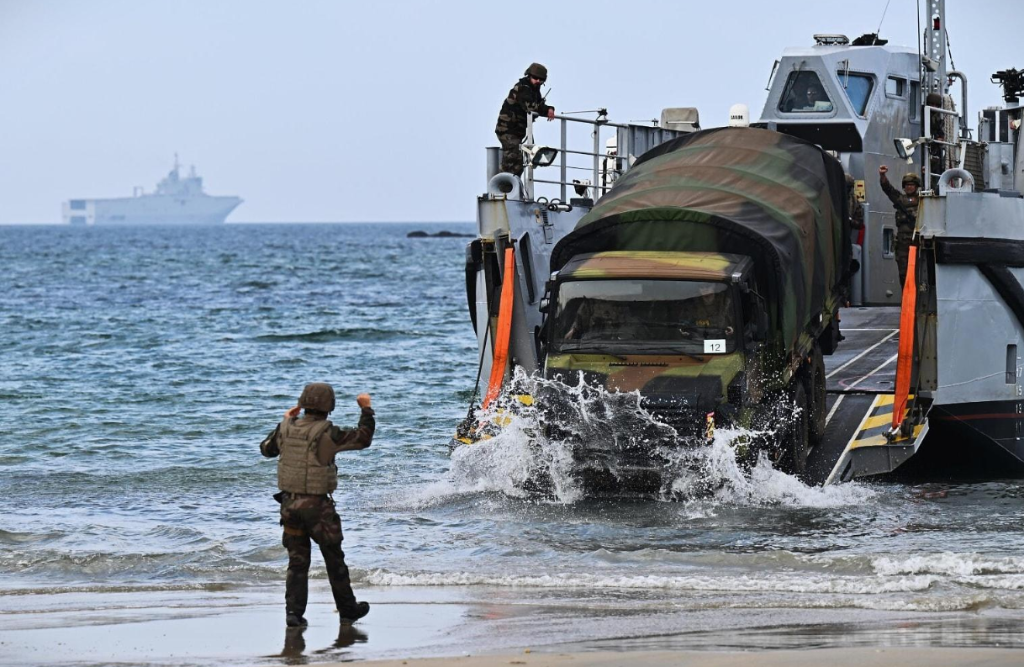
From November 24 to 29, the drill shifts to Gabon, where focus expands to amphibious operations, maritime interdiction, and long-range air support. France is deploying assets such as the Mistral amphibious assault ship and Mirage 2000 fighter jets to simulate combined arms operations across land, sea, and air domains. Gabon’s strategic location along the Atlantic coast makes it a critical node in efforts to secure regional maritime corridors against piracy, illicit trafficking, and transnational crime.
Interoperability: the missing link in Africa’s security architecture
The core of GEX 2026 is interoperability—achieving seamless coordination between different national militaries. Historically, African and European forces have struggled to synchronize operations due to divergent doctrines, equipment discrepancies, and command structures. GEX 2026 addresses this gap by enforcing standardized procedures, joint training cycles, and shared communication platforms. Participating observers—Bénin, Guinée, Liberia, and Sénégal—are invited not only to watch but to integrate into planning cells, laying groundwork for future joint exercises.
Why the Gulf of Guinea is the center of gravity
The Gulf of Guinea is more than a body of water—it’s the economic lifeline of West Africa. Home to major oil reserves, bustling ports like Abidjan and Libreville, and vital shipping lanes, its stability is non-negotiable. Yet, the region faces escalating risks: rising piracy, fuel and arms smuggling, and the spillover of violence from the Sahel. Côte d’Ivoire and Gabon, once considered stable, now find themselves on the front line of these transnational threats. GEX 2026 offers both countries a chance to harden defenses and build a joint response framework with France.
The quiet evolution of French military presence in Africa
GEX 2026 arrives at a pivotal moment in France’s African strategy. The withdrawal from Mali, Burkina Faso, and Niger, coupled with the handover of Port-Bouët base to Côte d’Ivoire in 2025, marks a definitive shift from permanent garrisoning to flexible, mission-based partnerships. Instead of large fixed bases, Paris is now investing in training, intelligence sharing, and rapid reaction capabilities. GEX 2026 exemplifies this model—deploying advanced assets on short notice while reinforcing defense ties without imposing lasting infrastructure.
A shift from influence to capability building
This is not about maintaining influence through military presence. Both Côte d’Ivoire and Gabon are asserting their strategic autonomy. They seek to diversify partnerships, enhance indigenous planning capacity, and reduce reliance on external support. For France, the benefit is clear: access to regional bases on favorable terms and a durable platform for security cooperation. But the real victory will be measured by whether these partnerships evolve into sustainable, self-driven mechanisms.
Can GEX 2026 spark a regional security renaissance?
The exercise’s regional dimension—with observers poised to become future participants—hints at something larger: the potential emergence of a new security architecture in West Africa. If successful, GEX 2026 could set a precedent for broader cooperation, including joint maritime patrols, intelligence fusion centers, and pooled logistics. Yet, challenges loom. Will participating states sustain the momentum? Can they fund and staff enduring structures beyond the drill? Above all, will African armies develop the capacity to lead operations without constant foreign oversight?
The role of observer nations: seeds of a wider alliance?
Countries like Bénin, Guinée, Liberia, and Sénégal are not passive spectators. Their involvement suggests a growing recognition: security threats do not respect borders. By observing and engaging in planning sessions, they are positioning themselves to adopt GEX 2026’s frameworks and demand inclusion in future iterations. This incremental approach may prove more durable than top-down alliances.
The long view: autonomy vs. partnership
GEX 2026 is more than a rehearsal—it’s a statement. For France, it reaffirms commitment to a forward-looking partnership model. For Côte d’Ivoire and Gabon, it’s a step toward strategic sovereignty. The real test lies not in the drills themselves, but in what comes after. Will the momentum translate into shared intelligence networks? Will training programs evolve into permanent academies? And most critically—will African forces assume full ownership of their security?
The answers will shape not just West Africa’s defense landscape, but the future of military cooperation on the continent.