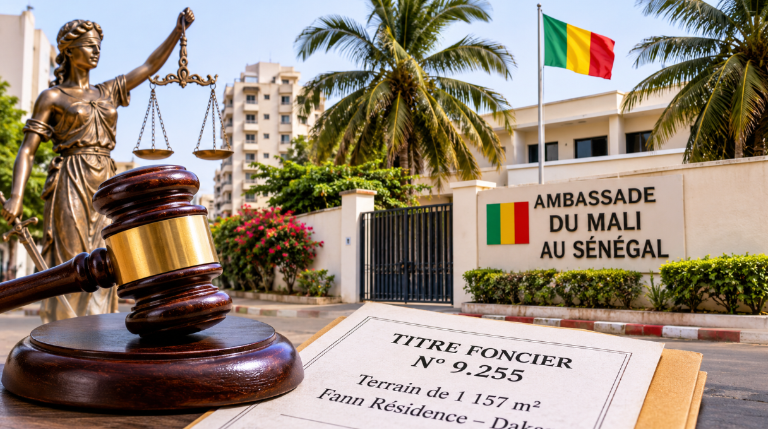

The recent court ruling in Dakar has sent shockwaves through diplomatic and legal circles after a Senegalese court ordered the eviction of Mali’s embassy from a disputed 1,157 m² plot in the upscale Fann Résidence neighborhood. But what lies beneath this legal face-off, and why does it matter beyond the immediate property dispute?
Behind the legal battle: a property dispute rooted in conflicting claims
The case stems from a fierce competition over a prime parcel of land in Dakar’s Fann Résidence, where Mali’s embassy has maintained a presence for years. According to court filings, Immoland SARL, a Senegalese real estate developer, claims legal ownership of the property based on land title n° 9.255. The company argues that the diplomatic mission has been occupying the land without valid title, sparking a high-stakes legal confrontation.
When the Senegalese judiciary examined the evidence, it found Immoland SARL’s claim more compelling. The court concluded that the embassy’s occupation of the land was “without legal basis,” providing the foundation for the eviction order. The ruling doesn’t just target the embassy—it encompasses all occupants and movable property connected to the mission on the disputed site.
From legal ruling to practical eviction: what happens next?
While the court has ruled in favor of Immoland SARL, translating a legal decision into reality is a separate challenge. The embassy has not yet vacated the premises, and details about how or when the eviction might be enforced remain unclear. For now, the embassy continues to operate from the site, leaving observers to wonder: what factors could delay or accelerate the physical removal?
This uncertainty raises practical questions. How will the eviction process unfold? Will authorities intervene to facilitate the transition, or will the embassy face legal repercussions if it resists? Until concrete steps are taken, the legal victory for Immoland SARL remains, in many ways, symbolic rather than immediately transformative.
Diplomatic immunity vs. property rights: navigating a delicate balance
This case is not just about land ownership—it’s about the intersection of property law and international diplomacy. Under the Vienna Convention on Diplomatic Relations (1961), foreign embassies enjoy protections, including inviolability of mission premises. However, these protections do not grant automatic ownership rights. A mission can be legally required to vacate property when the land title disputes arise and are resolved through the host country’s courts.
For Senegal, a nation that has long grappled with urban land disputes, this case underscores the need for clear legal boundaries. The ruling signals that no entity—diplomatic or otherwise—is above the law when it comes to property rights. For Mali, the decision forces a reckoning: how can its embassy secure legal occupancy rights in a foreign jurisdiction when faced with a determined claimant?
The bigger picture: Senegal’s urban land conflicts and their ripple effects
>Dakar’s real estate market, like many African capitals, is a hotspot for land disputes fueled by rapid urbanization and speculative development. The stakes in such cases are high—commercial projects can stall, communities can be uprooted, and international relations can fray. This particular dispute, involving a sovereign nation’s embassy, amplifies those risks by introducing diplomatic sensitivities into a legal and economic quagmire.
Yet, this case may also serve as a precedent. It demonstrates that Senegalese courts will enforce property rights even when the occupant is a foreign diplomatic mission. As urban pressure grows, more investors and developers could turn to the courts to resolve land conflicts, knowing that legal recourse is a viable option. But with that comes the challenge of ensuring fair process—especially when sovereign interests are involved.
What’s missing: unresolved questions and potential fallout
>Despite the court’s ruling, critical questions remain unanswered. Has the Malian embassy filed an appeal, or does it intend to challenge the decision? What procedural mechanisms will the Senegalese government use to enforce the eviction? And how might this dispute impact bilateral relations between Dakar and Bamako?
Until these issues are addressed, the case remains a looming question mark—one that could redefine how land disputes involving diplomatic missions are handled in Senegal. For now, the legal verdict stands, but its real-world implications are still unfolding.