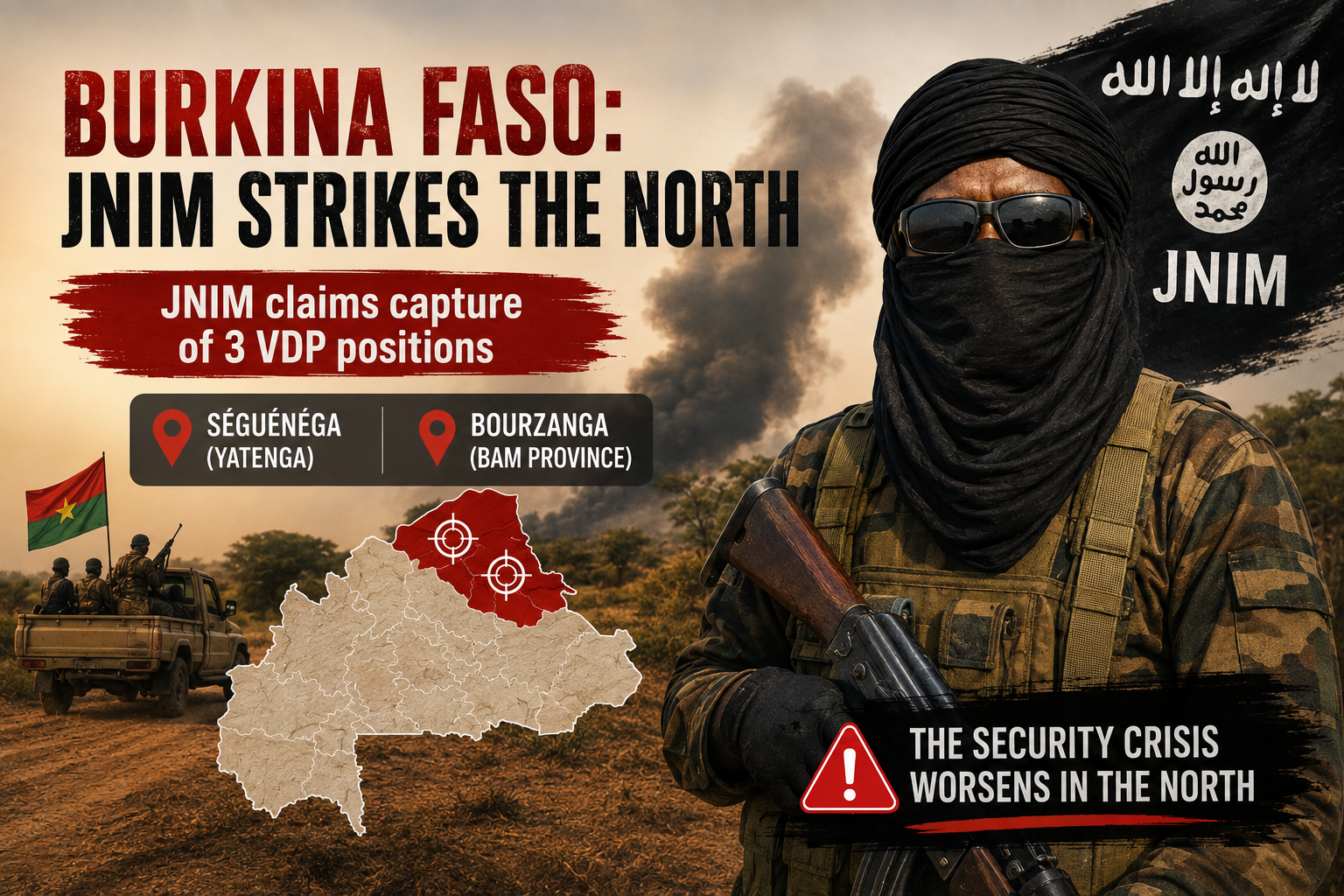

Burkina Faso continues to face a deepening security emergency, prompting heightened scrutiny of the government’s communication policies. On August 19, the Jama’at Nusrat al-Islam wal Muslimeen (JNIM) jihadist organisation seized three strategic positions previously held by the Volunteers for the Defense of the Homeland (VDP) in the northern part of the country. These attacks, executed with extreme brutality, targeted Séguénéga in Yatenga province and Bourzanga in Bam province, marking another significant territorial advancement for armed factions engaged in the conflict.
The recent offensive underscores persistent concerns regarding the ability of security forces to maintain stable control over recovered or vulnerable zones. The escalating violence, sustained pressure on civilian communities, and recurring vulnerabilities of certain outposts demonstrate that military reconquest cannot succeed in isolation. A holistic approach combining robust intelligence, adequate logistical frameworks, genuine civilian protection, and sustained state presence remains indispensable to counter insurgent expansion.
The strategic role of the VDP and its vulnerabilities
The VDP, integrated as a key element of Burkina Faso’s security architecture, often serves as the first line of defense against highly mobile and heavily armed militant groups. Each territorial loss not only signifies a military setback but also undermines public confidence, accelerates civilian displacement, and restricts humanitarian access to besieged regions.
Government response under scrutiny
In response to this growing instability, transitional leader Captain Ibrahim Traoré has faced criticism for his communication strategy. Rather than addressing systemic security shortcomings through substantive dialogue, the administration has resorted to sporadic, disjointed public appearances. These communications, largely rhetorical and populist in tone, appear designed to deflect attention rather than present coherent solutions, further alienating a populace already struggling with daily threats to their safety.
In times of crisis, symbolic rhetoric cannot substitute for tangible results. While appeals to national sovereignty, resilience, or shifting alliances may garner short-term public support, they offer no protection for villages, no reassurance for displaced families, and no deterrence against attacks on military or civilian installations. Citizens require action, not statements.
Beyond rhetoric: real accountability in security strategy
The essence of effective governance lies not in the elegance of political speeches but in measurable improvements to public safety. When villages remain exposed, populations are displaced, or military outposts fall despite allocated resources, the failures transcend mere communication gaps. They reflect deeper deficiencies in strategy, execution, and accountability.
Erosion of press freedom and its consequences
Independent journalism in Burkina Faso has come under severe pressure. Media professionals who attempt to investigate or report on critical developments face harassment, detention, or conscription under coercive measures disguised as patriotic duty. This suppression of dissenting voices creates a dangerous information void, particularly in a conflict zone where accurate, timely reporting is essential for strategic evaluation and crisis response.
The absence of reliable, independent journalism distorts reality rather than resolves it. Instead of advancing resilience, such measures deepen the divide between official narratives and the harsh realities experienced by affected communities throughout the Sahel.
The peril of self-deception in crisis management
By tightening control over the national narrative, authorities may attempt to shape public perception, but not the underlying crisis. Violent attacks, mass displacements, and civilian casualties persist as undeniable realities that cannot be obscured by institutional messaging.
An effective security strategy demands transparency, accountability, and openness to criticism. Acknowledging setbacks, understanding their root causes, and adapting accordingly are not signs of weakness but prerequisites for long-term success. Rejecting scrutiny may provide temporary political comfort, but it deprives decision-makers of essential insights needed to refine and strengthen their approach.
Ultimately, the true benchmark of success in combating terrorism is the safety and stability of the population. So long as insurgent groups continue to exert pressure, expand their influence, or inflict damage, the government must remain answerable for the outcomes of its strategy. Communication can influence public sentiment; it cannot, in itself, defeat terrorism.