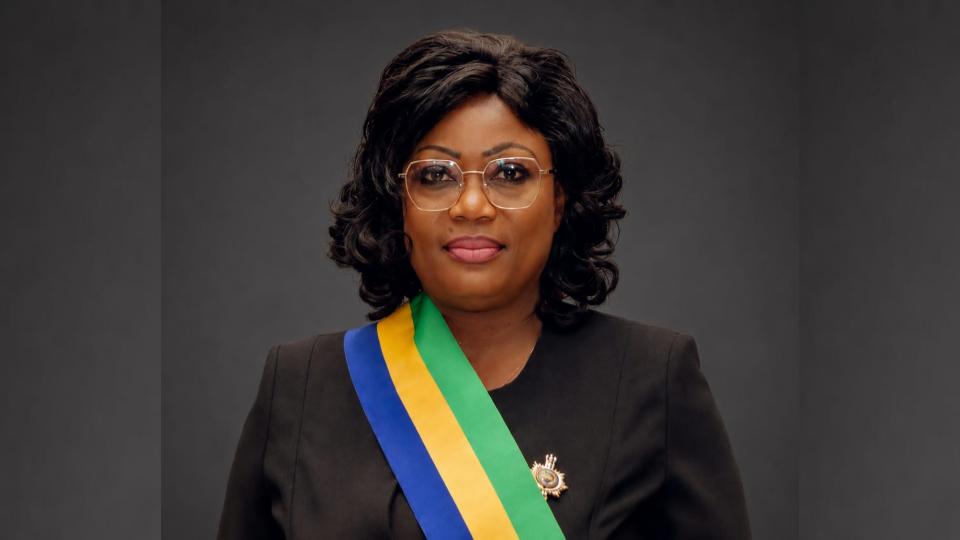

Gabon is witnessing a fierce political debate after controversial remarks attributed to activist Landry Mbeng, widely known online as “Lanlaire”, sparked outrage for attacking the family of President Brice Clotaire Oligui Nguema. In response, Daisy Léance Akinikoussou, a lawmaker representing the second constituency of the Plateaux region, has issued a bold statement titled, “Enough is enough!”
She firmly condemns the escalation of personal attacks against public figures’ relatives, arguing that such behavior crosses the line between political criticism and the violation of human dignity. Akinikoussou, who also serves as Secretary-General of the National Network of Women Parliamentarians (RENAFED), insists that defending the dignity of individuals—regardless of their political ties—is a non-negotiable principle.
Drawing a line between criticism and personal attacks
In her strongly worded declaration, Akinikoussou questions whether the freedom to criticize a leader should extend to targeting their family. She draws a clear distinction: “We can challenge the President’s policies, oppose his decisions, and condemn his governance with unwavering firmness. However, his mother is not a political actor simply because she is his mother.”
Her argument transcends partisan divisions. “Defending the President’s mother today is not about defending a regime—it’s about defending a fundamental principle: the respect for every individual’s dignity, especially when they are targeted solely due to their familial connections.”
Protecting women’s dignity in public discourse
As Secretary-General of RENAFED, Akinikoussou frames the issue through the lens of women’s rights and protection against symbolic violence. She emphasizes that demanding respect for oneself while participating in the humiliation of others undermines the very cause of gender equality. “The fight for women’s rights cannot be selective,” she states. “We must defend all women—even those whose views, alliances, or family ties we do not share.”
Her stance aims to shift the conversation from mere political rivalry to a broader discussion about the normalization of insults and personal attacks on digital platforms.
Setting dangerous precedents in political discourse
Akinikoussou warns that tolerating such attacks sets a perilous precedent. Violent rhetoric used today against a leader’s family could tomorrow target the relatives of an opponent, a journalist, an activist, or an ordinary citizen. “Today, it’s the President’s mother. Tomorrow, it could be the mother of an opponent, a journalist, or an average citizen,” she cautions.
Her appeal is not an attempt to shield the President from scrutiny. She acknowledges the legitimacy of critiquing his governance but insists that such criticism must remain focused on policies, decisions, and public actions—never on personal or familial ties.
Restoring balance in democratic debate
The lawmaker’s intervention comes at a time when civil society and public figures in Gabon are increasingly alarmed by the erosion of decorum in online debates. Beyond political affiliations, the real question is about the collective boundaries that should govern public confrontation. Akinikoussou encapsulates her position in a powerful statement: “One can be a determined political opponent without becoming an adversary of human dignity.”
In a democracy, ideas should be vigorously debated, and leaders held accountable. However, weaponizing family members to attack opponents erodes the very foundations of civil discourse, she argues. Hence her uncompromising call: “Enough is enough!”