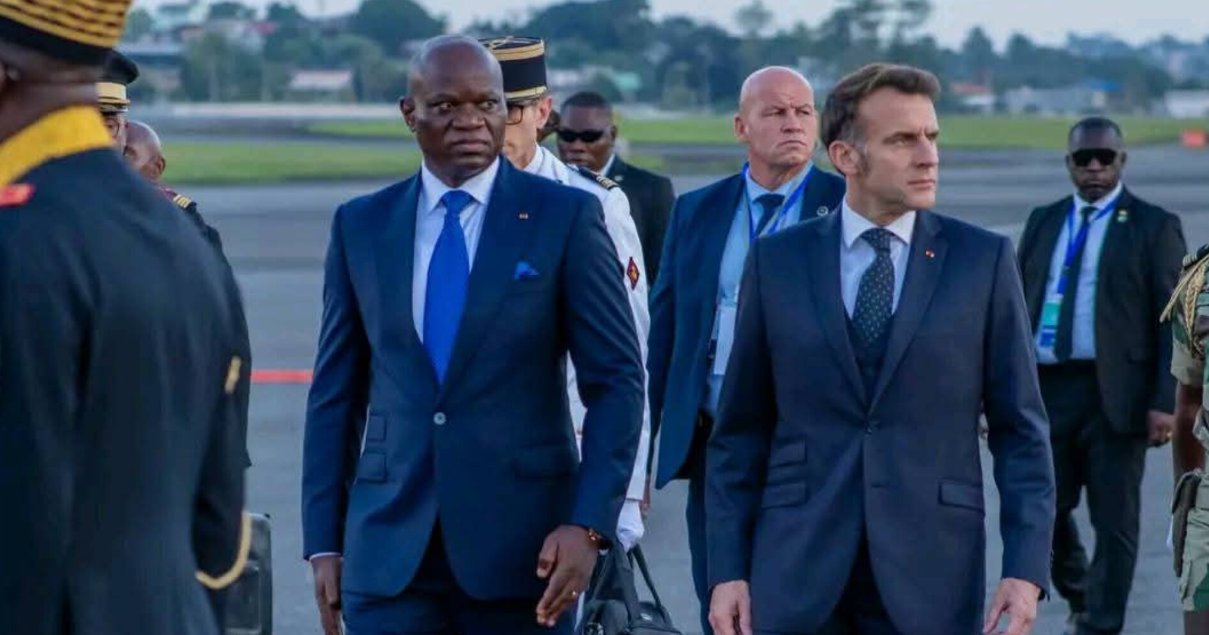

The President of Gabon, General Brice Clotaire Oligui Nguema, has just completed a landmark three-day state visit to France, where he redefined the partnership between Libreville and Paris. At the heart of the discussions with French President Emmanuel Macron were two major issues: the future of the Camp de Gaulle military base and Gabon’s push to locally process its manganese reserves. This diplomatic maneuver reflects a bold yet pragmatic strategy, avoiding the abrupt ruptures seen elsewhere in Africa while firmly asserting national sovereignty.
The Camp de Gaulle dilemma: sovereignty through negotiation
The future of the Camp de Gaulle—home to France’s Gabonese military detachment (EFG)—was high on the agenda. Once a symbol of enduring French influence in Central Africa, the base now faces a fundamental rethink. Under Paris’s broader military realignment in West and Central Africa, French troop levels have already been significantly reduced. However, Gabon’s approach is not about expulsion but renegotiation.
Libreville’s strategy is clear: transform the base into a locally co-managed training hub or drastically limit the French military footprint to technical cooperation and counter-piracy operations in the Gulf of Guinea. The message is unmistakable—national pride is being restored, but without severing critical security ties. For its part, France is keen to demonstrate flexibility, learning from recent setbacks in neighboring Sahel nations while preserving a key regional ally.
Manganese processing: Gabon’s bold economic pivot
Economic considerations took center stage alongside military talks. Gabon, the world’s second-largest manganese producer, is determined to move beyond its colonial-era extractive model. Historically, the mineral was shipped abroad in raw form, but Oligui Nguema has delivered an ultimatum to French mining giant Eramet (via its Comilog subsidiary): the partnership’s future hinges on local industrialization and high-value processing.
The Gabonese government is demanding a fairer profit-sharing model, skilled job creation for its youth, and financial and technological support to build advanced processing plants. This push aligns with global energy trends, as manganese is a vital component in electric vehicle batteries. Libreville’s stance signals a clear intent to capitalize on the green transition rather than remain a passive supplier of raw materials.
Libreville’s pragmatic alternative to Sahelian rupture
This state visit underscores Gabon’s distinct diplomatic path. While military juntas in the Sahel—Mali, Niger, and Burkina Faso—have embraced dramatic breakups with former colonial powers, Gabon is charting a different course. President Oligui Nguema’s approach highlights the flaws in the Sahel’s confrontational strategies, which have often led to economic isolation and instability under the guise of anti-Western posturing.
Gabon’s method is rooted in realpolitik: it negotiates firmly with France while diversifying partnerships with China, Turkey, and India. This balanced stance challenges the simplistic narrative that asserting African sovereignty requires rejecting Western engagement outright. Libreville’s model proves that sovereignty and cooperation can coexist—without the theatrics of rupture.
Digital control: the unaddressed contradiction
Despite Gabon’s outward diplomatic success, concerns linger over domestic freedoms. Frequent internet shutdowns and social media restrictions have raised alarms among civil society and opposition groups. The government justifies these measures as necessary for “public order” and combating misinformation, but critics see them as authoritarian overreach.
During informal discussions on the sidelines, French diplomats quietly emphasized the importance of free speech and fundamental liberties. For Oligui Nguema, the challenge is delicate: maintaining domestic stability while upholding the international credibility he has worked hard to build. The path forward demands not just diplomatic finesse but also tangible progress on democratic openness.
A strategic balancing act
As the Gabonese delegation departs Paris, the visit’s outcome is undeniably strategic. By redefining the Camp de Gaulle’s role and pushing for local manganese processing, President Oligui Nguema has reinforced his foreign policy vision: sovereign, pragmatic, and development-focused. Yet the true test lies ahead—on the ground in Libreville.
For this diplomatic reset to succeed, the Gabonese government must translate these agreements into action while safeguarding democratic freedoms. The success of Gabon’s transition will depend as much on its negotiating prowess in Paris as on its willingness to let its own society thrive at home.