
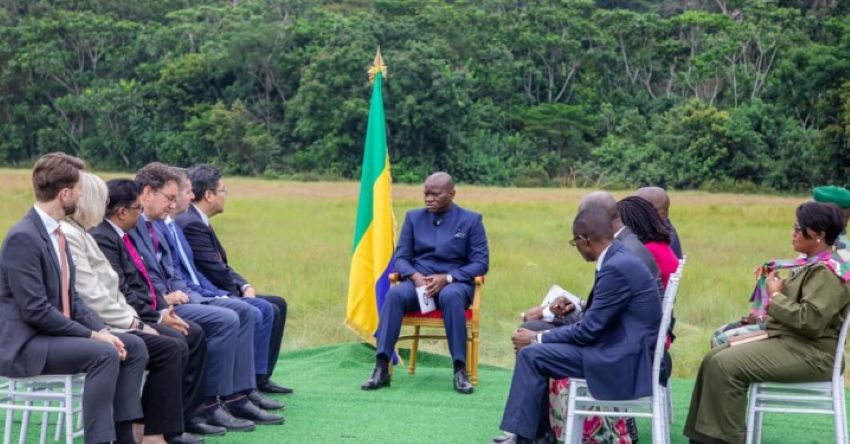
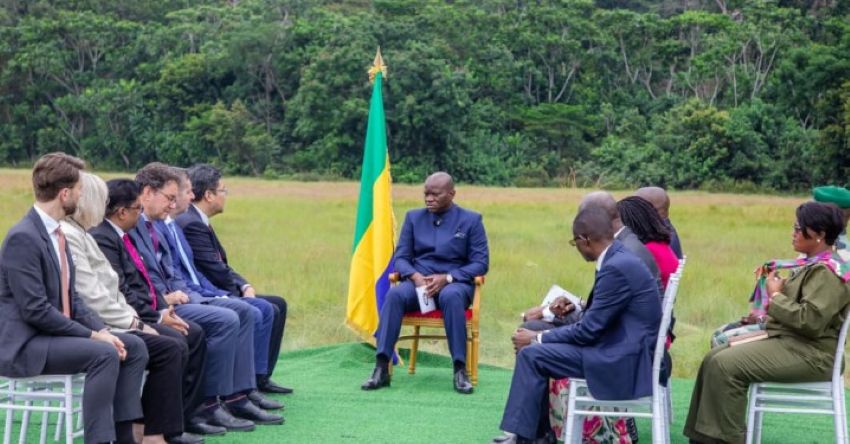
Libreville, June 9, 2026 — Hours after officially launching the deep-water port of Kobe-Kobe on Gabon’s Atlantic coast, President Brice Clotaire Oligui Nguema convened a high-level meeting with ambassadors and representatives from the key powers involved in the project. This gathering was more than a diplomatic courtesy—it marked the beginning of a bold new chapter for the country.
The president’s message was unequivocal: Gabon is no longer content with exporting raw materials. Through Kobe-Kobe, the nation is positioning itself as a future industrial, logistics, and mining hub for Central Africa. This infrastructure is not just about trade—it’s about building a post-oil economy, strengthening economic sovereignty, and integrating Gabon into global value chains.
A new economic vision
The cornerstone of this transformation is the Belinga iron ore deposit, one of the most significant untapped reserves in the world, with an estimated 7.5 billion tonnes of high-grade ore (65% iron content). But the real innovation lies in the integrated approach. For decades, African extractive economies have followed a simple model: extract and export raw materials. The Kobe-Kobe project breaks that mold.
The planned complex combines four key components: the Belinga mine, a 500-plus-kilometer electrified railway, a deep-water port capable of accommodating massive cargo ships, and dedicated energy infrastructure to power the entire operation. This vertical integration aims to retain more value within Gabon’s borders and foster the rise of a national steel industry capable of processing part of the mineral output locally.
Multipolar partnerships for sustainable growth
President Oligui Nguema made it clear to the assembled diplomats that Gabon’s future cannot hinge on a single partner or regional bloc. Instead, it must rely on a diversified network of international cooperation. This principle is already reflected in the consortium behind Kobe-Kobe, where China leads rail and mining development, France contributes logistics expertise, and Italy, India, the United States, and Australia bring industrial, financial, and commercial strengths.
This multipolar strategy serves two purposes: securing the funding and technology required for large-scale projects while preserving Gabon’s decision-making autonomy. The ambassadors of France and China, Fabrice Mauriès and Zhou Ping, both praised this balanced approach, calling it a model for future cooperation. Their endorsement underscores the growing confidence international investors have in Gabon since the establishment of the Fifth Republic.
A bold industrial bet for Central Africa
Beyond infrastructure, Kobe-Kobe represents a high-stakes economic wager. Government projections anticipate over 100,000 direct and indirect jobs, the emergence of a robust national subcontracting network, and a powerful multiplier effect across industries like transport, energy, logistics, metallurgy, services, engineering, vocational training, construction, and industrial maintenance.
The geopolitical stakes are equally significant. With its future deep-water port, Gabon could become one of Central Africa’s main maritime gateways at a time when competition among regional logistics hubs is intensifying. By inviting diplomats to champion this vision with their governments and financial institutions, President Oligui Nguema is seeking to broaden the investor base even further.
Kobe-Kobe is far more than a construction site—it embodies a national strategy to convert natural resources into levers for industrialization, attract international capital, and reinforce economic sovereignty. If the goals are met, Gabon could transition from a raw material exporter to a key industrial player in Central Africa within the next decade. The post-launch meeting with international partners underscores a crucial shift: for Libreville, the development battle is no longer confined to national borders—it is now a global endeavor.