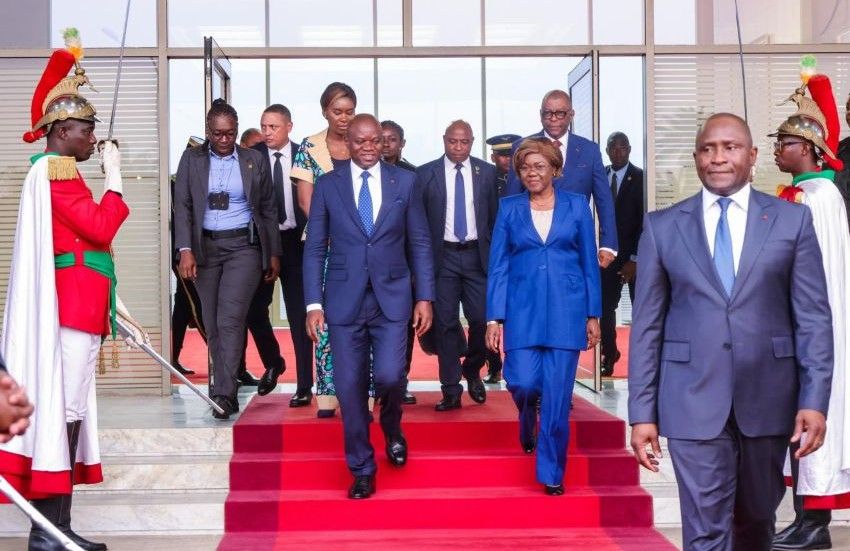
Libreville, August 5, 2026 — The arrival of Brice Clotaire Oligui Nguema in Abidjan marks a turning point in Gabonese diplomacy. Following visits to Ghana, Gambia, and Sierra Leone, the Gabonese president’s West African tour reaches a pivotal stage in Côte d’Ivoire.
Invited as the guest of honor by Ivorian President Alassane Ouattara for the country’s 66th Independence Day celebrations, Oligui Nguema’s mission extends beyond ceremonial diplomacy. His visit signals Gabon’s strategic pivot toward West Africa, where political alliances must now translate into tangible economic cooperation and mutual benefits.
Arriving Tuesday evening with First Lady Zita Oligui Nguema, the president was formally received by Nialé Kaba, Côte d’Ivoire’s Minister of State for Foreign Affairs. The high-level reception underscores the depth of relations between Libreville and Abidjan. Yet beneath the protocol lies a pressing objective: Gabon is redefining its continental role and diversifying its partnerships.
The real challenge isn’t merely increasing diplomatic visibility but converting political proximity into practical cooperation.
Côte d’Ivoire stands out as a key partner in this regard. Its expertise in economic transformation, infrastructure development, agriculture, services, and urban planning offers Gabon a valuable benchmark. While Libreville boasts significant resources and potential, it still seeks mechanisms to channel these assets into job creation, investment, and improved public services.
The presidential agenda in Abidjan will focus on exploring this potential. Meetings with the Gabonese diaspora are scheduled, alongside visits to key infrastructure projects and discussions on strengthening bilateral cooperation. As of now, no major agreements or investment figures have been disclosed—an approach that underscores the distinction between diplomatic gestures and concrete economic outcomes yet to be realized.
For Gabon, this West African outreach represents more than a series of visits; it’s part of a broader strategy. The rapprochement with Accra, Banjul, Freetown, and now Abidjan reflects a deliberate shift toward countries with diverse development experiences compared to Central Africa.
Enhanced knowledge-sharing, market access, talent mobility, and intra-African partnerships could help Gabon reduce its reliance on traditional partnerships. However, effective diplomacy isn’t measured by the number of presidential trips—it’s measured by the tangible outcomes left behind.
For the people of Gabon, the pressing question is what this newfound closeness with Côte d’Ivoire will mean for their daily lives. More business partnerships, stronger academic exchanges, investments, skill transfers, opportunities for local enterprises, and deeper cooperation in strategic sectors would all signal that this relationship has substance beyond diplomacy.
In Abidjan, Brice Clotaire Oligui Nguema commands a prestigious diplomatic stage. But the true test begins after the ceremonies conclude. Gabon can no longer afford to simply attend major African summits; it must now transform presence into influence, and influence into results.
The friendship between Libreville and Abidjan is long-standing. The next phase must be more ambitious—turning this relationship into a concrete tool for development, economic sovereignty, and mutual opening for both nations. It is against this backdrop, far more than protocol, that Gabonese citizens will judge the true significance of this visit.