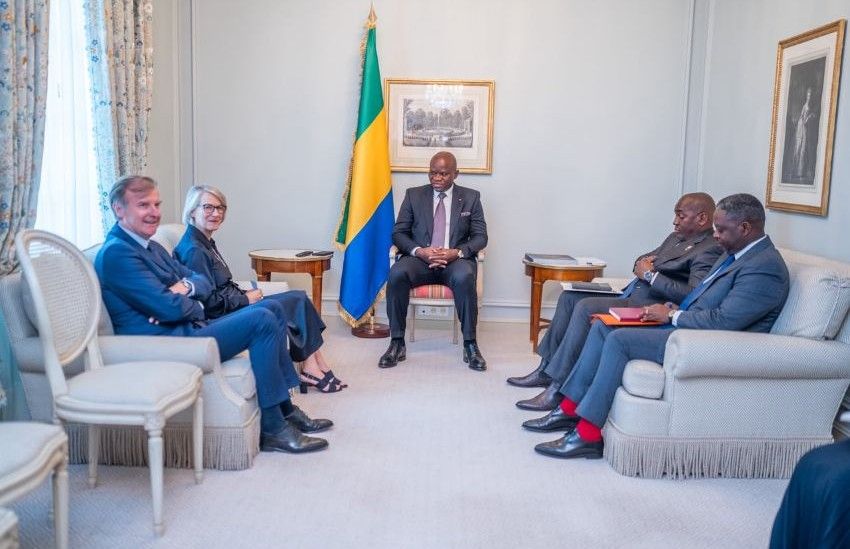
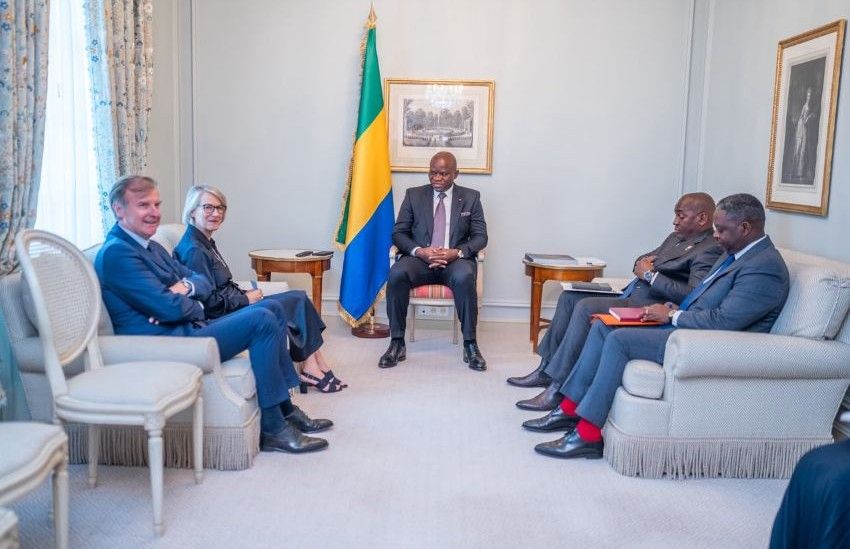
Libreville, August 4, 2026 — The state visit of President Brice Clotaire Oligui Nguema to France from July 19 to 22 was far more than a diplomatic showcase. While the official agenda included military honors at Les Invalides, a tour of the Palace of Versailles, and a state dinner at the Élysée Palace, Libreville’s primary objective lay elsewhere: securing tangible economic commitments that would translate into measurable benefits for Gabon.
With a delegation of over 80 individuals—including top figures from Gabon’s private sector—the visit aimed to move beyond symbolic gestures. The identities of French business leaders who met with the president were closely guarded during negotiations, but details have since emerged, revealing the depth of discussions and the sectors prioritized for collaboration.
Key sectors under the spotlight
Aviation: strengthening regional and international connectivity
The visit kicked off on July 19 with a meeting between President Oligui Nguema and Anne Rigail, CEO of Air France. The aviation sector, often overlooked in broader economic dialogues, emerged as a critical focus. Air France and Fly Gabon already share commercial ties, and negotiations are underway to finalize a codeshare agreement by the end of the year. This would enable Fly Gabon to sell tickets to Paris under its own branding, enhancing its market presence and improving travel options for passengers.
While no final agreement was signed during the meeting, the proposed timeline demands close monitoring. For Gabon, the stakes extend beyond airline partnerships. Enhanced air connectivity directly impacts business travel, tourism, investment flows, and the mobility of skilled professionals—all vital for economic growth.
Mining: transforming raw materials into local value
The following day at the Élysée Palace, mining took center stage. Discussions centered on a protocol between Gabon and Eramet, the French multinational, and its subsidiary Comilog, focused on local processing of manganese. The framework, presented as a collaborative effort with Gabonese authorities, outlines ambitious targets: processing up to 700,000 tons of manganese locally by the end of 2031.
Several implementation scenarios are still under review, including the establishment of a “Made in Gabon” fund and the development of a biocharcoal industry. It is crucial to note that this is currently a working framework, not a finalized investment. For Gabonese citizens, the distinction is critical. Local manganese processing will only become an economic reality once feasibility studies, financing, infrastructure, and investment decisions are fully executed.
Energy: unlocking Gabon’s hydroelectric potential
Energy infrastructure also featured prominently in the negotiations. Gabon’s state-owned Gabon Power Company, EDF Power Solutions, and the Gabonese government signed an agreement for the Booué hydroelectric project on the Ogooué River. The proposed plant would add 400 megawatts to the national grid, addressing a persistent gap between supply and demand.
Gabon possesses significant untapped hydroelectric potential but currently generates only about 700 megawatts—well below the national demand of over 1,000 megawatts. The agreement signed in Paris is not the project’s conclusion but a stepping stone. Partners have set a deadline of October 31 to finalize the development agreement, with monthly meetings scheduled to advance the initiative. This timeline now serves as a critical test of commitment.
Additionally, Omega Consortium, specializing in water and electricity infrastructure, was received by the president to discuss improving access to essential networks—another key priority for Libreville.
From promises to action: what Gabon expects next
The visit succeeded in identifying partners, setting deadlines, and launching several high-stakes projects. Air France for aviation, Eramet and Comilog for manganese processing, EDF and Gabon Power Company for energy, and Omega Consortium for water and electricity infrastructure—these are the building blocks of potential progress. Yet, the true measure of success lies in what comes next.
Gabonese citizens are not concerned with the names of executives or the number of agreements signed. Their focus is on tangible outcomes: job creation, reliable electricity, improved water access, enhanced mobility, increased local value addition, and ultimately, a noticeable improvement in living standards.
The October 31 deadline for the Booué project, the anticipated codeshare agreement with Air France by year-end, and the evolution of the manganese processing roadmap will all be closely scrutinized. Diplomatic and economic engagement cannot be judged by the volume of meetings or the number of signed documents alone. Its true value will be measured by the real transformations it delivers in the daily lives of Gabonese people.