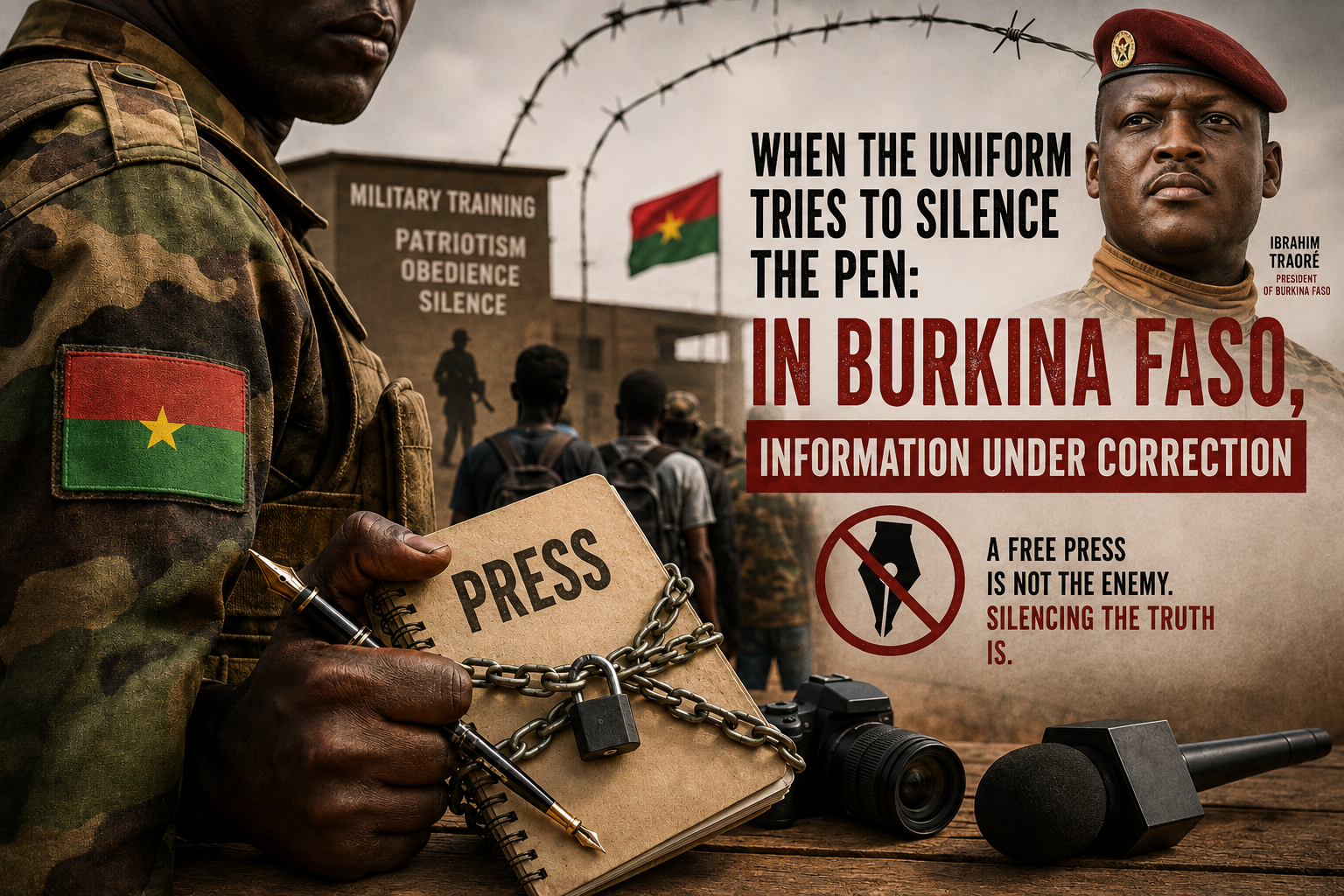

An unsettling image has emerged in Burkina Faso: scores of journalists, most hailing from the Ouagadougou region, have just completed what authorities labelled a ‘patriotic training’ session. Beneath the sanitized language lies a far more troubling agenda one that uses the language of civic duty to impose re-education and curtail independent reporting.
The very notion of press freedom is undermined when reporters face overt coercion or subtle intimidation, dragged into military camps to be instructed on what may and may not be published. Investigative journalism and the accurate portrayal of civilian hardship, security failures, and institutional shortcomings are now treated as acts of betrayal rather than professional obligation. By confining media professionals to undisclosed correctional facilities, the current administration is not cultivating informed citizens; it is manufacturing compliant mouthpieces for state propaganda.
From security management to absolute control
This systematic effort to align journalism with state doctrine signals a deeper transformation. Burkina Faso is no longer merely coping with a security crisis orchestrated by armed groups; it is witnessing the consolidation of an autocratic model where the public sphere is monopolised and the right to inform is effectively revoked. The state now positions itself as the sole arbiter of national truth, rendering dissent or critical inquiry an act of disloyalty.
Yet journalism that marches in lockstep with official narratives ceases to be journalism at all. Silencing reporters or compelling them to adopt the intellectual uniform of sanctioned opinion does nothing to resolve the nation’s challenges. On the contrary, it erodes the very foundations of public trust, replacing verifiable fact with unchecked rumor and institutional opacity.
Who owns the news in times of crisis?
A government facing terrorism is entitled to request that media respect operational confidentiality and refrain from endangering lives. It may outline guidelines on protecting military identities or avoid broadcasting sensitive tactical information. However, these legitimate security concerns must not be weaponised to transform journalists into extensions of the ruling apparatus. National security is not synonymous with regime security.
The concept of ‘patriotism’ in this context demands scrutiny. Loyalty to one’s country need not equate to uncritical allegiance to those in power. A journalist can be deeply devoted to Burkina Faso and still scrutinise displacement crises, document civilian suffering, interrogate officials, and expose systemic failures. In a democracy, the reporter’s duty is not to shield the government from scrutiny but to uncover facts and present them to the public within the bounds of ethical and legal obligations.
When authorities pre-determine what the press should believe, they cross a fundamental line. The state may challenge a story, present counter-evidence, or utilise legal remedies; it should never pre-emptively dictate editorial conclusions.
The paradox of a controlled public sphere
The suppression of critical reporting does not leave a vacuum it invites infiltration. Rumors, unverified social media claims, and clandestine narratives rush to fill the silence. Far from restoring confidence, attempts to monopolise public discourse often amplify doubt and accelerate the erosion of institutional credibility.
Trust cannot be decreed; it must be earned through transparency, robust debate, and the ability to verify official statements. Citizens who know they can rely on freely reported events are better equipped to distinguish reliable information from fabrication. Conversely, when certain truths become too dangerous to voice, skepticism seeps into every corner of public life.
Journalism under uniform: a contradiction in terms
There is an inherent contradiction in re-educating journalists in the name of patriotism. The essence of the profession lies in asking uncomfortable questions: investigating public decisions, holding leaders to account, and confronting official narratives with lived realities. When reporters are barred from fulfilling this role, they cease to function as a democratic counterweight.
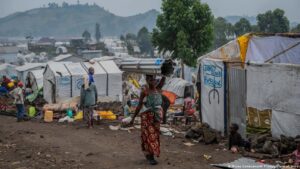
In a period marked by armed violence, mass displacement, and economic strain, the demand for independent journalism intensifies. Societies in crisis require reporters who can verify events, amplify victims’ voices, contextualise developments, and examine policies enacted in their name. Militarising the journalistic profession risks conflating two incompatible logics: the hierarchical discipline of the barracks and the critical inquiry of the newsroom.
A precedent with far-reaching consequences
The implications extend beyond the media. If journalists today must prove their patriotism, which professional spheres might be next? Academics, judges, artists, civil society leaders, and human rights defenders could all be subjected to ideological scrutiny for daring to question government decisions.
A resilient democracy is measured not by its ability to silence critics under the banner of loyalty, but by its capacity to withstand contradiction without branding dissent as treason. History shows that regimes that attempt to monopolise truth rarely succeed in suppressing reality. Facts persist spreading through testimonies, diaspora networks, social media, and international outlets no matter how forcefully the state tries to control the narrative.
The true test of patriotism
Patriotism should never serve as a license for censorship, nor should it be used to separate ‘good’ citizens from those who ask questions. A reporter exposing a state weakness is not betraying the nation; they may be preventing that weakness from escalating into catastrophe.
The current trajectory in Burkina Faso is not merely a crisis for journalists it is a referendum on the kind of society the country wishes to build. Do we want a nation where information must first secure state approval, or one where the state accepts that uncomfortable truths are an inevitable part of civic life? If patriotism now demands turning a blind eye to reality in deference to power, then the very foundations of Burkinabè democracy are marching in lockstep toward authoritarianism. If, instead, patriotism means defending one’s country with integrity, then the journalist must retain the right to face reality even when it displeases those in charge.