
Khombole controversy: Maïmouna Dièye’s remarks on Ousmane Sonko spark debate
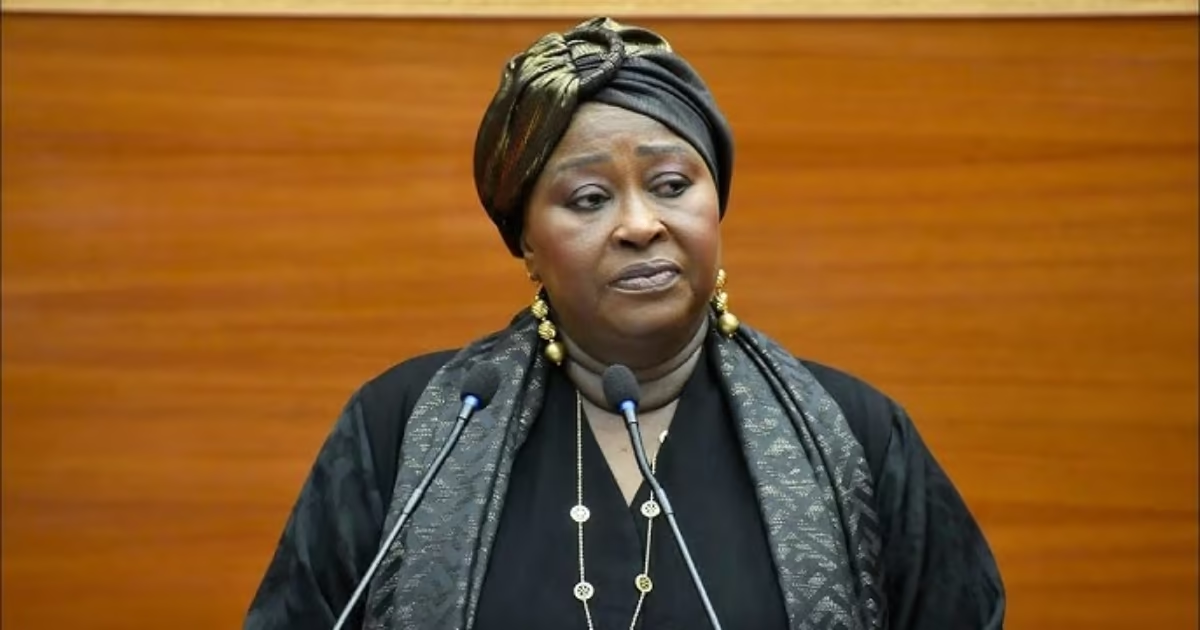
Maïmouna Dièye’s choice of words during a political gathering in Khombole has ignited a heated discussion across Senegal. By invoking a religious formula typically reserved for the Prophet Mohammad when referring to opposition leader Ousmane Sonko, she inadvertently crossed a line that many consider sacred in Islam.
Why Maïmouna Dièye’s statement caused uproar in Khombole
In a speech delivered this past Saturday, Maïmouna Dièye addressed Ousmane Sonko using the honorific phrase ‘Seyidina Ousmane Sonko Salalahou Aleyhi Wa Salam’. This expression, which translates to ‘Our master Ousmane Sonko, may blessings and peace be upon him,’ is traditionally reserved exclusively for the Prophet Mohammad in Islamic practice. While some Muslim traditions extend this phrasing to other prophets, the vast majority of scholars and believers restrict its use to the Prophet alone. By applying it to a political figure, Dièye elevated Sonko’s status to an almost divine level—one that carries profound religious significance.
The gravity of the statement stems from the fact that this invocation is not merely a form of respect but a sacred act in Islam. It is recited in prayers, sermons, and any mention of the Prophet, underscoring his unique and unparalleled position in the faith. When used for a person who holds no prophetic status, even one as influential as a political leader, it blurs the critical distinction between veneration and religious sanctity. The reaction from observers was swift, with many condemning the phrasing as an overstep that risks undermining the principles of Islamic teachings.
Ousmane Sonko’s response and the broader implications
Ousmane Sonko, visibly taken aback by the remark, responded with measured clarity. He acknowledged the deep affection his supporters hold for him but firmly corrected the statement, emphasizing that such reverence belongs solely to the Prophet Mohammad. In a rare public correction, Sonko made it clear that he neither claims nor aspires to any spiritual status beyond that of a political leader. His swift intervention served to diffuse tensions and prevent the remarks from being exploited by critics who might seek to undermine his credibility or stoke religious divisions.
This incident highlights a recurring challenge in Senegal’s political landscape: the delicate balance between expressing admiration for a leader and crossing into the realm of sacralization. Religious leaders across the country have long warned against the dangers of conflating political respect with religious veneration. Such blurring of lines can lead to unintended consequences, including the exploitation of faith for partisan purposes—a concern that resonates deeply in a nation where religion plays a central role in public discourse.
In Senegal, where the majority of the population identifies as Muslim, the boundaries of religious language in politics are closely scrutinized. Statements that appear to blur these boundaries often spark public outcry, as seen in this instance. Ousmane Sonko’s immediate clarification underscores the sensitivity of the issue and the importance of adhering to religious norms in political communication. For many, this episode serves as a reminder of the need to maintain clear distinctions between political respect and religious sanctity to preserve both faith and civic harmony.