Mauritania’s delicate balancing act in western Sahara tensions
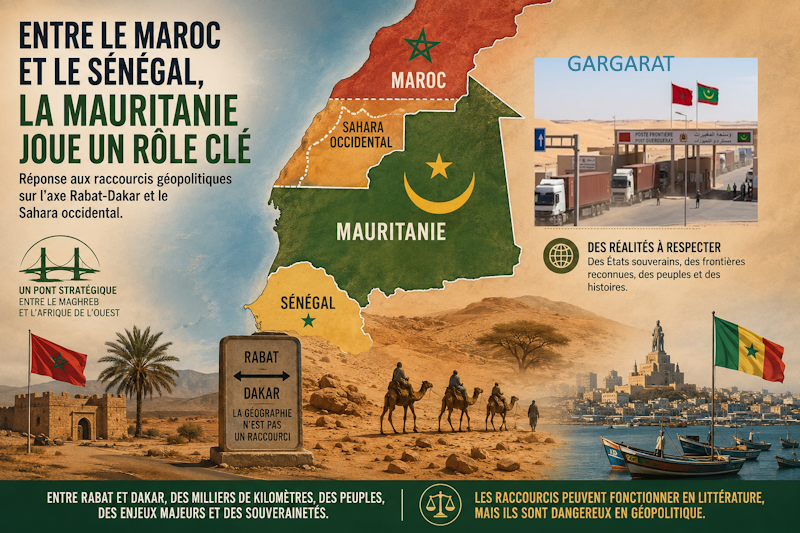

An unexpected diplomatic clash in Dakar has thrust Mauritania’s complex stance on the Western Sahara conflict into the spotlight. Between economic pragmatism, strategic ambiguity, and the need to preserve national sovereignty, Nouakchott’s balancing act faces growing pressure.
When historical narratives collide in Dakar
A seemingly routine diplomatic reception in Dakar took an explosive turn in late July 2026. During an event hosted by the Moroccan embassy to launch a book, Senegalese former foreign minister Cheikh Tidiane Gadio ignited controversy by suggesting that in Senegalese collective memory, Morocco was located “just a few kilometers away” from Senegal—a subtle nod to pre-colonial territorial claims. The remark provoked an immediate reaction from Mauritania’s ambassador, Mohamed Ould Abdellahi Ould Ethmane, who interrupted the speech to denounce what he called “historical revisionism” that erased Mauritania’s very existence.
The Moroccan ambassador, Hassan Naciri, quickly stepped in as mediator to defuse the tension. Yet the incident laid bare the tightrope Mauritania walks: attending an event celebrating Morocco’s sovereignty over Western Sahara while insisting on strict neutrality in a decades-old territorial dispute.
Mauritania’s former foreign minister, Isselmou Ahmed Izidbih, amplified the uproar with a strongly worded statement on social media. “As a Mauritanian citizen,” he declared, “I call for Cheikh Tidiane Gadio to be declared persona non grata in Mauritania’s territorial waters, airspace, and on its soil.”
Nouakchott’s calculated neutrality
This diplomatic episode encapsulates Mauritania’s long-standing positioning in the Western Sahara saga. Officially, Mauritania recognized the Sahrawi Arab Democratic Republic (SADR) in 1984 and maintains regular dialogue with the Polisario Front, all while nurturing critical security ties with Algeria. Yet, at the same time, it stops short of granting the SADR full diplomatic status in Nouakchott—a deliberate concession to Rabat, which views any recognition of SADR as an act of war.
By participating in Morocco’s official commemorations, Mauritania signals respect for its northern neighbor, but only as long as Rabat refrains from reviving the historical concept of a “Greater Morocco” that once encompassed Mauritanian territory.
The economic lifeline of Guerguerat
Beyond symbolic gestures, Mauritania’s foreign policy is shaped by hard economic realities. The Guerguerat border crossing, straddling Western Sahara and Mauritanian soil, has become the vital artery through which Moroccan goods flow into West Africa. Daily convoys of Moroccan trucks pass through the zone, supplying Mauritania, Senegal, and Mali with essential goods—from fresh produce to manufactured products.
For Nouakchott, blocking this trade would be economic suicide. By securing and facilitating this route, Mauritania tacitly endorses Morocco’s operational control over the territory—without ever acknowledging it formally.
A strategic ambiguity that ensures survival
To regional analysts, Mauritania’s “both-and” diplomacy is not indecision—it is a survival strategy. Trapped between an economically assertive Morocco and a geopolitically vigilant Algeria, Nouakchott cannot afford to take sides without risking retaliation, border instability, or economic isolation.
The fallout from Cheikh Tidiane Gadio’s remarks serves as a reminder that this neutrality, however delicate, is highly sensitive. Whenever Mauritania’s national identity or territorial integrity appears threatened by its neighbors’ ambitions, the country swiftly abandons its usual restraint to reassert itself as the indispensable—and sovereign—linchpin of Maghreb stability.