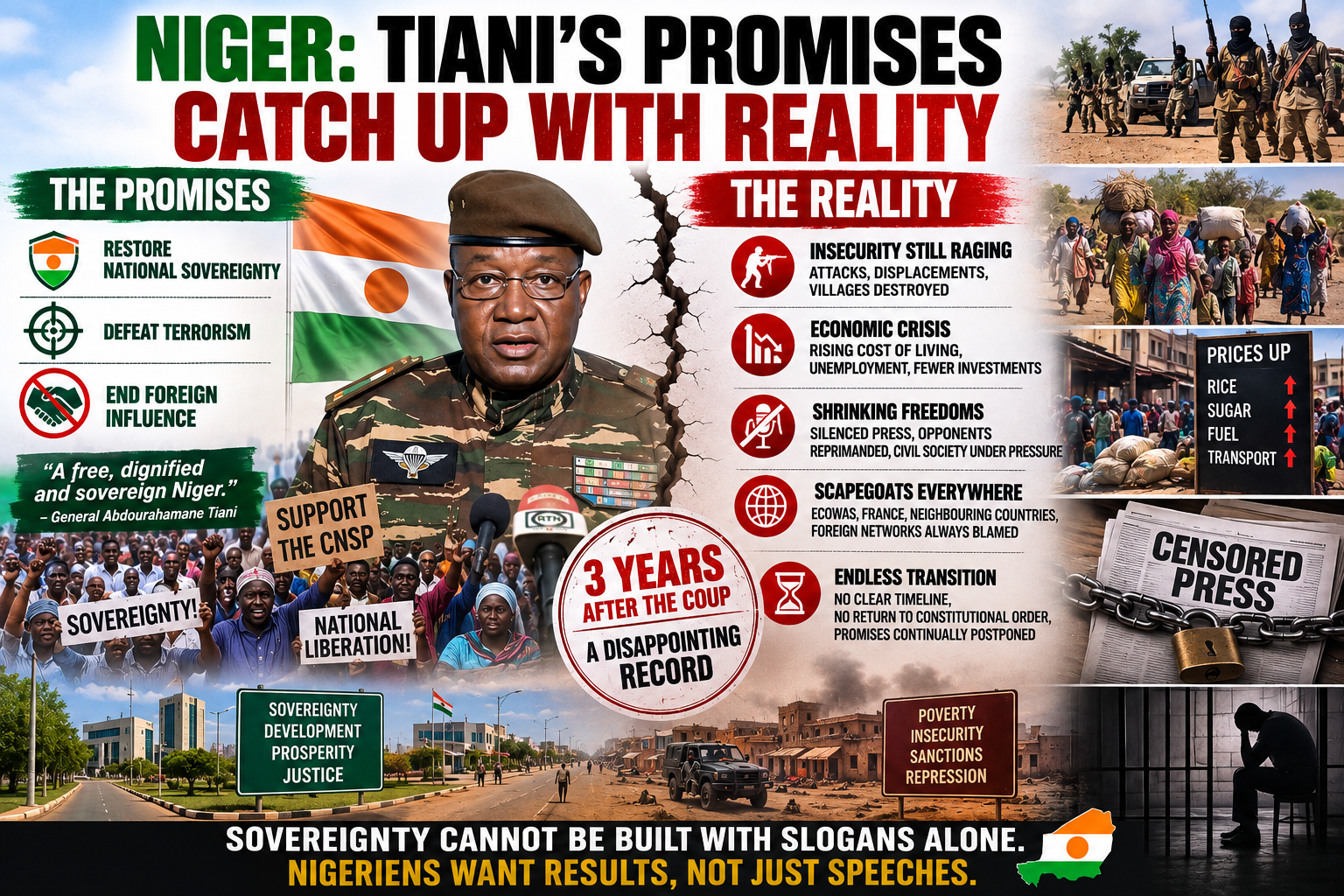

When General Abdourahamane Tiani seized power in Niamey on July 26, 2023, his justification rested on three pillars: restoring national sovereignty, eradicating terrorism, and ending foreign interference in Niger’s affairs. The narrative, amplified by regime-aligned media and pan-Africanist movements, resonated with a population weary of chronic insecurity and economic hardship. Yet, three years later, the gap between rhetoric and reality has sparked intense debate.
While official discourse continues to denounce neocolonialism as the root of Niger’s woes, the daily struggles of ordinary citizens remain dominated by unrelenting violence, economic strain, and shrinking civic freedoms. The military-led transition, once hailed as a historic break, now faces scrutiny over its ability to deliver tangible progress.
Sovereignty as a Political Tool
The National Council for the Safeguard of the Homeland (CNSP) has framed its legitimacy around a simple premise: Niger has regained sovereignty by severing ties with former Western partners. This narrative thrives on a clear dichotomy portraying the government as patriotic while framing critics as puppets of foreign interests. The strategy serves multiple purposes: uniting public opinion under a nationalist banner, deflecting internal criticism, and deflecting attention from policy shortcomings.
True sovereignty, however, extends beyond diplomatic ruptures. It demands robust security, functional institutions, protected freedoms, and improved living standards. On these fronts, the government’s track record remains hotly contested.
Exploiting Public Frustrations
The junta has deftly channeled widespread disillusionment—stemming from insecurity, unemployment, inequality, and soaring living costs into a narrative of radical change. Yet, over time, official communication has shifted from promising results to sustaining a perpetual state of patriotic mobilization. Political rallies, anti-foreign conspiracy rhetoric, and symbolic gestures now dominate the media landscape, while substantive discussions on governance and performance have faded into the background.
This approach reshapes the political debate: loyalty to the regime increasingly trumps accountability, stifling open evaluation of public policies and eroding the culture of oversight essential for democratic governance.
Security: The Unresolved Crisis
Toppling the civilian government was justified primarily by the need to restore security. Yet, large swathes of Niger continue to suffer under relentless armed attacks, mass displacements, and deepening instability. Civilians bear the brunt of a conflict that devastates livelihoods, disrupts access to essential services, and fractures community cohesion.
The Nigerien military has launched multiple offensives, but recurring raids on villages and military outposts reveal the persistent resilience of armed groups. The conflict’s complexity defies simplistic solutions whether regime change or geopolitical realignment alone can address its root causes remains an open question.
Without transparent, verifiable indicators, public skepticism about the effectiveness of the current security strategy continues to grow.
Blame Gaming: Externalizing Responsibility
Faced with mounting challenges, the government frequently attributes national crises to external forces regional sanctions, former Western allies, neighboring states, or shadowy foreign networks. While geopolitical tensions undeniably influence the Sahel’s security environment, they do not fully account for Niger’s internal struggles.
This habit of externalizing blame risks converting every domestic crisis into a diplomatic standoff, diverting attention from institutional reforms, governance failures, and the urgent need for self-criticism. Over time, such a stance may erode the state’s capacity to recognize and address its own shortcomings.
Economic Strain: Promises Unfulfilled
The anticipated economic dividends of the coup have yet to materialize. Trade disruptions, plummeting investment, regional sanctions, and political uncertainty have crippled key sectors. For households, the realities are stark: rising prices, shortages of basic goods, and scarce employment opportunities dominate daily life. For many, the promised fruits of political rupture remain elusive.
Economic sovereignty, often invoked in speeches, requires long-term investments in production, infrastructure, public finances, and business environments. Yet, tangible progress in these areas has been limited, leaving citizens to question whether sovereignty is more slogan than substance.
Civic Space: A Shrinking Landscape
Independent observers warn of a growing erosion of public freedoms. Journalists, civil society leaders, and opposition figures face heightened scrutiny, with dissent increasingly met with state vigilance. In many military-led systems, power centralization naturally curtails checks and balances. Niger now confronts a critical dilemma: how to uphold national unity amid security threats without sacrificing the pluralism essential for responsible governance?
The absence of a clear political transition roadmap further fuels uncertainty about the junta’s long-term intentions and the prospects of a return to constitutional order.
Patriotism vs. Performance: The Looming Reckoning
National pride can unite a country, but it cannot indefinitely substitute for concrete results. Sovereignty is not declared it is built through resilient institutions, credible justice, effective security, and transparent governance. Recent Sahelian history demonstrates that no regime military or civilian can sustain legitimacy solely on anti-foreign rhetoric. As time passes, citizens judge leaders not by their words, but by their ability to improve daily lives.
For General Abdourahamane Tiani and the CNSP, the challenge is no longer to convince Nigeriens of their sovereignty, but to prove that this sovereignty yields real dividends in security, development, justice, and freedom. Without tangible progress, anti-imperialist rhetoric risks being seen not as a nation-building project, but as a political survival tool.