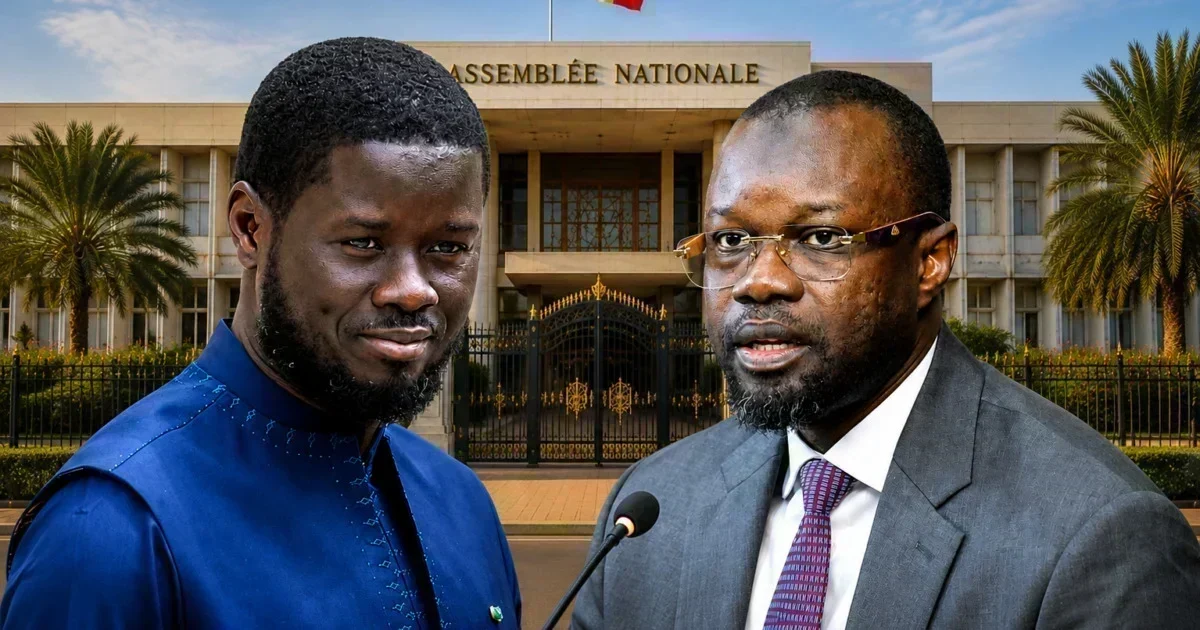

The first extraordinary session of the Sénégal National Assembly, convened on August 6, began yesterday under a tense political atmosphere. During the opening, the Assembly’s president, Ousmane Sonko, announced the receipt of seven legislative proposals submitted by President Bassirou Diomaye Faye. However, none of these initiatives were included in the session’s agenda, leaving political analysts and lawmakers to question the reasons behind this exclusion.
Seven key legislative proposals left unaddressed
The seven proposals from President Bassirou Diomaye Faye covered critical international agreements and conventions, including:
- A bill authorizing the ratification of the Marrakech Treaty, aimed at improving access to published works for visually impaired individuals;
- A bill authorizing the ratification of amendments to the Chicago Convention on International Civil Aviation;
- A military and technical cooperation agreement between Sénégal and the Republic of the Congo;
- An extradition convention between Sénégal and the United Arab Emirates;
- A convention on the transfer of sentenced persons between Sénégal and the United Arab Emirates;
- A judicial mutual assistance treaty in criminal matters between Sénégal and the United Arab Emirates;
- A judicial mutual assistance treaty in criminal matters between Sénégal and Italy.
Agenda dominated by government and opposition priorities
Despite the exclusion of the presidential proposals, the session’s agenda was packed with other pressing legislative matters. The Assembly’s Bureau included three government bills and eight opposition proposals in the session’s program. These included:
- A new Labor Code bill;
- A Social Security Code bill;
- A bill on the protection of critical information infrastructures and digital security;
- Two urgent proposals to amend the Constitution regarding the declaration of assets by the President of the Republic;
- A proposal on the legal framework for special credits;
- Six proposals to establish parliamentary inquiry commissions, addressing issues such as land management, state property sales, financial mechanisms like Total Return Swaps, irregularities in the “One Student, One Laptop” program, revenue losses, tax exemptions, and fishing license issuance and renewal.
Procedural urgency for constitutional amendments
The urgency of the proposals to amend the Constitution and regulate special credits was emphasized by Ousmane Sonko, who noted that these would be prioritized during the session. The proposals aim to strengthen transparency in governance and financial oversight, key topics of debate in recent months. Meanwhile, the inquiry commissions will probe alleged mismanagement across various sectors, reflecting growing public demand for accountability.
The extraordinary session, set to last for two weeks, will now focus on these legislative priorities, leaving the presidential proposals for potential inclusion in future sessions. The political dynamics at play suggest a strategic alignment or divergence of interests between the legislative and executive branches, a topic likely to dominate discussions in the coming months.