Burkina Faso’s militarisation drive: the debate over security and sovereignty
A paradox that unsettles public debate
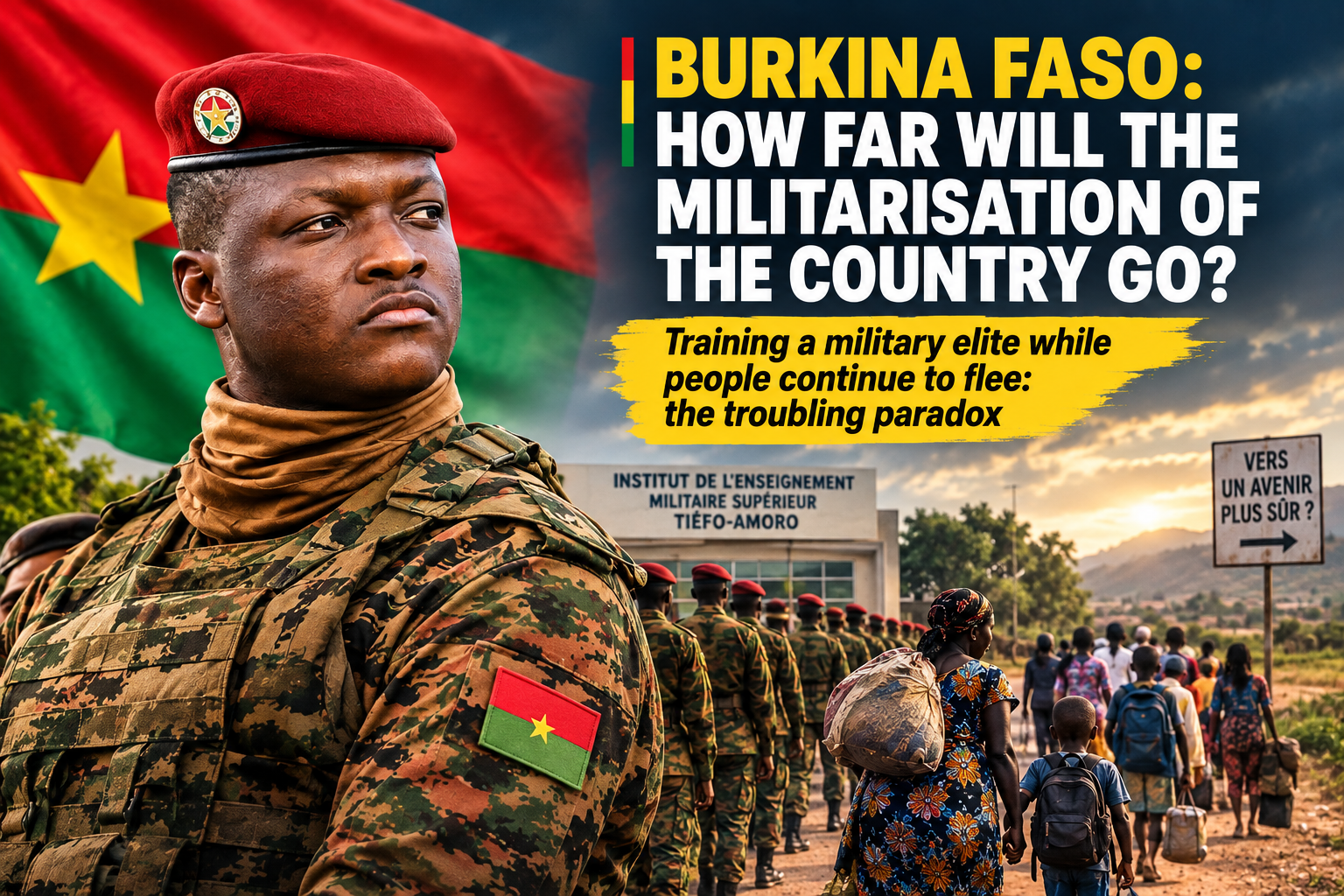
Burkina Faso is determined to train its own military elite. The government of Ibrahim Traoré frames this shift as a major step toward strategic sovereignty. The Tiéfo-Amoro Higher Military Education Institute is tasked with preparing officers locally in strategy, command, crisis management and geopolitics. Its first cohort includes 28 trainee officers.
In principle, no one can deny a state the right to train its own soldiers.
But the issue is not the existence of a military school. The issue is the timing, the scale and the growing place the military appears to occupy in the national project.
For while Ouagadougou speaks of strategic sovereignty, another reality is unfolding on the ground: Burkinabè continue to leave their villages, their land and sometimes their country in search of safety elsewhere.
At the end of 2025, UNHCR counted more than 2.1 million forcibly displaced people in Burkina Faso, including over 2 million internally displaced. And in 2025, more than 221,000 Burkinabè fled the country, mainly to neighbouring states.
In Côte d’Ivoire, UNHCR still recorded around 82,000 Burkinabè refugees in June 2026.
So a question becomes unavoidable: what is the point of strengthened military sovereignty if part of the population still does not feel protected enough to stay home?
Does Burkina Faso need this now?
This is where the debate becomes serious.
Burkina Faso faces a security, humanitarian and social crisis that cannot be solved by multiplying military structures alone.
Training senior officers can be useful. Strengthening the army’s strategic capabilities may be necessary. But this must not overshadow the most urgent priority: reclaiming territories affected by insecurity and enabling displaced populations to return home sustainably.
The paradox is striking.
The more official discourse insists on sovereignty and military power, the more a basic question returns: why do so many citizens continue to seek safety beyond the borders?
This is not an accusation. It is a political and social contradiction that deserves scrutiny.
From army to state: the risk of generalised militarisation
The real issue is therefore not simply the creation of a military school.
It is the growing role of the military in building the new Burkinabè state.
The government says it wants to adapt the defence apparatus to national realities and strengthen sovereignty. President Ibrahim Traoré regularly addresses the hierarchy of the Defence and Security Forces, giving them directions on how to conduct the war against armed groups.
Taken separately, these choices can be explained by the security context.
But added together, a question emerges: is Burkina Faso simply strengthening its army to respond to a war, or is it gradually placing the military at the centre of the country’s organisation?
The nuance is fundamental.
A state may need a strong army without becoming a state dominated by military logic.
It is precisely this boundary that Burkina Faso must avoid crossing.
For when the army becomes the preferred answer to almost every national problem, the risk is a gradual shrinking of space for other dimensions of reconstruction: civil administration, education, the local economy, justice, social services, rural development and the return of displaced populations.
Sovereignty is not measured by the number of uniforms
The Burkinabè government speaks of sovereignty. Fine.
But sovereignty should not be only military.
It must also be territorial, economic, food-related, institutional and social.
A sovereign country is one where a farmer can return to work his field without fear of attack.
A sovereign country is one where a family is not forced to cross a border to sleep in safety.
A sovereign country is one where a school can operate without children being displaced by fear of violence.
A sovereign country, finally, is one where the state is able to protect its citizens to the point that fleeing becomes the exception, not a survival strategy.
Yet displacement figures show the problem remains considerable. UNHCR estimates that more than 221,000 Burkinabè left their country in 2025.
The danger of a society that thinks only in terms of war
Burkina Faso is at war with armed groups. That is a reality.
But a country cannot be built around war alone.
A war can justify strengthening an army. It must not necessarily become the matrix of an entire society.
This is where the stated ambition to train a new military elite deserves close attention.
Training a national military elite can strengthen Burkina Faso’s strategic autonomy. But this policy must not become the symbol of a deeper transformation in which the military ends up as the central reference of the state.
Because at that point, the problem would no longer be only security-related.
It would become institutional.
Ibrahim Traoré’s real test
The real test for Ibrahim Traoré’s government will therefore not be only its ability to train officers, create military institutions or display a doctrine of sovereignty.
The real test will be whether Burkinabè can gradually return to their villages, reclaim their land, reopen their shops and send their children to school without fearing for their lives.
That is what populations expect.
For a country can have a perfectly trained army and still experience a deep crisis if its citizens do not feel sufficiently protected.
And that is precisely why Burkina Faso must ask itself this question now, before it is too late:
By militarising the response to every problem, does the country risk losing sight of the problem it was supposed to solve first: guaranteeing the security of its population?
Military sovereignty can be a tool.
It cannot become an end in itself.
And above all, it must never forget those in whose name it is supposed to exist: the Burkinabè people.