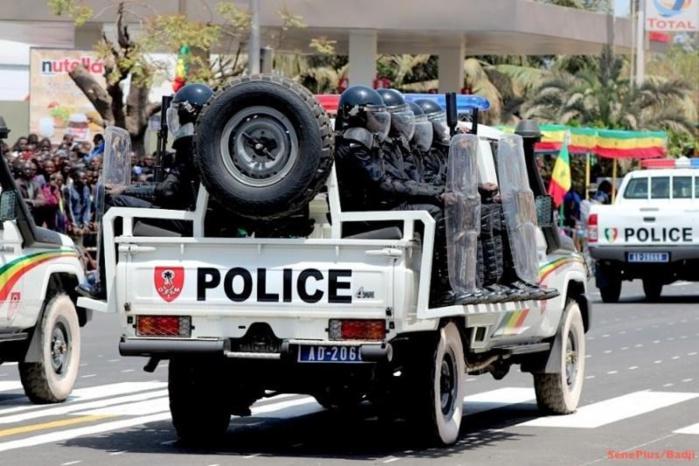

In the heart of Dakar, a series of heightened police checks targeting foreigners has sparked widespread discussions. Over an eight-day span, authorities conducted verifications on 490 individuals, with 36 referred to the prosecutor’s office for irregular stay. While authorities frame these operations as routine administrative measures, civil society and foreign residents express growing unease about the shifting landscape of immigration enforcement in the country.
a sudden change in routine checks
For many long-term foreign residents in Dakar, police checks have become an unsettling part of daily life. Take the example of Amadou Bangoura, a 30-year-old student from Bénin who has been pursuing higher education in Sénégal for five years. One evening, as he left a gym in the Liberté 6 district, a police patrol stopped him and requested identification. Without his documents on hand, he was temporarily detained while officers verified his status. Though his papers were eventually found to be in order, the incident left him shaken.
« This has never happened to me in five years, » Bangoura admitted. « The fear of being sent back, facing prosecution, or being held indefinitely crossed my mind. It was an ordeal I wasn’t prepared for. » His experience reflects a broader trend: foreign residents who have lived in Sénégal for years are now finding themselves subjected to sudden, intrusive checks that blur the line between routine procedure and harassment.
statistics reveal a tightening grip
Between June 30 and July 8, the Direction de la Police des Étrangers et des Titres de Voyage (DPETV) carried out a sweeping campaign across Dakar and its suburbs. The operation led to the inspection of 490 foreigners of various nationalities, with 36 cases referred to the judicial system for irregular stay. While authorities insist the crackdown targets only those in violation of residency laws, critics argue the approach fosters a climate of suspicion that extends far beyond administrative compliance.
civil society warns against rising suspicion
On July 13, a coalition of civil society organizations—including Legs Africa, Frapp, Nawle, Afrikajom Center, and Diwan Citoyen—issued a joint statement expressing deep concern over what they describe as the « normalization of suspicion » toward foreigners in Sénégal. While acknowledging the government’s right to regulate immigration, they cautioned against conflating sovereignty with arbitrary enforcement.
« The issue isn’t the existence of immigration policies, but the creeping normalization of a system where foreigners are no longer seen as rights-bearing individuals, but as potential administrative risks, » the statement read. The groups emphasized that regular residency itself is increasingly becoming a bureaucratic minefield, turning what should be a secure legal status into a perpetual state of uncertainty.
balancing security and hospitality
Elimane Kane, president of Legs Africa, stressed that security and hospitality are not mutually exclusive values in Sénégala culture. While acknowledging the legitimacy of border control and identity verification, he warned that poorly coordinated enforcement could be perceived as persecution rather than protection.
« Security does not exclude otherness, » Kane stated. He called for better coordination among security forces to ensure that checks are conducted with proportionality and respect, avoiding the pitfalls of collective suspicion. Kane also highlighted the importance of recognizing the role of foreign professionals in Sénégal’s economy, noting that just as Sénégala youth seek opportunities abroad, foreign workers contribute meaningfully to local development.
« The solution isn’t to stigmatize migrants, but to create opportunities so that young Sénégala can also thrive at home, » he concluded. As debates continue, the challenge for authorities will be to enforce immigration laws without eroding the trust and openness that have long defined Sénégal’s national identity.