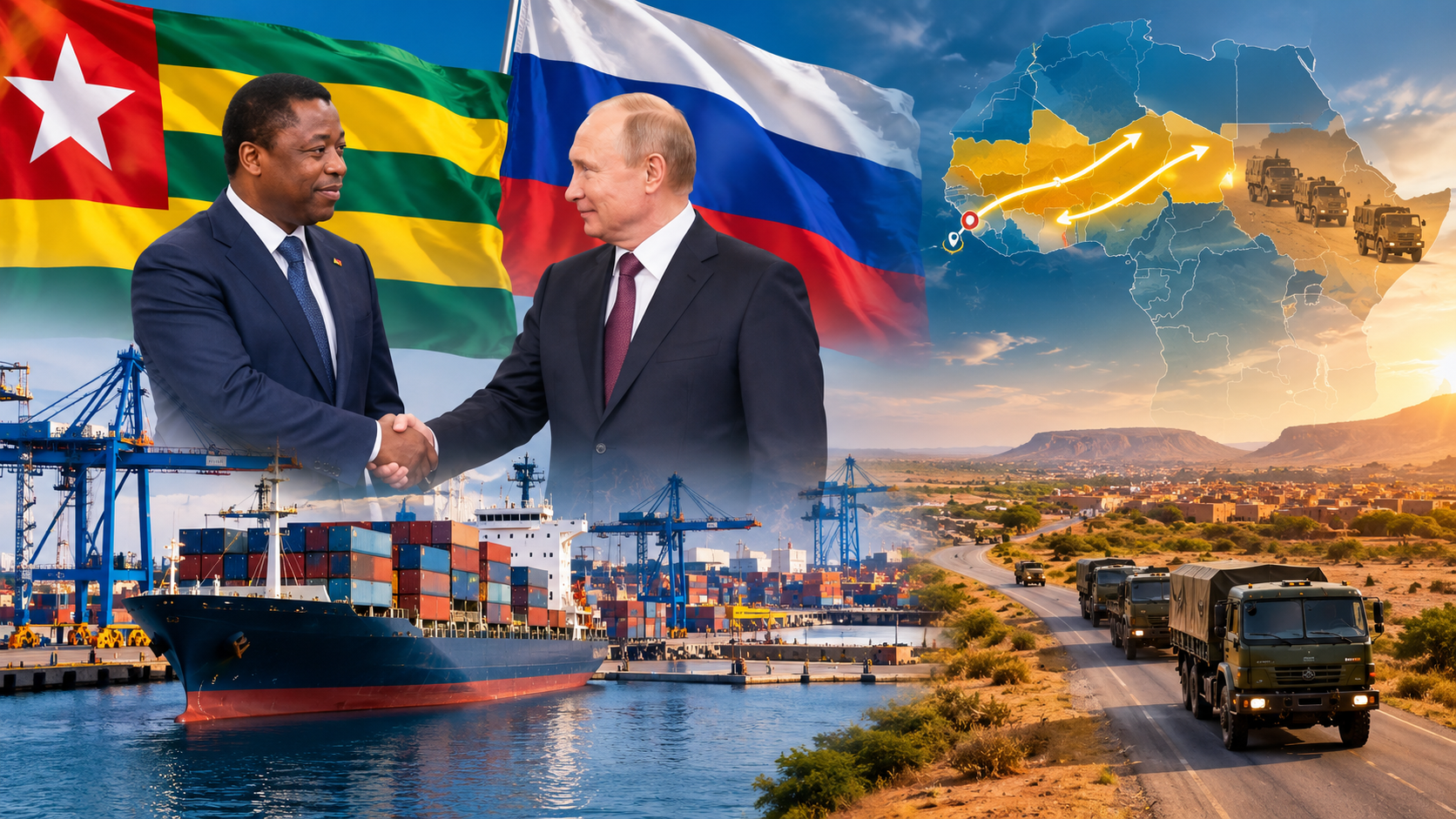

The growing partnership between Lomé and Moscow is entering a new phase. Behind the initiative to use the Port of Lomé as a hub for transporting Russian goods to Togo and across West Africa’s Sahel region lies a fundamental shift in regional trade, logistics and strategic routes.
Russia’s latest move seeks to establish a dedicated transport corridor, designed to streamline the delivery of its merchandise to Togo and key markets in both West Africa and the Sahel. The initiative was unveiled during the first session of the Russo-Togolese Intergovernmental Commission, held in Lomé from September 29 to October 1, 2026, where Russian Deputy Minister of Transport Alexei Shilo presented the proposal to Togolese officials.
A high-level Russian delegation of 29 members met with Togolese leaders and private sector representatives to discuss freight logistics, cost optimization, transit timelines, infrastructure readiness, and opportunities to deepen economic exchanges between the two nations. The Russian officials also toured critical Togolese infrastructure, including the Autonomous Port of Lomé, Gnassingbé-Eyadéma International Airport, and the Adétikopé Industrial Platform. While framed as a commercial and logistical project, the timing and context of this initiative suggest far broader implications.
From transit hub to strategic gateway
As traditional trade routes in the Sahel face increasing instability, Lomé is emerging as a viable alternative for cargo destined to landlocked Sahelian markets. The persistent closure of the Benin-Niger border has disrupted long-standing commercial flows, intensifying competition among regional ports and redirecting attention toward Lomé’s strategic location.
What makes this development particularly consequential is Lomé’s role beyond mere commercial transit. The port has already been used this year to facilitate the movement of Russian equipment bound for the Sahel a precedent that underscores its growing importance in Moscow’s regional strategy.
The Mikhail Britnev case: a strategic trial run
On July 9, 2026, the Russian cargo vessel Mikhail Britnev docked at the Port of Lomé, despite being subject to U.S. sanctions since 2024. Maritime tracking data confirmed its arrival, and within days, a large convoy of military vehicles was observed near Bamako, Mali. Satellite imagery analyses, corroborated by expert assessments, indicated that the Mikhail Britnev had transported trucks, armored personnel carriers, and other military vehicles matching those later seen in Mali.
According to assessments by the Critical Threats project, the vessel delivered approximately 50 military vehicles to the Africa Corps forces in Mali, with the convoy traveling through Togo and Burkina Faso before reaching Bamako. This sequence of events occurred before the formal announcement of the new Russo-Togolese transport corridor demonstrating that Lomé’s logistical capabilities were already being leveraged for strategic shipments.
Beyond trade: a corridor with dual-use potential
The Mikhail Britnev incident does not imply that all future cargo passing through Lomé will be military in nature. However, it confirms a crucial reality: Lomé can already serve as a critical link between Russian maritime routes and the overland networks leading into the Sahel.
Russia’s ambitions appear to have evolved beyond mere commercial access. The Kremlin now seeks to secure logistics corridors, energy partnerships, transport infrastructure, and gateway access to Sahelian markets. The Mikhail Britnev case illustrates how this model could function operationally: a Russian ship docks in Lomé, cargo is offloaded, and goods whether civilian, industrial, or strategic are transported onward to destinations such as Mali.
The newly proposed corridor could institutionalize and commercialize this model, raising a pivotal question: Is Moscow aiming to expand trade with Togo, or is it positioning Lomé as a full-fledged regional hub for Sahel-bound shipments?
A partnership years in the making
The foundation for this cooperation was laid long before the October 2026 talks. On November 19, 2025, Togolese President Faure Gnassingbé met with Russian President Vladimir Putin in Moscow, where they discussed economic, commercial, energy, and security cooperation with a focus on Sahel dynamics. Since then, bilateral engagement has intensified, shifting from diplomatic dialogue to tangible infrastructure, transport, energy, and industrial projects. The September-October 2026 commission meeting marks another step in this accelerating trajectory.
President Gnassingbé has become a central figure in Togo’s evolving relationship with Moscow. Reports suggest the cooperation includes the presence of Russian military personnel on Togolese soil, raising questions about the depth and long-term implications of the alliance. The critical issue now is determining how far Lomé intends to align with Moscow’s strategic objectives and what advantages or risks this alignment entails.
Industrial integration: the Adétikopé factor
The Russian delegation’s visit to the Adétikopé Industrial Platform (PIA) adds another layer to this evolving partnership. The PIA, equipped with advanced logistics and industrial infrastructure, could transform Lomé from a mere transit point into a comprehensive logistics hub capable of receiving, storing, processing, and redistributing goods across multiple regional markets.
A traditional port handles cargo in transit. A logistics hub, however, enables value-added activities: storage, partial processing, cross-docking, and distribution. If realized, this transformation would significantly enhance Togo’s role in Moscow’s African strategy, embedding it deeper into the continent’s supply chains.
Sahel corridors: a shifting geopolitical battleground
The question is no longer which port will handle Russian ships, but which trade routes will connect Russia to Sahelian markets, which states will control them, and which powers will manage their logistics. In this competition, Lomé holds several strategic advantages: a deep-water port, robust road and rail connectivity, and proximity to the PIA. Moscow now seems intent on leveraging this unique combination to assert influence across West Africa and the Sahel.
The Mikhail Britnev episode proved that this capability is not theoretical. As regional trade patterns shift, borders remain contested, and Sahelian states seek alternative supply routes, Togo’s capital is becoming a focal point in this realignment. Lomé is not just a port—it is increasingly positioned as a junction where Russia’s commercial interests, Gulf of Guinea logistics, and Sahelian demand converge.
For now, no definitive timeline has been set for the full implementation of the new transport corridor. Yet one development is already clear: the Togo-Russia relationship is transitioning from political cooperation to a more operational alliance. In a Sahel where alliances are fluid and strategic landscapes are rapidly evolving, the Port of Lomé could soon stand at the center of a new geopolitical and economic order.

By Idriss MAMADOU — Journaliste