
Washington has raised new concerns over Madagascar’s deepening military cooperation with Russia, warning that replicating Moscow’s controversial Sahel security model could undermine regional stability. Behind the diplomatic alert lies a broader calculation: the strategic stakes of Indian Ocean maritime routes and the Kremlin’s expanding influence across Africa.
Behind the American warning: what the Sahel security model reveals
The United States is concerned that the security partnership model Russia has promoted in the Sahel—characterized by rapid military agreements, private security contractors, and abrupt shifts away from Western partners—has not delivered lasting solutions to jihadist threats. Instead, violence has persisted or even escalated in Mali, Burkina Faso, and Niger despite increased Russian involvement.
American officials argue that this approach, centered on short-term security fixes and limited civilian oversight, risks creating new instability rather than resolving it. They point out that the Africa Corps, Moscow’s state-backed successor to the Wagner group, continues to operate with minimal transparency, raising questions about long-term sustainability and accountability.
How Madagascar became a focal point in the US-Russia contest
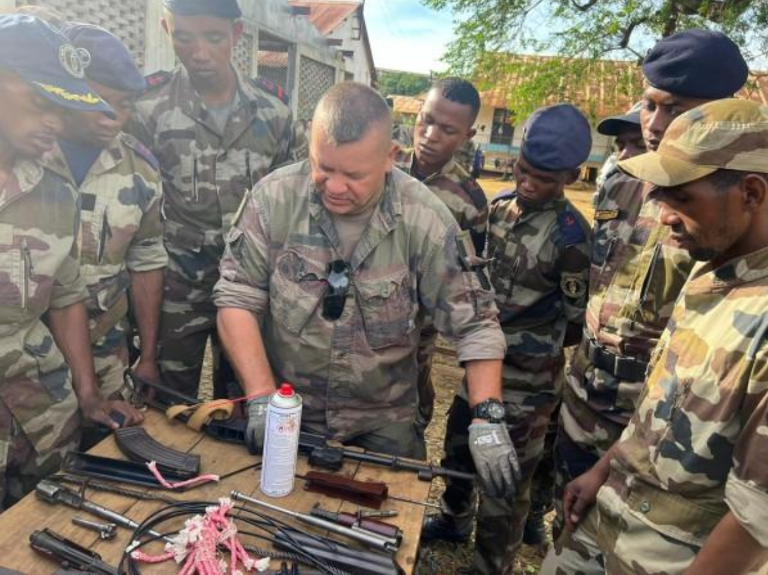
Since a political transition in 2025, Madagascar has significantly strengthened ties with Russia. Under President Colonel Michaël Randrianirina, bilateral relations have expanded beyond diplomacy into defense cooperation, including the delivery of unmanned aerial systems, small arms, and training by Russian military instructors. The shift culminated in a February 2026 state visit to Moscow, where multiple cooperation agreements were signed, covering defense, energy, tourism, and trade.
These developments have not gone unnoticed in Washington. The timing and nature of the rapprochement—occurring amid broader African realignments following global geopolitical shifts—have prompted U.S. officials to reassess Madagascar’s strategic choices. While not an outright rejection of cooperation with Russia, the increased engagement raises concerns about the long-term implications for regional security and sovereignty.
From drones to defense: what’s actually changing on the ground
Recent cooperation between Madagascar and Russia includes:
- Provision of surveillance drones and communications equipment to enhance coastal monitoring
- Training programs for Malagasy armed forces in counter-insurgency and border security
- Planned joint exercises to improve interoperability and rapid response capabilities
- Infrastructure upgrades at key ports, including upgrades to radar and port security systems
While Madagascar emphasizes these moves as efforts to modernize its defense capabilities, U.S. observers warn that such partnerships could lock the island nation into dependency on external actors, limiting its ability to pursue independent policy choices.
The Indian Ocean dimension: why maritime security matters more than ever
Madagascar’s location at the crossroads of the Indian Ocean makes it a critical node in global trade and energy flows. The Mozambique Channel, separating Madagascar from mainland Africa, is one of the world’s busiest shipping lanes, handling millions of tons of fuel, minerals, and manufactured goods annually.
American strategic planners fear that growing Russian naval presence—disguised under civilian or dual-use initiatives—could complicate maritime security, especially as Islamic State-affiliated groups in northern Mozambique have begun targeting commercial vessels and coastal infrastructure. The U.S. has emphasized the need for collective maritime surveillance, intelligence sharing, and capacity building to counter evolving threats.
Can Antananarivo navigate the geopolitical crossfire?
Washington’s recent statements do not amount to sanctions or coercive measures, but they signal a clear preference for alternatives to the Russian model. U.S. officials have underscored that while Madagascar retains the sovereign right to choose its partners, it must weigh the risks of alignment with a security framework that has not delivered stability elsewhere.
The central question now is whether Madagascar can maintain balanced relations—leveraging support from both Moscow and Washington—without compromising its national interests or becoming a proxy in broader power rivalries. The challenge is compounded by internal pressures, including rising public expectations for security and economic development, and external expectations from global powers.
For now, Antananarivo appears to be playing a careful game. It has welcomed Russian military assistance while continuing to engage with traditional Western partners on governance, health, and infrastructure projects. The government has also signaled interest in non-aligned principles, reaffirming its commitment to neutrality in global conflicts.
What’s next for Madagascar’s foreign policy?
Looking ahead, Madagascar’s choices will likely be shaped by three key factors:
- Internal cohesion: The ability to maintain political stability and public support amid shifting alliances
- Resource needs: The urgent requirement for investment in maritime security, healthcare, and climate adaptation
- Diplomatic leverage: The skill to negotiate from a position of strength, avoiding over-dependence on any single partner
As global powers intensify competition for influence in the Indian Ocean, Madagascar stands at a crossroads. The decisions it makes today will reverberate not only across the island but throughout the wider region.