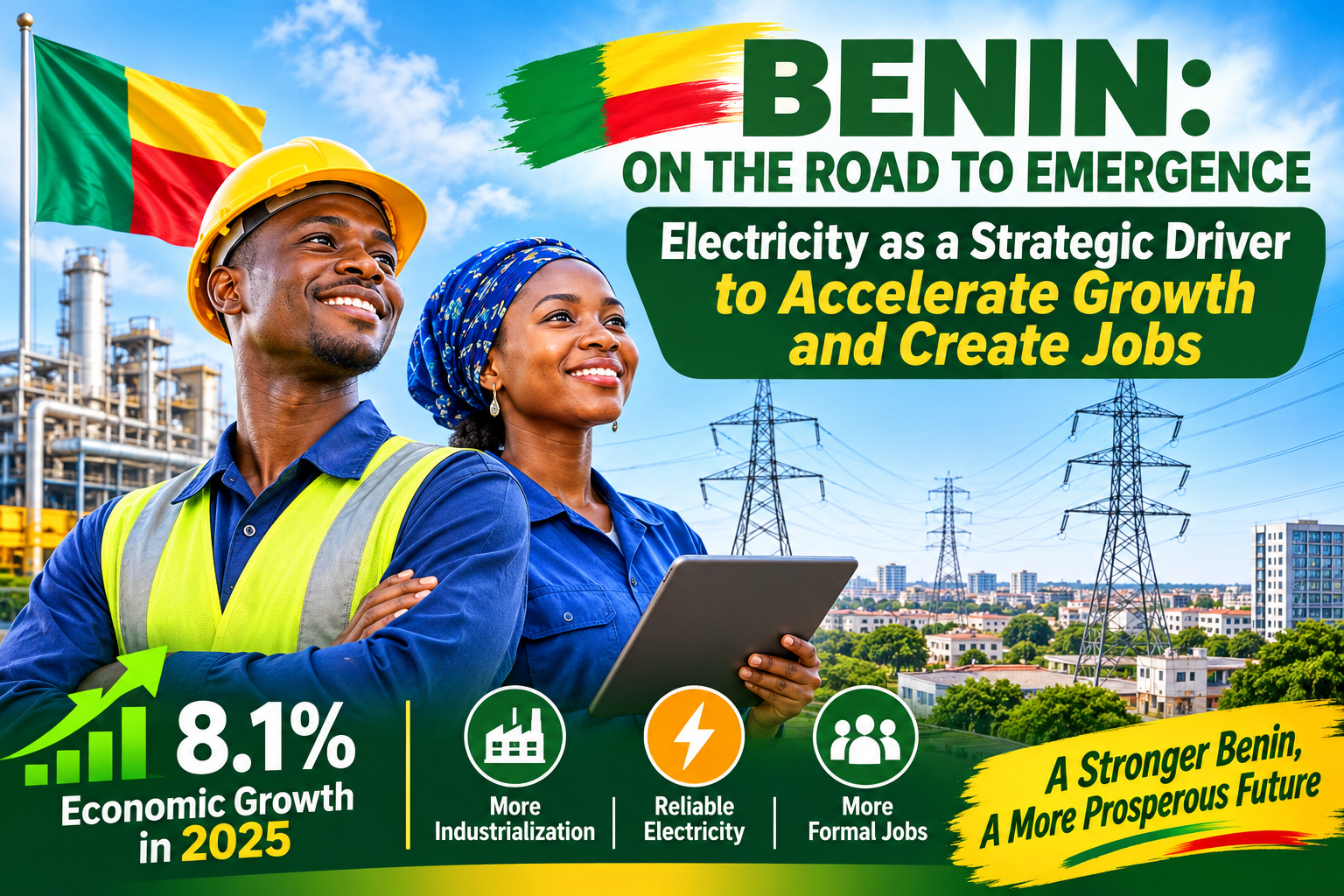

Benin’s economy is expanding at an impressive 8.1% in 2025, showcasing one of the fastest growth rates in West Africa. This momentum, sustained over the past five years with an average annual expansion of 7.1%, reflects strategic investments in infrastructure, industrialization, and economic modernization. Yet beneath these promising figures lies a persistent challenge: economic growth has not yet translated into enough formal, stable, and well-paying jobs for citizens.
The World Bank’s latest economic outlook underscores this paradox. Despite strong growth, 96.3% of workers in Benin were employed in the informal sector as of 2022, with eight out of ten jobs categorized as self-employment. Formal employment remains scarce only 19.8% of workers held salaried positions in 2024, a figure that drops to just 9% among young people. This gap highlights a critical issue: growth alone is not sufficient to create productive, secure, and sustainable employment.
The inability to convert economic gains into decent jobs stems from structural barriers, particularly in the energy sector. While industrial zones like the Glo-Djigbé Industrial Zone (GDIZ) have created over 22,798 jobs in 2025 a 28.8% increase from the previous year many businesses, especially small and medium enterprises, continue to struggle with unreliable electricity supply. Without consistent access to power, productivity suffers, costs rise, and expansion remains out of reach for countless entrepreneurs.
Why electricity shortages are throttling Benin’s job market
Nearly half of all Beninese businesses cite unreliable electricity as a major obstacle to operations, according to recent assessments. The consequences are immediate and costly. Factories face production delays, farmers lose perishable goods, and manufacturers relying on backup generators see their operational expenses surge. These disruptions not only hurt profitability but also erode trust among international buyers and investors, threatening the country’s export competitiveness.
The scale of the challenge extends beyond service interruptions. In 2024, electricity losses on Benin’s network reached 24.7%, and nearly half of the country’s power transmission lines and substations were over 25 years old. Compounding the issue is a reliance on heavy fuel oil for backup generation, a solution that is both expensive and environmentally unsustainable. Addressing these vulnerabilities requires more than just increasing power output it demands a modernized grid, improved distribution efficiency, and cost-effective supply chains.
Mission 300: a transformative plan for Benin’s energy sector
The World Bank’s Mission 300 initiative, developed in partnership with the African Development Bank, aims to connect an additional 300 million Africans to reliable electricity by 2030. For Benin, this translates into a national energy pact designed to enhance production capacity, upgrade transmission and distribution networks, and attract private investment.
Several projects are already underway to diversify the energy mix and strengthen supply. Four solar plants in Natitingou, Djougou, Bohicon, and Parakou with a combined capacity of 50 MW are set to come online soon, while the proposed 128 MW Onigbolo thermal plant aims to bolster baseload power. These developments represent a crucial step toward energy diversification and reliability.
But the true value lies in the potential economic ripple effects. Analysts estimate that full implementation of the Mission 300 pact could generate or improve up to 159,000 jobs in Benin by 2030. However, realizing this potential hinges on overcoming persistent challenges: reducing technical and commercial losses, improving governance, stabilizing fuel supply costs, and accelerating grid expansion and electrification rates.
Breaking down the barriers to job creation
For the energy transition to translate into real employment gains, several conditions must be met:
Grid modernization: Upgrading ageing infrastructure to minimize losses and improve service delivery across urban and rural areas.
Private sector engagement: Encouraging private investment in renewable energy and grid expansion to complement public initiatives.
Affordability and access: Ensuring small businesses and young entrepreneurs can afford reliable power without resorting to costly alternatives like diesel generators.
Policy alignment: Strengthening regulatory frameworks to improve transparency, reduce corruption, and fast-track project approvals.
Youth and SME integration: Prioritizing training programs and financing schemes that enable young people and small enterprises to benefit from industrial growth.
The road ahead: from growth to inclusive prosperity
Benin has built a strong foundation with rapid economic expansion and high-profile industrial projects. The next phase of development must prioritize inclusion transforming growth into tangible opportunities for citizens through stable jobs, higher wages, and improved living standards.
Reliable electricity will serve as the backbone of this transformation. It will empower farmers to process crops locally, enable manufacturers to meet export demands, and allow small businesses to innovate and expand. Most importantly, it will give young people a real chance at formal, dignified employment something far more valuable than GDP figures alone.
The country’s leadership has set ambitious energy targets, but success will be measured not by megawatt capacity or foreign investment pledges, but by how many Beninese households and businesses finally get the power they need to thrive. That is the true test of whether Benin’s economic rise will become a story of shared prosperity or remain a promise unfulfilled.
By Idriss MAMADOU — Journalist