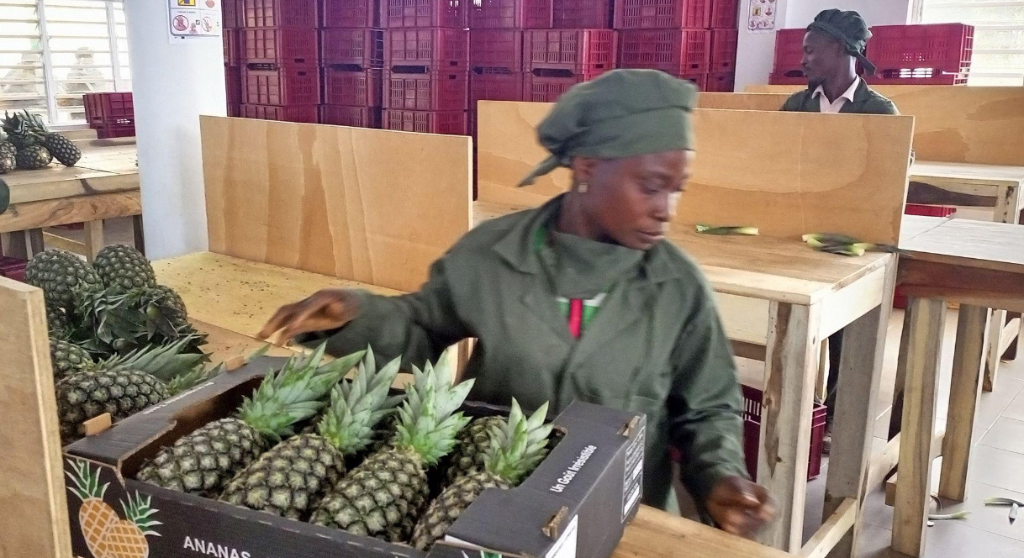

Behind the headline-grabbing figures of Benin’s burgeoning trade relationship with the UK lies a deeper narrative of evolving market dynamics, strategic product positioning, and persistent challenges. Fresh data from London’s Department for Business and Trade reveals that Benin’s exports to the UK soared by 62.5% over the 12 months to June 2026, reaching £13 million—a growth rate that stands in stark contrast to the decline seen in British exports to Benin during the same period.
The invisible engine: how Beninese produce is carving out space in UK shelves
While the overall bilateral trade between Benin and the UK grew by just 1.5% to £67 million, the standout performance comes from Benin’s side. The real story, however, lies in the composition of this export surge. More than four-fifths of the increase is attributed to merchandised goods—especially fresh produce—whose value leapt by 400% to hit £5 million. This remarkable uptick has placed fruits and vegetables at the center of Benin’s trade success with the UK, with agricultural shipments valued at £5.2 million.
The shift is not merely quantitative but qualitative, signaling a growing recognition among UK retailers and consumers of Beninese horticulture. Producers, processors, and exporters across Benin are now tapping into what was once a niche segment, proving that national agro-products can compete in sophisticated international supply chains.
From farm to fork: the invisible hurdles in the export pipeline
Despite the visible momentum, the path to sustained market penetration is strewn with technical and operational obstacles. UK importers demand rigorous adherence to sanitary and phytosanitary (SPS) standards, impeccable traceability, consistent product quality, reliable cold-chain logistics, and cost-effective transportation solutions. These requirements are not merely bureaucratic hurdles—they are gatekeepers to long-term market access.
While many Beninese exporters have made significant strides in meeting these benchmarks, inconsistent compliance and limited infrastructure still serve as bottlenecks. The result is periodic rejections, delayed shipments, and increased operational costs—risks that can erode the gains seen in export volumes.
UK goods take a step back: the other side of the trade equation
The mirror image of Benin’s export surge is a 6.9% decline in British exports to Benin, which fell to £54 million. Despite this contraction, UK goods still dominate the bilateral trade balance, accounting for 80% of total commerce between the two countries. The trade deficit remains firmly in the UK’s favor, with a £41 million gap in its favor.
This imbalance underscores a critical truth: while Benin is making historic inroads into the UK market, the broader trade architecture still heavily favors British suppliers. Reversing this trend will require more than fleeting price advantages—it will demand structural investment in value addition, branding, and logistical integration.
The untapped frontier: measuring the real distance between two trade partners
Despite the recent gains, the data reveals a striking asymmetry in the economic relationship. In 2025, the UK held a mere 1.3% share of Benin’s total import market, placing the country at 169th position among the UK’s global trading partners. These statistics highlight the vast untapped potential lying dormant between Cotonou and London.
For Benin, the strategic imperative is clear: move beyond sporadic export spikes and engineer a sustainable commercial ecosystem. This means diversifying the export basket beyond raw agricultural goods, investing in local processing to boost value-added content, and strengthening port infrastructure and trade facilitation.
Aligning data, aligning expectations: the challenge of measurement
It is important to note that the figures cited come from the UK’s Department for Business and Trade and do not mirror Beninese customs declarations. Variations between the two datasets stem from differences in data collection methods, classification standards, and reporting timelines. Despite this, the overall trend—Benin’s sharp export growth—remains unambiguous.
What remains to be seen is whether this growth phase is a short-lived uptick or the beginning of a lasting reconfiguration in Benin-UK trade relations. For Beninese exporters, the challenge now is to turn transient gains into permanent market presence—one that elevates the country’s profile and redefines its role in global supply chains.
Key takeaways for Beninese exporters
- Focus on compliance: Adherence to SPS standards is non-negotiable for long-term access to the UK market.
- Invest in traceability: Digital tracking systems can enhance transparency and reduce rejection risks.
- Enhance value addition: Processing raw materials locally can increase export revenues and resilience.
- Diversify the export mix: Relying solely on horticulture limits growth potential—exploring other sectors is vital.
- Strengthen logistics: Reliable cold storage and efficient transport networks are critical to maintaining product integrity.