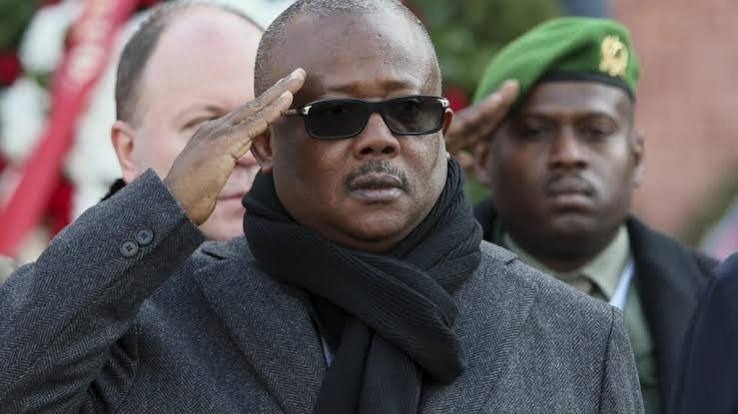

The political chessboard in Bissau has shifted dramatically. With Umaro Sissoco Embaló’s bold announcement from exile that he intends to return to contest Guinea-Bissau’s upcoming presidential election, the military junta has fired back with an uncompromising rejection. In a blunt communiqué, the transitional authorities have slammed the door permanently on the former president’s potential homecoming, labeling his move a deliberate bid to destabilize the nation and flatly dismissing his electoral ambitions.
From exile to election battleground: Embaló’s high-stakes gamble
It’s a move that has sent shockwaves across West Africa. Umaro Sissoco Embaló, who fell from power following a dramatic unraveling in November, has publicly declared his intent to reclaim the presidency by returning to Bissau and standing in the election slated for later this year.
The former leader, far from conceding defeat, is positioning himself as the legitimate heir to Guinea-Bissau’s democratic future. He points to the transitional charter—whose clauses explicitly bar current junta members from running—as a loophole that paves the way for his own candidacy. To turn this theory into reality, Embaló has quietly assembled a broad coalition of political parties and civil society groups under the banner of the Republican Platform. This alliance is designed to mobilize support and signal his enduring influence despite the November setback.
For Embaló, this isn’t just about running again. It’s about institutional revenge. He is determined to prove that his base of support remains solid and that the November defeat was not the final word—despite the dramatic events that followed.
The November rupture: how a disputed election led to a coup that still divides the nation
The roots of this standoff trace back to November 23, when Guinea-Bissau went to the polls in a high-stakes presidential vote. As vote counting neared completion and both Embaló’s camp and his rival claimed victory, heavy gunfire erupted in the capital. Within hours, armed units from the People’s Revolutionary Armed Forces stormed the presidential palace, detaining Embaló and suspending the electoral process.
The new military leadership, self-styled as the High Command for National Security Restoration, cited a need to prevent alleged vote-rigging. Yet from the outset, skepticism ran deep. International observers, diplomats, and opposition figures dismissed the coup as a thinly veiled political charade. Critics of Embaló went further, accusing him of staging an auto-coup to block his opponent’s victory and overturn the will of the voters. The very next day, he was flown out of Bissau to Dakar under tight security, leaving behind a nation gripped by legal limbo and political paralysis.
Junta rules with iron fist: why Embaló’s return is not an option
The military leadership has made its position unmistakable. In response to Embaló’s latest declarations, the junta issued a scathing rebuke, declaring that the former president would not be permitted to re-enter the country. In a stinging communiqué, they branded him the primary architect of the crisis that culminated in last year’s coup.
« No individual who has undermined social peace and national stability will be allowed to exploit the transition process for electoral agitation, » the military statement declared with finality.
For the generals now in charge, allowing Embaló’s return would reintroduce an unpredictable and volatile element into an already fragile political equation. The junta intends to maintain strict oversight over the electoral timeline and vet all potential candidates with a heavy hand. Their message is clear: the road to the presidency does not run through Bissau for Umaro Sissoco Embaló.
A democracy under siege: the cost of exclusion in a nation at the crossroads
By barring Embaló, the military risks igniting further unrest. Traditional opposition leaders remain sidelined—either silenced by exile or hounded by legal action—while Embaló’s supporters denounce what they see as an authoritarian crackdown and a blatant attempt to marginalize their voice.
As Guinea-Bissau struggles to draft a credible roadmap back to constitutional order, the junta’s refusal to entertain Embaló’s return raises a pressing question: Will the upcoming election truly reflect the will of the people? With a deposed president determined to force his way back from abroad and a military regime equally determined to keep him out, the country’s democratic trajectory hangs by a thread. The question of whether this election will mark a turning point—or deepen the crisis—now looms larger than ever.