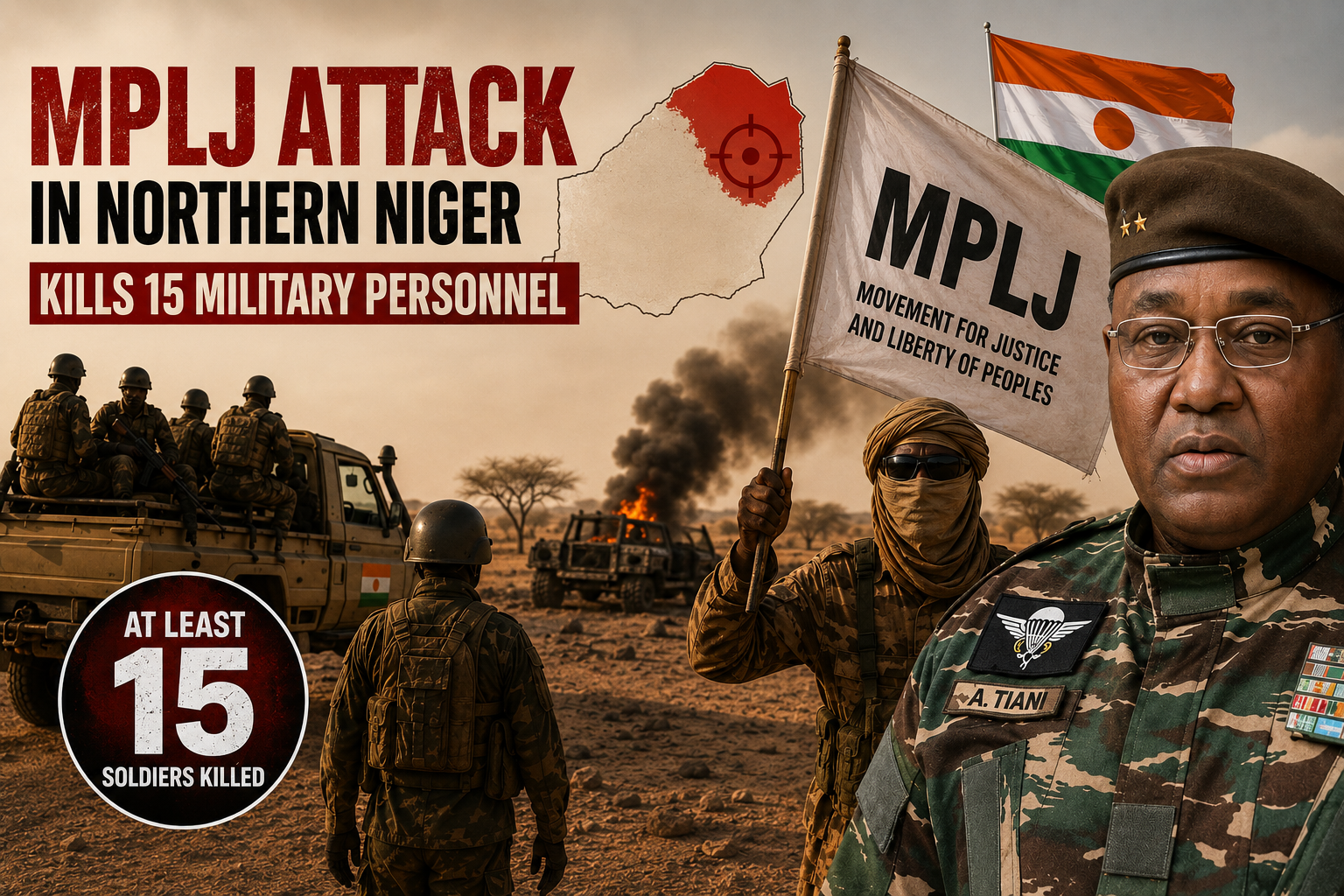

In Niger, the escalating security crisis continues to expose the fragility of the military junta’s nationalist rhetoric. The recent dual assault, claimed by the Movement for the Justice and Freedom of the Peoples (MPLJ), has left at least 15 soldiers dead in the northern region. This brazen attack underscores a harsh reality: the administration led by General Abdourahamane Tiani is struggling to fulfill its most fundamental duty—protecting its citizens and asserting control over its territory.
Beyond the human toll, the incident raises critical questions about the operational capacity of Niger’s armed forces to monitor the vast desert expanses and porous borders that define its landscape. With an enormous territory and lengthy frontiers shared with neighboring states also grappling with armed threats, unchecked regions can quickly become havens for groups that strike with impunity before vanishing into the terrain.
The issue extends far beyond a single violent episode. It lays bare the shortcomings of a security strategy that remains heavily reliant on immediate military responses, despite the need for robust intelligence networks, sustained administrative presence, cross-border cooperation, and proactive measures to prevent armed groups from establishing permanent footholds.
Accountability in doubt: where will Niamey point the finger?
Following accusations directed at Paris, a rupture with the Economic Community of West African States (ECOWAS), and strained relations with regional neighbors, the latest attack leaves the regime with few scapegoats. Will the junta now blame Algeria, a neighboring partner with whom cooperation is indispensable, or will it turn on its new strategic allies? The practice of deflecting blame has reached its structural limits, as the junta’s legitimacy increasingly hinges on its ability to deliver tangible security improvements.
Since the July 2023 coup, the military leadership has cultivated its credibility on promises of breaking from past security policies. Sovereignty, the rejection of foreign interference, and the pursuit of fresh alliances have dominated official discourse. Yet for civilians in affected areas, the true measure of success is far simpler: the ability to live, travel, work, and sleep without fear of another armed assault.
The paradox in Niamey is striking. While the government projects confidence in navigating international geopolitics, its grasp of local security dynamics appears dangerously inadequate. As nationalist rhetoric resonates in diplomatic forums, the country’s borderlands and desert regions sink deeper into insecurity, exploited by armed factions operating with near impunity.
Sovereignty redefined: beyond rhetoric and into action
The current crisis highlights a fundamental contradiction. True sovereignty is not measured by denunciations of foreign influence or shifts in diplomatic alliances alone. It is defined by the state’s ability to exercise authority over its territory, secure its borders, and safeguard its population. The surge in violence in remote areas tests the junta’s governance like never before. With each attack, the pressure mounts for the regime to demonstrate that its 2023 policy shifts have yielded concrete improvements on the ground. Nigerien citizens cannot indefinitely accept political declarations while the death toll rises.
The question of alliances demands sober reflection. Pursuing new partnerships is not inherently problematic and may even strengthen national defense capabilities. However, a change in allies does not equate to a revised security doctrine. What matters are outcomes: effective intelligence, preemptive action against threats, civilian protection, secure transit routes, and a consistent state presence in vulnerable zones.
In this context, Niger’s diplomatic isolation from certain regional partners may prove counterproductive. Armed groups in the Sahel thrive precisely because of ungoverned cross-border spaces, where movement and reorganization go unchecked. Countering this threat requires seamless cooperation, intelligence sharing, and coordinated efforts—all of which become harder to achieve amid diplomatic tensions.
Beyond battlefield failures: systemic challenges
It would be simplistic to attribute each military setback solely to the troops on the front lines. Soldiers operate in an environment of extreme complexity, where success depends on factors far beyond their control: the quality of intelligence, logistical support, command structure, aerial and ground capabilities, and the political will to implement a coherent long-term strategy. The losses incurred demand a thorough reassessment of the entire security apparatus—not a futile search for external culprits.
In a nation where institutional order has been disrupted without delivering on its security promises, the responsibility of domestic actors has never been more pivotal. For lasting stability and civilian protection, both the military and civil society must critically examine the current trajectory. A prompt return to constitutional order offers the only framework capable of restoring democratic legitimacy and forging robust alliances to confront the terrorist challenge.
Security cannot indefinitely rest on the popularity of nationalist slogans. It demands strong institutions, a clear national strategy, pragmatic regional cooperation, and an administration that extends its reach to the most distant territories. The MPLJ assault is more than another bloody episode in the Sahel conflict—it is a stark reminder that sovereignty begins and ends with the state’s ability to protect those under its authority.