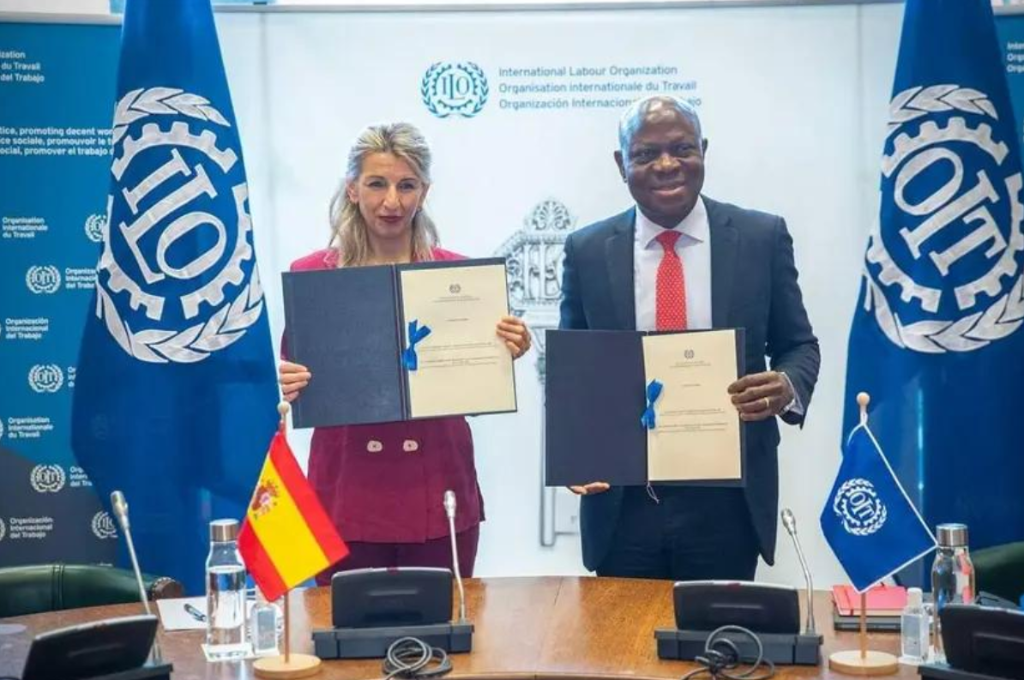

In an unprecedented turn of events at the International Labour Organization (ILO), Tuesday’s election for its next director-general took an unexpected direction. Togo’s Gilbert Houngbo secured a second term without facing any opposition after Spain’s Yolanda Díaz withdrew her candidacy just hours before the vote. While Díaz framed her decision as a move to protect the unity of the global labor movement, her sharp critique of the outgoing administration revealed deep-seated tensions within one of the world’s most influential UN agencies.
The hidden cost of financial mismanagement at the ILO
At the heart of Díaz’s objections lies what she describes as a “historic financial crisis” within the ILO. The Spanish minister pointed to chronic funding shortfalls, exacerbated by delayed and unpaid contributions from key member states—most notably the United States, which owes substantial arrears. These financial strains have forced the organization to contemplate drastic spending cuts, including staff reductions and restructuring measures that risk undermining its core social mandate.
Díaz’s assessment underscores a broader paradox: an institution built to champion workers’ rights is now struggling to balance its own budget, raising questions about the sustainability of its operations. Her withdrawal from the race served as a final warning that fiscal responsibility cannot come at the expense of the organization’s founding principles.
Workers’ voices sidelined: a crisis of social dialogue
Beyond financial concerns, Díaz highlighted a second major issue: the erosion of social dialogue within the ILO itself. As the agency responsible for fostering cooperation between governments, employers, and trade unions, its internal governance has increasingly come under scrutiny. Staff representatives have accused the outgoing leadership of marginalizing their input, particularly in restructuring decisions that could reshape working conditions for ILO employees.
This internal discord mirrors the very challenges the ILO is meant to address globally. Díaz’s public remarks—echoing concerns raised by ILO staff unions—painted a picture of an organization struggling to practice what it preaches. Her parting shot: a call for the agency to restore meaningful dialogue with its own workforce, a cornerstone of its mission.
The politics of withdrawal: unity versus competition
The withdrawal of Díaz was not merely a tactical move—it was a reflection of political realities within the international labor movement. The International Trade Union Confederation (ITUC) had already thrown its support behind Houngbo, while the International Organization of Employers (IOE) followed suit. Díaz, however, questioned whether this alignment truly reflected the broader sentiment among workers worldwide.
Her decision to stand down also followed that of Peru’s Javier González-Olaechea, who had similarly abandoned the race. With both challengers out of the running, Houngbo faced no competition, leaving critics to question whether the election’s legitimacy could overshadow deeper governance concerns.
What’s next for the ILO under Houngbo’s leadership?
Houngbo’s re-election ensures continuity at the ILO, but the critiques from Díaz introduce a new layer of accountability. His second term will demand more than just administrative reforms; it will require a renewed commitment to transparency, financial stability, and—critically—the restoration of trust with the global labor community. With staff morale and member-state contributions hanging in the balance, the stakes could not be higher.
The coming years will test whether the ILO can reconcile its financial constraints with its social mission—or whether the very institution designed to protect workers will become a cautionary tale about internal dysfunction.