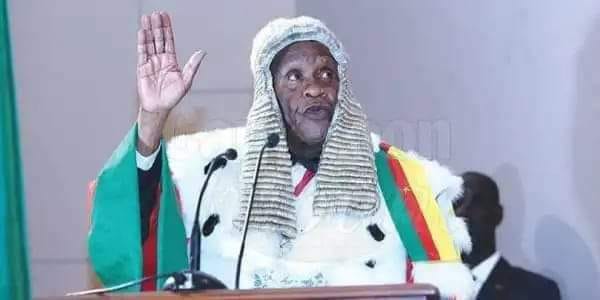

The passing of Cameroon’s former Constitutional Council president Clément Atangana on October 4, 2026, in Paris has triggered a historic turning point for the nation’s electoral framework. His eight-year tenure at the helm of the highest judicial body in electoral matters came to an abrupt end, leaving behind a complex legacy and an institution now facing unprecedented challenges.
An institution shaped by decisive authority
The name Clément Atangana became synonymous with the Constitutional Council’s authority during his time as president from 2018 to 2026. His authoritative voice—often delivering the word “irreceivable” in final rulings—left an indelible mark on Cameroon’s political landscape. This phrase, whether used literally or metaphorically, carried immense weight, symbolizing the final word in high-stakes electoral disputes.
The verdicts that defined an era
Under Atangana’s leadership, the Constitutional Council ruled on contentious presidential election results in both 2018 and 2025. In both cases, opposition figures—Maurice Kamto in 2018 and Issa Tchiroma Bakary in 2025—challenged the official outcomes, yet none of their appeals succeeded. This consistent pattern fueled perceptions of the council as an extension of political authority, despite its judicial mandate.
From magistrate to institutional pillar
Atangana’s journey through Cameroon’s judiciary spanned nearly five decades. After graduating from the National School of Administration and International Institute of Public Administration in Paris, he rose through the ranks: judge in Nkongsamba, president of courts in Eséka, Bafia, Sangmélima, and Mora; prosecutor general in Maroua; president of the Central Appeals Court; Supreme Court justice; and finally, president of the Administrative Chamber. His retirement in 2014 was followed by a historic return in 2018 when he was appointed president of the Constitutional Council—just months before the October presidential election.
A sudden vacancy with far-reaching consequences
Now, with his death, the Constitutional Council faces a leadership vacuum. As the president of the Republic prepares to appoint a successor, the institution must navigate a pivotal moment—one that could redefine its role in Cameroon’s electoral future. The decisions made in the coming weeks will shape public trust, legal precedent, and the country’s democratic trajectory.
Key milestones in Atangana’s career
- 1941: Born in Ekoumeyeck, Nyong and So’o
- 1968: Joined the judiciary after training at ENAM and IIAP in Paris
- 1980s–2014: Served in multiple high-ranking judicial roles across Cameroon
- 2014: Retired as president of the Administrative Chamber of the Supreme Court
- 2018: Appointed president of the Constitutional Council
- 2018–2026: Presided over high-profile electoral disputes